







TL;DR: No single tell catches a deepfake reliably. A check that catches a face-swap may miss a voice clone. Detection requires three layers working together: trained interviewers who recognize visual and behavioral signals, consistent interview scripts paired with targeted follow-up techniques designed to surface inconsistencies, and in-session AI detection that flags anomalies for human review before a candidate advances. Prioritize detection investment for roles with access to production systems, financial data, or infrastructure. Require an ID check and keep cameras on throughout. We surface risk signals during the interview itself, and humans review every flag before any decision is made.
Deepfake fraud in hiring is no longer rare. When an imposter clears your process, the cost isn’t limited to a bad hire. They arrive with credentialed access to your systems, data, and internal infrastructure.
This article breaks down the specific indicators of deepfake fraud, the process changes that reduce your exposure, and the technology that catches fraud signals before a candidate advances.
Detect AI-altered candidate footage
Deepfake technology targets how a candidate looks and how they sound. Facial rendering and voice synthesis are the two primary attack surfaces, with expressions manipulated as part of the visual layer. Lower-quality deepfakes produce visible rendering errors, like soft or blurred edges at the face boundary, and skin texture that reads as flat rather than natural. Sophisticated ones produce subtle inconsistencies that only show up in motion, not in still frames.
Edge failures around hair, ears, and collar lines are most visible in motion, according to Adaptive Security’s deepfake detection research. Voice clones tend to sound flat: the prosody doesn’t shift naturally, breaths are absent, delivery is emotionally inert, and the silence between words is too clean, as Doppel’s analysis of deepfake indicators describes.
Deepfake fraud in interviews commonly takes several forms, by using face-swap technology where an imposter uses another person’s face, or voice cloning using synthesized speech.
Protect your pipeline from deepfakes
Remote hiring removes the in-person friction that once made impersonation harder. The process changes below add structured friction back at the right points.
How remote work enables deepfake fraud
Async interviews without built-in detection can give imposters time to prepare and test their setup before a human ever reviews the session.
Layer your detection approach
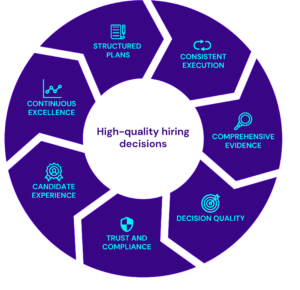
Detection works best as a layered defense: human observation, process design, and technology. No single tell is reliable on its own, because sophisticated deepfakes can pass individual checks. The layered approach works because it forces the imposter to maintain consistency across multiple dimensions simultaneously, which is where deepfake technology breaks down.
Train recruiters to watch for behavioral signals during the call: irregular response timing, audio artifacts, visual inconsistencies, and candidates who resist turning on video or performing spontaneous actions.
“Our customers have told us that candidate fraud is one of the biggest challenges they’re facing today, and it’s been increasingly hard to catch.” – Ben Sesser, co-founder and CEO at BrightHire, per Biometric Update’s coverage
Prioritize high-risk roles
Not every req carries the same fraud risk. Prioritize detection protocols for:
- Roles with access to sensitive data, financial systems, or infrastructure
- High-volume early-round screening interviews where human attention is thinnest
- Remote-first roles with no in-person touchpoint at any stage of the process
Roles with production access, financial system permissions, or infrastructure credentials carry more exposure than roles with no system access, so weight your detection investment accordingly.
Red flags that signal a deepfake interview
The signals below are organized by type and are most effective as a layered checklist alongside your detection technology, not as a standalone pass/fail screen.
Recognize deepfake rendering errors
Experts say there’s no reliable visual method to spot high-quality deepfakes. The visual checks below are more likely to surface errors in lower-quality renders.
Against lower-quality deepfakes, head turns can expose artifacts around the jawline, ear, or hairline that don’t appear in frontal views, and facial boundary blending can break down where the generated face meets the background or the candidate’s body. High-quality and real-time models are less likely to produce these errors at all.
Check for lip-sync and audio delays
Audio-to-video latency, where the candidate’s mouth movements don’t precisely track their spoken words, is what Adaptive Security calls “the most consistent combined detection signal.” Voice quality inconsistencies, such as cadence that doesn’t shift with emotional register, or pacing that sounds generated rather than spoken, signal voice cloning or synthesis. Unnatural pauses before answers indicate that the candidate is waiting for a deepfake model to generate a response or that a proxy is consulting notes or a script.
Read behavioral and visual red flags
Behavioral red flags often surface before visual ones. Scripted answers that sound polished but don’t address the specific question asked suggest the candidate is reading from a prepared response or using an AI tool to generate answers in real time. Watch for flatline response timing, such as candidates who pause for the same duration before every answer regardless of question difficulty, because natural response latency varies with how demanding the question is.
Refusal to show ID, inconsistent background details across interviews, and lighting changes that don’t match the time of day or the candidate’s stated location all warrant closer scrutiny. Watch for a flat affect throughout the call. A candidate with no involuntary shifts in expression across a full interview is worth flagging for a secondary review.
Deepfake interview setups
Camera angle, lighting, and background tells can reveal a deepfake setup. A candidate who insists on a specific camera angle, especially one that keeps their face in a narrow frontal range, is likely limiting the deepfake model’s exposure to angles it can’t render accurately. Lighting that’s too flat or too directional can mask rendering artifacts.
Some practitioners have used gesture tests, like asking candidates to wave a hand in front of their face, to surface hand occlusion artifacts. This approach was more reliable against earlier deepfake models, but real-time deepfake models have largely addressed this flaw.
Methods to spot deepfake candidate fraud
Detection coverage varies by where in the process you apply it. The methods below are sequenced by stage, from early-round through final verification.
Use BrightHire Screen for early-round detection
Require biometric and document verification at the application or pre-interview stage, and validate location using IP and device fingerprinting. BrightHire Screen, BrightHire’s AI interviewer, runs the early-round screening interview with fraud detection built in. Candidates complete a structured voice interview on their own schedule, and BrightHire Screen analyzes the session for fraud indicators before a recruiter ever reviews the result.
Add detection to live interviews
For live interviews, ask candidates to briefly display a government-issued ID on camera and perform a unique gesture or phrase, and require cameras to remain on to ensure real-time presence. For teams interviewing on Zoom, BrightHire’s Candidate Fraud Detection draws on real-time deepfake detection powered by Zoom’s own models, plus device, network, and location signals from the Zoom session itself. Detection is also available for teams interviewing on Microsoft Teams and Google Meet. Our fraud detection runs in real time, analyzing signals as the interview unfolds
Complete verification at final round and beyond
Final-round verification includes verifying prior employment and higher education details directly with the businesses and educational institutions. Fraud prevention should continue even after the offer is extended. Consider withholding system access until you complete your background screen. For full record-keeping requirements, see the compliance section below.
Add in-session detection technology
In-session detection analyzes video, audio, and session metadata in real time so a human reviewer has the full signal set before the candidate advances.
Detect deepfakes in live interviews
In-session detection works by analyzing the video feed and audio track alongside session metadata in real time. Our coverage is tiered by platform:
| Platform | Detection signals |
|---|---|
| BrightHire Screen | Most robust signal set. BrightHire runs the whole session |
| Zoom | Proprietary deepfake model plus session metadata |
| Microsoft Teams | Deepfake detection plus IP-derived geolocation and VPN signals |
| Google Meet | Deepfake detection today, expanded signals planned |
Key technical indicators of deepfakes
Audio-visual inconsistencies, such as how the face moves, how the voice sounds, and how those two tracks align, combine with session metadata to form the detection signal set. Network-level signals such as IP geolocation and VPN detection add another verification layer that can surface mismatches between the candidate’s stated location and their connection point, though IP addresses typically point to an internet provider’s network or general geographic region rather than a specific physical location.
Check candidate identity for remote hiring
Document-based identity verification and liveness checks complement deepfake detection by confirming that the person on camera is present and matches their application record. Your security or HR compliance team can advise on which vendors and methods apply to your jurisdiction.
Defend your pipeline from deepfakes
Enforce consistent interview scripts
Structured interviews with consistent question sets make fraud harder to execute successfully. A structured live interview can surface inconsistencies when combined with techniques designed to elicit them. Ask your candidate to explain past work, walk through a problem, describe tradeoffs, and answer follow-up questions in their own words. Unscripted follow-up questions that require personal experience and specific detail are particularly effective at revealing when a proxy or AI tool is generating responses rather than drawing on lived experience.
Our interview plans and in-interview guidance keep interviewers on script, ensuring every candidate is assessed against the same criteria.
Essential deepfake detection protocols
The following checklist can be used as a live-interview reference for interviewers and recruiters.
Quick reference checklist for recruiters during live interviews:
- Gesture test: low-confidence only, real-time models have largely closed this gap
- Lighting check: note any lighting that seems designed to mask facial detail
- Behavioral red flags: scripted answers, resistance to unscripted questions, refusal to show ID
- Audio-visual sync: watch for lip-sync delays or mismatched mouth movements
- Response timing: note any unnatural pauses or reaction times that don’t match the question
These checks are a starting point, not a reliable screen. High-quality and real-time deepfake models can pass every item on this list without producing a detectable error. For roles where the risk warrants it, BrightHire’s Candidate Fraud Detection analyzes video, audio, and session metadata in real time. These are ignals that a recruiter on a live call cannot reliably assess manually.
Keep video hiring compliant
Document every verification step and detection decision for auditability: what was checked, when, by whom, and the result. For BrightHire-flagged signals, our candidate fraud detection tool logs what was surfaced, who reviewed it, what they decided, and why, keeping risk flags and human review decisions in a single auditable record automatically.
Legal safeguards for AI interview screening
Know when Illinois requires disclosure
Illinois’s AI Video Interview Act requires employers hiring for positions based in Illinois who ask applicants to record video interviews and use AI to analyze them to notify applicants before the interview, explain how the AI works and what it evaluates, and obtain consent first. Check with counsel on how it applies to live interviews.
Set retention rules for interview evidence
Retention rules vary by jurisdiction. In Illinois, employers must destroy all video copies within 30 days if the candidate requests it and must instruct any other persons who received copies to also delete the videos, including all electronically generated backup copies, per Statute Sec. 15. Videos cannot be distributed to other parties except as necessary to obtain expert assistance in evaluating a candidate’s fitness for a particular position. Zero Data Retention (ZDR) is available. Speak with us to confirm what the option covers for your compliance policy and jurisdiction.
Steps for reporting deepfake incidents
When an interview surfaces risk signals that warrant escalation, hold the candidate at their current stage in your ATS and do not communicate a reason to them. Alerting them early may cause evidence destruction. Route the flagged session to your security and legal teams, and document the specific anomalies that triggered the review.
When documenting the escalation, record what the interview surfaced, such as a lip-sync lag, a location mismatch, a flatline response pattern.
Build a defensible detection process
The audit trail is what makes detection defensible. When a risk signal escalates, your security and legal teams need that record to assess the flag and respond. Build the audit trail into the process from the start, before a flag surfaces.
Signal depth varies by platform, with Zoom and Teams each contributing platform-specific metadata layers on top of core detection.
Request a demo to see how we flag fraud indicators in live interviews and BrightHire Screen sessions, with an auditable record of every flag.
Common enough to plan for. Checkr’s 2025 Hiring Hoax Survey of 3,000 managers puts the share of managers involved in hiring who have personally interviewed a candidate using a fake identity at nearly one in three. Yes. Every flag goes to a human reviewer, who applies the judgment before any action is taken. Hold the candidate at their current pipeline stage without communicating a reason to them, route the session to your security and legal teams, and document the specific anomalies that triggered the review. The escalation steps above cover this in full. It depends on where you hire and how you interview. Illinois requires notice, explanation, and consent when employers hiring for positions based in Illinois ask applicants to record video interviews and use AI to analyze them. See Illinois’s AI Video Interview Act for the full statutory requirements and check with counsel on live interviews and other states. We provide custom quotes based on team size and interview volume. Request a demo to discuss pricing for your specific hiring plan.Frequently asked questions (FAQs)
Key terms glossary
Deepfake: AI-generated synthetic media that replaces or alters a person’s face, voice, or likeness in video or audio content.
Synthetic identity: A composite persona built by combining genuine personal data with fabricated data, such as pairing a real government identifier with a made-up name, date of birth, and address, or a fully fabricated identity using invented identifiers.
Liveness detection: A verification method that confirms the person on camera is a live human, not a recorded video or static image, by requiring real-time responses to prompts.
Face-swap: A deepfake technique that replaces one person’s face with another’s in video content, often used to impersonate a real identity.
Voice cloning: AI-generated synthetic speech that mimics a specific person’s voice patterns, tone, and cadence.
Session metadata: Technical data about the video call itself, including IP address, device type, connection quality, and platform-specific signals.
VPN signal: A network-level indicator that the candidate is using a virtual private network to mask their actual location.
False positive: A legitimate candidate incorrectly flagged as a risk by detection technology, which is why human review is required before any decision is made.