




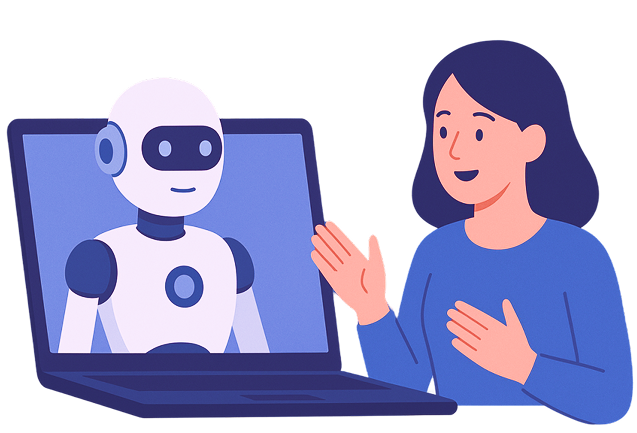
An AI interviewer conducts a structured early-round screening interview, usually by voice, and adapts to the candidate’s answers with follow-up questions. After the conversation it produces a transcript, a summary, and a score against the criteria your team set, then routes that to a recruiter for review.
- AI screening interview: a first-round interview run by an AI interviewer, in place of an initial recruiter phone screen.
- Résumé screening: filtering applications by their written content. This happens before an interview and is a different job. An AI interviewer does not do it.
- One-way (recorded) video interview: the candidate records answers to fixed prompts with no back-and-forth. It’s a different format from a two-way conversational interview.
- Conversational apply / chatbot: a text assistant that helps candidates apply or schedule. It’s not an interview.
The short version: an AI interviewer holds a real, two-way structured conversation and hands the results to a human. For a side-by-side of the formats, see
Conversational AI Interviews vs. One-Way Video vs. Chatbots vs. Human Screens
A typical two-way AI screening interview runs in six steps:
- Setup and rubric. The recruiting team defines the questions and the evaluation criteria for the role. The interview is built around what the job actually requires.
- Candidate disclosure and consent. The candidate is told they’re doing an AI-led interview and how it works before they begin.
- Orientation (optional). Some teams add a short practice round or a hiring-manager video intro so the candidate knows what to expect before the interview begins. Teams turn this on during setup, and not every team uses it.
- The conversation. The candidate talks with the AI interviewer, on their own schedule and device. The AI works from the interview guide your team built, asking follow-up questions to probe or clarify an answer. This way it stays consistent across candidates while still adapting to what each person says.
- Signal surfaced. The system summarizes the conversation and surfaces the signal in it: insights from the discussion, scores against the team’s rubric, and key qualifications highlighted. Not every question is scored the same way. Summary questions capture context without a score, qualification questions return a clear yes/no, and rubric questions get a score.
- Human review and decision. A recruiter reviews the score, the summary, and the recording, and decides whether to advance the candidate. The AI interviewer does not advance or reject anyone.
- Record kept. The transcript, summary, score, and recording are retained as an auditable record of how the candidate was assessed.
This is the question employers and candidates ask first, so it’s worth answering clearly: the AI interviewer does not make the hiring decision. It evaluates each answer against the criteria your team defined and returns a score and a summary. Those are inputs. A recruiter or hiring manager reads them and decides. Responsible AI interviewers do not auto-reject candidates, do not recommend who to hire, and treat scores as evidence rather than verdicts.
That design is also what lets a team explain any hiring decision later: a person reviewed the evidence and made the call, with the AI’s score as one input among several, and the decision stays with an accountable human.
BrightHire builds to this standard: scores are inputs, not verdicts; the AI never auto-rejects; and customer data is not used to train AI models.
Recruiters tend to use an AI interviewer when the first round of interviews stops keeping pace. Application volume has climbed, AI-written résumés have made the application itself a weaker signal, and most applicants never reach a live conversation.
In BrightHire’s study of 17,000 positions, only about 1 in 10 applicants got a recruiter screen on average. An AI interviewer lets a team give far more candidates a real, structured first-round interview without adding recruiter hours.
The first round also gets faster and more consistent: candidates reach a first interview sooner, and every one answers the same questions set to the same bar instead of a conversation that can vary depending on the recruiter’s day. It also surfaces the kind of signal a résumé can’t always show. A 2026 field experiment by Jabarian and Henkel of about 70,000 applicants found that candidates who went through AI-led screening were 12% more likely to get an offer, 18% more likely to start, and 18% more likely to still be employed a month later.
When Steer, an auto-repair marketing platform, outgrew what one recruiter could keep up with, it used BrightHire Screen for first-round Customer Success and Onboarding interviews. In two months, Screen ran 110 of those interviews, saved the team more than 35 hours, and led to seven hires. Candidates who advanced then passed the hiring-manager round 80% of the time, 45% more often than in Steer’s non-Screen interviews.
Candidate trust is where AI interviews are won or lost, and the public data is sobering. In a 2026 Greenhouse survey of US job seekers, 63% had already experienced an AI interview, but 70% said the use of AI was not clearly disclosed to them beforehand, and only 8% believed AI makes hiring more fair. Candidates are not rejecting the format outright, but they are reacting to how it is run.
The same field experiment by Jabarian and Henkel found that when applicants were given the choice, about 78% picked the AI voice interview over a human recruiter. That points to real acceptance, though it reflects comfort and convenience rather than a verdict that the strongest candidates prefer AI: the applicants who chose the AI tended to score lower on skills.
Three things consistently separate an AI interview candidates accept from one they resent: it’s disclosed up front, it’s a real two-way conversation rather than a recording, and a human reviews the result. BrightHire Screen is built around those conditions, and candidates so far rate the experience 4.5 out of 5. One candidate interviewing for a customer support role put it plainly: “The call felt natural and it allowed me to answer like I was in a conversation.”
It’s also worth being honest about the open questions candidates raise: whether a human really reviews the result, whether they can opt out, and how to handle AI-assisted answering on the candidate’s side.
For the full picture, see
Short answer: AI screening interviews can be run lawfully and fairly, and the requirements are becoming clearer. This section is an orientation, not legal advice, so confirm specifics in your jurisdictions with proper counsel.
A few laws shape how AI interviews must be run:
- NYC Local Law 144 governs automated employment decision tools and requires a bias audit before use, plus candidate notice.
- Illinois AIVIA applies to AI analysis of video interviews and requires notice, an explanation of how the AI works, and consent.
- EU AI Act lists AI used to evaluate candidates for recruitment as a high-risk use case, which brings documentation and oversight obligations.
- Colorado has its own AI hiring rules, and they keep changing. Check what’s currently in effect rather than relying on an older summary.
These laws vary in details, but core requirements are the same: notice and consent, an explanation candidates can understand, bias auditing, a way for a human to review and override, and a retained record.
BrightHire keeps that human in the loop, and covers the rest of the list: independent third-party bias audits, SOC 2 Type II, GDPR and CCPA compliance, candidate consent and opt-out, and Zero Data Retention options.
For the detailed regulation-by-regulation view, see
Higher volume and better generative tools have made candidate fraud easier, and it shows up in a few ways: an AI-written résumé, experience that was exaggerated or invented, a proxy who sits the interview in the real candidate’s place, even a deepfaked face or voice on a video call.
The parts of a hiring process that don’t push back are the easiest to fake. A résumé is just a claim on paper, and a one-way recorded interview lets a candidate script or read their answers with no one there to ask a follow-up.
Conversely, a two-way conversation is harder to game: when the AI asks an unplanned follow-up about something the candidate just said, a coached or borrowed answer tends to fall apart. And because the whole interview is recorded, the team can go back and check anything that looks off.
BrightHire builds on this: it detects signals of candidate fraud and flags moments in the AI interview that may show suspicious behavior, so the team can investigate before making any decision.
For how to protect interview integrity at scale, see
When you compare options, the criteria below will help you choose:
- Two-way conversational, not one-way recorded. Does it adapt with follow-up questions, or record answers to fixed prompts?
- Human-in-the-loop. Does a person make every advance-or-reject decision, with the AI surfacing signal only?
- Independent bias audits. Are fairness checks done by a third party, not self-certified?
- ATS fit. Does it integrate with your ATS (for example Greenhouse, Workday, or Ashby) and write results back?
- Candidate experience. Is it disclosed, conversational, and reviewed, and is there evidence candidates accept it?
- Security and compliance. SOC 2, GDPR, CCPA, data retention, and whether your data trains their models.
- Multi-language and role coverage. Does it fit the roles and regions you actually hire for?
- Platform, not a point solution. Does it work alongside your ATS, notetakers, and the rest of your hiring stack, sharing one record of the candidate, rather than living in a silo?
- Data access and reporting. Can you get your data out easily (API/MCP), and does it give you insights and reporting across interviews?
- Candidate reach. What channels can it reach candidates through?
- Support and roadmap. Is there expert-level human support, and evidence of ongoing product investment?
- Customizable to your roles. Can you configure the questions and scoring criteria for each role, rather than being locked into fixed templates?
- Scoring transparency. Does it show how it scored an answer against your rubric, so a reviewer can see the reasoning behind a score and not just a number?
For a deeper buyer’s framework and an RFP checklist, see
Before rolling out an AI interviewer, baseline the metrics you’ll judge it by, then compare after launch. The useful metrics include completion rate, pass-through rate to human interviews, time to first interview and time to fill, recruiter hours saved, candidate satisfaction and drop-off, and a quality-of-hire proxy you already track.
One step matters before you start counting: calibrate the interview and rubric internally first, with participants across seniority levels, so early candidates aren’t judged on an unrefined rubric and your baseline reflects a fair, consistent process from day one.
For a concrete example, the Steer results above (recruiter hours saved, hires made, and a higher hiring-manager pass rate) show what these metrics look like when a rollout works.