




Every recruiting team has had this experience: A hire who looked great in the process performs below expectations 90 days in. Or, a candidate the team passed on turns out to be exactly what the role needed.
To try to prevent this, the response has been to treat quality of hire as a measurement problem. Find the right metric, track it at 90 days or 180 days, report it to the business. But measuring outcomes doesn’t tell you what went wrong in the process.
That’s the conclusion Nicole Hirsch, Head of TA and People Operations at Lattice, and Tracy St.Dic, Global Head of Talent at Zapier, both reached. In a recent conversation with BrightHire CEO Ben Sesser, they shared how their teams have moved past measurement and toward something more useful: a system where interview quality drives quality of hire, and hiring outcomes feed back into the process so it gets smarter over time.
Most conversations about AI in hiring have focused on efficiency. Nicole, Tracy, and Ben see a bigger opportunity: using AI to make the hiring process more structured, the evidence more complete, and the decisions more informed.
Hiring quality comes from process quality
Every hiring team wants to improve the quality of hire. But doing that means focusing on improving the hiring process itself, not just measuring the results. It comes down to the difference between focusing on lagging and leading indicators:
- Lagging indicators (90-day performance, retention, quota attainment, on-time delivery) tell you whether your system worked, but only after the fact.
- Leading indicators (role definitions, interviewer calibration, evidence capture, decision structure) are the inputs your TA team directly controls. You can observe them in real time and change them immediately.
Most teams spend their energy on the lagging indicators. They measure, analyze, and build quality of hire scorecards. But without reliable leading indicators, there’s nothing to improve.
“You can’t improve what you can’t standardize. For a TA leader, the goal goes beyond one great hire. The goal is a hiring system that gets smarter over time.”
– Tracy St.Dic, Global Head of Talent, Zapier
The question both Tracy and Nicole kept returning to: what does a quality hiring process actually consist of?
The Quality of Hiring System
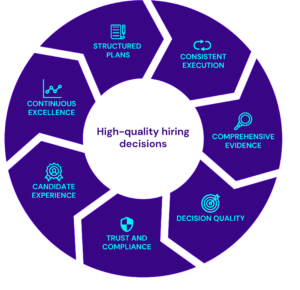
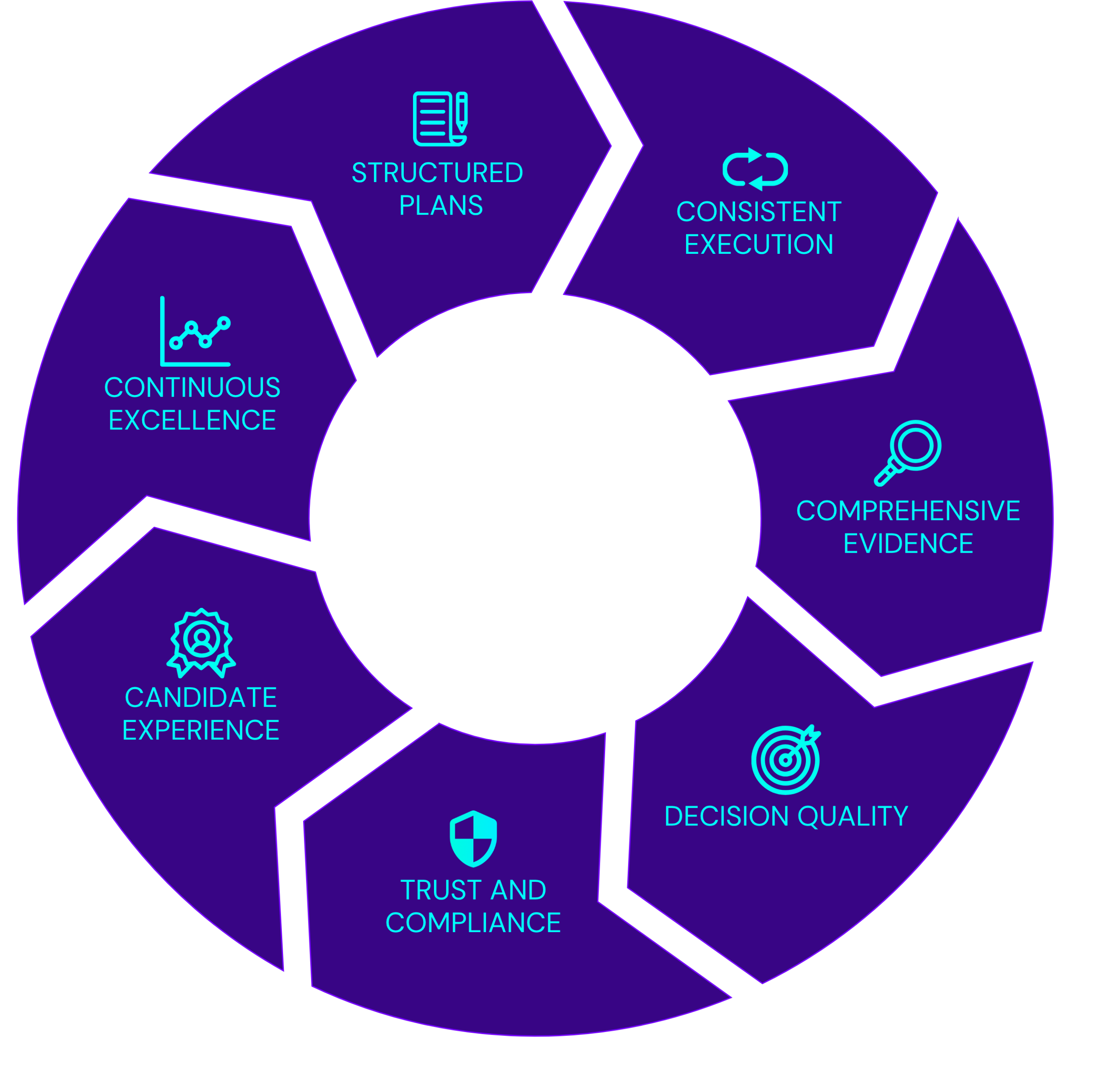
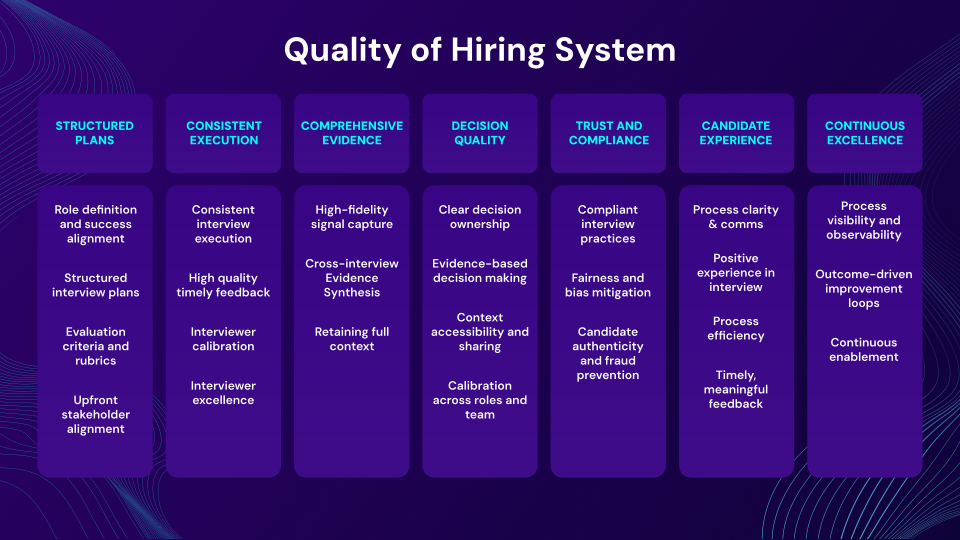
BrightHire’s framework breaks it down into seven pillars, each representing a component of the hiring process that, when done well, produces better outcomes downstream.
- Structured plans: The upfront work that defines what “good” looks like and how it will be evaluated.
- Consistent execution: The reliable, repeatable execution of the hiring process for every candidate.
- Comprehensive evidence: Capturing and synthesizing the best possible information to inform decisions.
- Decision Quality: Turning evidence into clear, confident, and aligned hiring decisions.
- Trust and Compliance: Ensuring the hiring process is fair, compliant, and worthy of confidence.
- Candidate experience: Delivering a hiring experience that attracts and retains top talent.
- Continuous Excellence: Using insight and enablement to continuously improve hiring over time.
Continuous Excellence feeds back into Structured Plans. A change to interview questions this quarter shapes the signal feeding decision quality next quarter.
The system doesn’t have to be perfect to get started. Nicole described it as running a red-yellow-green assessment across your organization: what’s working, what’s good enough for now, and what’s quietly undermining everything downstream.
Where to get started
Both Nicole and Tracy were clear that you don’t need to overhaul your entire hiring process at once. What matters is picking the right starting points and building from there. These are four moves they think are worth getting right early:
1. Define your evaluation criteria before you open the role
The single highest-leverage move in structured planning is getting alignment on evaluation criteria before a single candidate enters the pipeline.
At Zapier, Tracy’s team uses a three-tier framework for every role:
- Table stakes (non-negotiables)
- Acceptable growth areas (things you can coach post-hire)
- Bar-raisers (where this hire should elevate the team).
When all three are defined and agreed upon by the recruiter, hiring manager, and executive sponsor before sourcing begins, every downstream decision has a shared reference point.
“If we don’t get that right on the front end, the consistency, the candidate experience, the decision quality all becomes off,” says Tracy.
AI accelerates this step. Tracy’s team built a workflow where hiring managers input role information into a chatbot that pulls from Zapier’s full library of past roles and rubrics, then generates a structured interview plan the manager reviews and adjusts. The heavy lifting is done and human judgment shapes the last mile.
2. Build the evidence layer you need to make decisions
Most interview processes generate two things: a scorecard and the interviewer’s memory of the conversation. But neither tells the full story.
To make the right hires, teams need a complete, objective record of what actually happened in each interview.
“High-fidelity signal capture is the superpower. We haven’t really had access to it before, and the technology has finally caught up. For teams who use it well, everything changes.”
– Nicole Hirsch, Head of TA and People Operations, Lattice
In practice, Nicole said, it stops being a debate about impressions. You have the metadata, the themes, everything pulled from the actual interview conversation. There’s no ambiguity.
At Lattice, that shift produced a concrete outcome. During a focused engineering hiring push where go-to-market recruiters recruited for technical roles, 93% of those hires were meeting or exceeding expectations at their 90-day review.
The post-hire analysis paired interview scorecards, transcripts, and intake documents, all captured and synthesized by BrightHire’s AI, to understand what strengths and growth areas the process correctly identified, beyond the binary question of whether the hire succeeded.
3. Create a feedback loop that actually changes behavior
The seven pillars are designed to work together. What you learn from hiring outcomes doesn’t just improve your planning. It sharpens how you calibrate interviewers, what evidence you capture, how you make decisions, and how you evaluate candidate experience. That requires deliberate tracking.
At Zapier, Tracy’s team used a large account executive hiring cohort as a testing ground. They deliberately varied parts of the interview process by quarter and tracked outcomes at 90 and 180 days. Because they documented every change, they could trace which process adjustments actually moved the needle on hire performance.
“If we weren’t disciplined about tracking every change we made to the process, we wouldn’t have good data to influence the business.”
– Tracy St.Dic, Global Head of Talent, Zapier
Getting access to outcome data is where most teams stall. Performance information is often confidential, patchy, or siloed. Nicole’s team is addressing this by adding a hiring-related question to their 90-day review, creating a formal feedback channel between TA and the people team.
Tracy offered an alternative entry point: run a retrospective whenever a new hire leaves within their first year. Get the recruiter, hiring manager, and people business partner in a room. Go back through the interview evidence. Ask what you thought you knew, what you actually knew, and what you missed. With AI capturing the full interview record, teams can ground these retros in what actually happened in each conversation rather than relying on memory. Even a handful of these retros can start revealing patterns in where your process breaks down.
4. Focus on using AI to scale quality hiring, not just speed
By making the leading indicators of quality of hire visible at scale, AI enables teams to continuously improve the process that drives hiring quality.
At Zapier, Tracy’s team is building agents that review BrightHire transcripts and ATS scorecards before executive interviews, flagging any criteria from the original alignment that didn’t get sufficient signal in earlier stages. Executives walk into final interviews knowing exactly where the gaps are.
Zapier is also building an AI-orchestrated reference check system that cross-references interview transcripts and scorecards to generate tailored questions for each candidate, specifically targeting areas where interview signal was weakest. The system connects their ATS, BrightHire, Slack, Gmail, and Google Calendar, with Zapier as the orchestration layer. The AI does the synthesis work that would previously have required a recruiter to manually read every scorecard and transcript before drafting the questions.
According to Tracy, every TA team needs a tool that allows all their platforms to share data, rather than one isolated product doing something useful in a silo.
“If your tools aren’t talking to each other, and your data isn’t shared across all of them, you lose time and accumulate gaps across the whole tech stack.”
– Tracy St.Dic, Global Head of Talent, Zapier
Nicole’s team built a Slack bot called Talent Hub that handles geographic tiering lookups, salary range queries, job description drafts, and interview plan generation, all pulling from existing company data and their BrightHire account’s historical records.
Each component is small on its own. Together, they keep the quality of hire system running consistently at the points where execution is hardest to maintain.
The takeaway
Quality of hire isn’t a single metric you optimize overnight. It’s the output of a system built on clear criteria, calibrated execution, comprehensive evidence, and a feedback loop that actually closes.
“Quality of hire is built on the back of a system of quality of process. The interview process is the heart of things and drives outcomes.”
– Ben Sesser, CEO of BrightHire
AI is what makes that system scalable: capturing evidence teams couldn’t gather manually, surfacing patterns they’d otherwise miss, and keeping the feedback loop running continuously.
To build the system, both Nicole and Tracy started with focused experiments: a single role, a single cohort, a single new criterion. What’s important is building enough structure and consistency that you can see what’s working, change what isn’t, and get measurably better over time.