







Hiring has always been one of the most consequential things a company does. And right now, it’s being quickly shaped by AI, a labor market where the skills companies need are shifting fast, and new challenges like candidate fraud and a wave of AI regulation. The work ahead for TA leaders is figuring out what to keep, what to change, and what to build new.
BrightHire’s Shine event is the day we set aside to work through those questions together. Each year, we bring together a group of talent and industry leaders to step outside the day-to-day and discuss the big topics shaping recruiting and hiring.
This year’s conversations centered on the state of AI, the future of TA, the rising bar on quality of hire, and how the industry is responding to the increase in candidate fraud. The day brought together speakers from OpenAI, Anthropic, LinkedIn, Zoom, Deloitte, HubSpot, Toast, and more across seven sessions. Below are the key takeaways.
1. AI Agents are already reshaping how we work
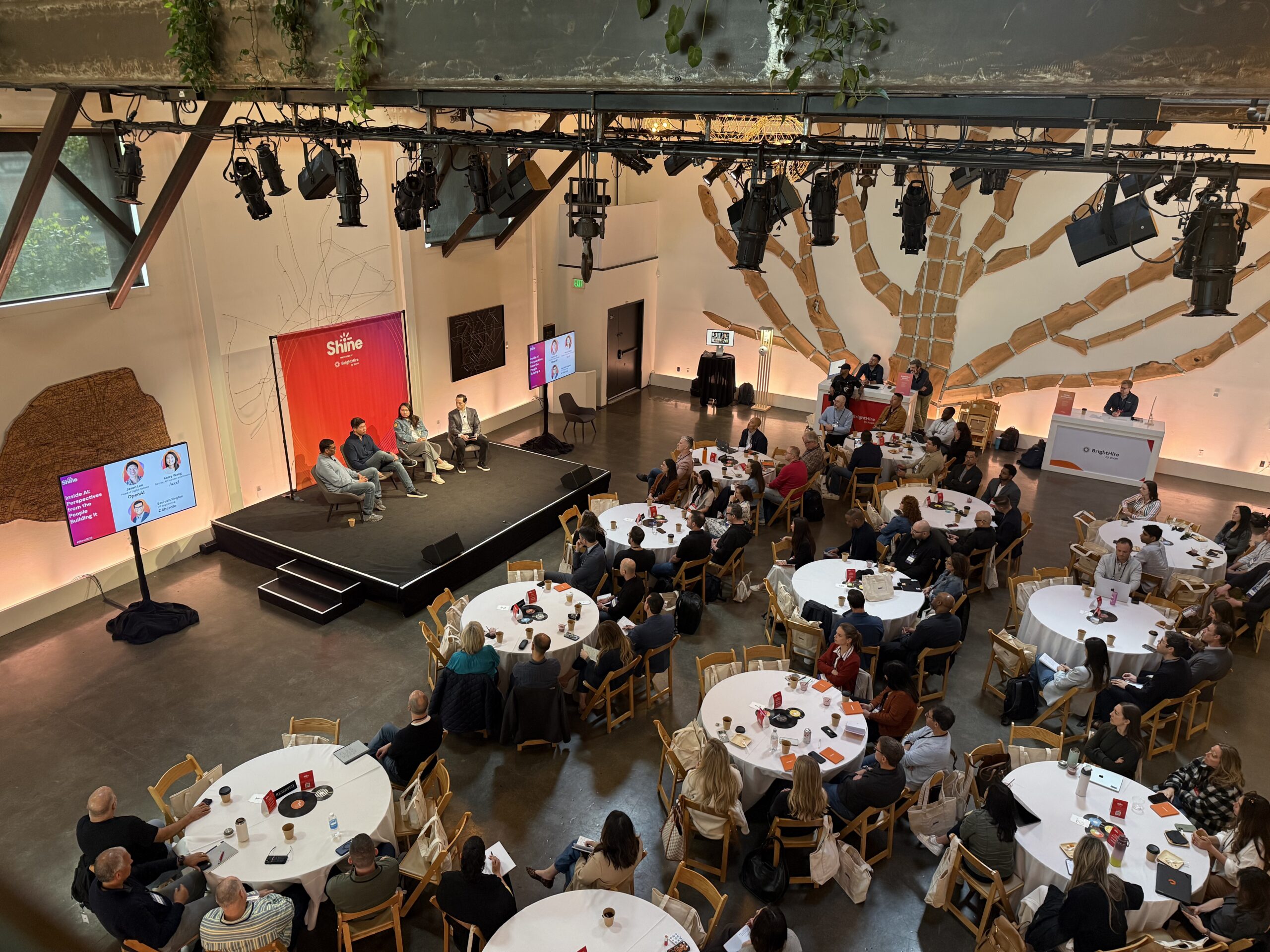
We kicked off the day with three people building and investing in AI from inside the technology itself: Jason Lee, Head of Digital Natives at OpenAI; Saurabh Singh, VP, Engineering at Liberate; and Kerry Wang, Partner at Accel. The conversation circled one shared observation: a year ago, agents were mostly a promise. Today, they’re running real workflows in production. At Liberate alone, voice agents handle 2.8 million insurance transactions a month across more than 200 agents in production.
What changed isn’t just the intelligence of the models. It’s the structure around them. Models can now think longer, take multiple turns, and call tools mid-task, which means the kind of long-running, multi-stakeholder workflow TA teams have always run is suddenly the kind of workflow agents can support.
The shift also reshapes how companies should be built around the technology.
“Companies that will be more successful are more like a factory with a supply chain that they’re investing in, making sure that their entire tech stack and suppliers could change overnight with every new model that comes out.”
— Kerry Wang, Partner at Accel
The implication for hiring: the underlying technology is here. The work TA leaders need to be doing now is building the factory around it.
2. AI is reshaping jobs, not erasing them
AI is driving one of the most significant technology shifts in modern history. Maxim Massenkoff, Economist at Anthropic, and Mar Carpanelli, Head of AI and Skills Research at LinkedIn, brought data on what that shift is actually doing to the labor market.
Maxim’s research shows that since AI tools went mainstream with ChatGPT, there has been no material increase in unemployment for the most AI-exposed jobs. Mar’s research adds another layer. Companies adopting tools like GitHub Copilot are actually hiring more software engineers, not fewer, and changing what they hire for. Programming specialization is giving way to people skills: leadership, collaboration, and the ability to work across non-technical teams.
“It is kind of creative that more exposed jobs are actually adopting AI the most. You would expect that they are automated, but instead they’re leaning in and using AI more in a way that is augmenting their jobs rather than replacing them.”
— Mar Carpanelli, Head of AI and Skills Research at LinkedIn
The pattern shows up in TA itself. Recruiters used to spend hours on note-taking and summarization. That time is now going to higher-quality conversations, deeper assessment, and the kind of judgment AI can’t make.
3. Candidate fraud has reached a scale that demands a real defense
Candidate fraud has gone from a niche problem to an industry-scale one. Soups Ranjan, Co-founder and CEO of Sardine; Brendan Ittelson, Chief Ecosystem Officer at Zoom; and Joshua Fattal, Privacy, AI and Data Security Attorney at Morrison Foerster, came to the stage to talk about what’s changed and what to do about it.
What used to require sophisticated tools is now accessible to almost anyone. Synthetic media is growing at roughly 1,200% year over year, and three seconds of audio is now enough to clone a voice with 85% fidelity. The stakes have stacked, too: A single bad hire can stack security, privacy, and sanctions exposure into one incident.
“I think collectively we could build something super powerful together where we eliminate candidate fraud. From the financial services industry, we have a pretty large consortium where if the same device was used to apply for an account at one bank, I can share that information across banks.”
— Soups Ranjan, Co-founder and CEO of Sardine
According to Brendan, the path forward isn’t one company building one tool. It’s an open platform with shared signals across LinkedIn, Zoom, World ID, and the deepfake detection vendors emerging on top.
4. The AI-native TA org isn’t your current org plus AI tools
What does “AI-native” actually mean for a TA function? Chris Abbass, CEO of Talentful; Tracy St.Dic, Global Head of Talent at Zapier; and Scott Dicke, VP of Talent at MaintainX, broke it down.

The panel’s shared answer: AI-native isn’t a layer of new tools on top of the existing org. It’s a redesign of the org itself, built on a TA leader’s vision for how the function will change and a team that’s fluent enough to build that change themselves.
“AI native comes down to two things. One is strategic vision, that’s usually coming from the TA leader. And then it is the AI fluency of your team. If you don’t have the strategic vision of how your function is fundamentally going to change, how you have to redesign the factory and break hiring down into its core components and rebuild them, then you’re just chasing tools.”
— Tracy St.Dic, Global Head of Talent at Zapier
At Zapier and Handshake, that redesign is already underway. Tracy decided not to hire a leadership recruiter and is instead building a system around the role, enabled by AI, with humans brought in for the white-glove parts where finesse matters. Scott sees resumes becoming obsolete within a year, replaced by AI-driven prompting against real role context.
The TA teams that figure this out first won’t just be more efficient. They’ll be operating in a different category of work entirely.
5. Quality of hire is a process, not a metric
Quality of hire has been the white whale of TA for decades. Kyle Forrest, U.S. Future of HR Leader at Deloitte; Becky McCullough, Vice President of Talent Acquisition & Mobility at HubSpot; and Jeff Moore, SVP of Talent, Operations and Workspaces at Toast, made the case that the way the industry has been chasing it is wrong.
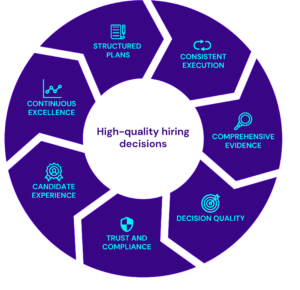
The pattern most TA functions fall into is hunting for a single quality-of-hire metric: a North Star number that proves the function is delivering. Becky and Jeff both pushed back on that. There is no single metric. There is a process, and if the process is high-quality, the outcomes will be too.
“I don’t believe there is a North Star quality-of-hire metric. We have a saying: if you can trust the process, you can trust the outcomes. So for me, quality of hire is a great process.”
— Becky McCullough, Vice President of Talent Acquisition & Mobility at HubSpot
Kyle Forrest added a principle for how AI should fit into that process. Most companies use AI at the top of the funnel to filter candidates out. He argued the opposite: AI should filter candidates in, surfacing high-signal candidates a recruiter might otherwise miss. One optimizes for recruiter time. The other optimizes for getting better candidates a fair look.
Toast saw exactly that pattern when they piloted BrightHire Screen on entry-level SDRs and dropped from nine screening questions to two, with a 0.2% false-negative rate. Quality of hire improves when teams stop chasing more data and start engineering the process for signal.
6. Context is key for moving hiring AI from analysis to action
We know AI is reshaping every layer of the hiring process. Ben Sesser, Co-founder and CEO of BrightHire, spoke to where the technology is heading next.
Ben framed BrightHire’s journey in three eras: turning interviews into data, applying large language models to make sense of that data, and now an emerging third era where agents take action on a team’s behalf.
The key to making those agents useful is context, knowing not just what happened in the hiring process, but why.
“AI is most powerful when it can actually eliminate trade-offs. The key to unlocking that promise in a world that’s going to be defined by agents is context. That’s the key ingredient. That’s not just knowing what happens, but why it happens. And that’s what helps agents learn and understand and deliver.”
— Ben Sesser, Co-founder and CEO of BrightHire
In hiring, that context lives in calls, chats, and video conferences, not in the systems of record. Which is why BrightHire has built the system of action: proactive agents for hiring that are powered by deep context and embedded directly in the hiring workflow.
7. The cost of a bad hire is bigger in the AI era
Eric Yuan, Founder and CEO of Zoom, joined Ben Sesser for a fireside chat on the lessons he’s drawn from fifteen years of scaling Zoom, and what they mean for how teams hire in an AI era.
Eric’s biggest career mistake, in his own words, was hiring too fast. During the pandemic, every department’s traffic jumped 10x, 20x. Every leader wanted more headcount. Eric approved the open reqs, and Zoom added more than 6,000 employees in 18 months. He says it broke the company culture.
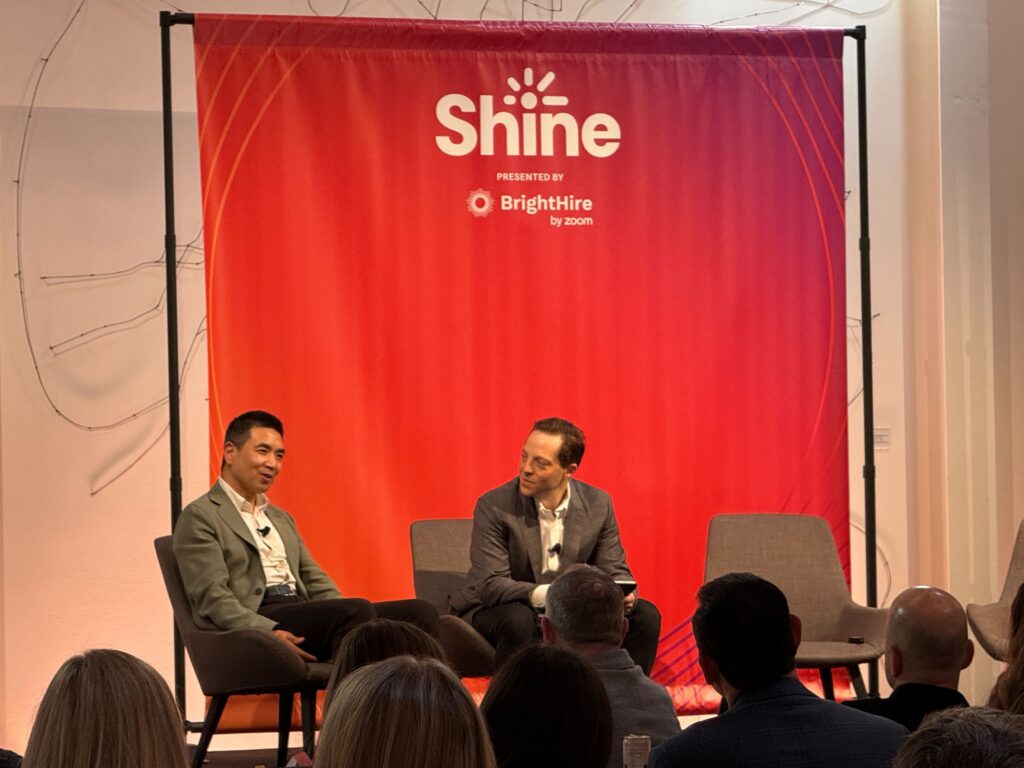
The lesson he carries: hire slowly, hire for quality, focus on talent that can grow with the company rather than fill an immediate gap. And according to him, this matters more in an AI era than it ever has.
“Talent will become even more important in the age of AI. If you hire a very good individual contributor, it’s not just one individual contributor — they can deploy so many digital agents to work for you. And the inverse is also true.”
— Eric Yuan, Founder and CEO of Zoom
The leverage of a great hire just went up and so did the cost of a bad one.
Final takeaway
The conversations at Shine 2026 made one thing clear: the teams that win at hiring in the AI era will be the ones who invest in the process behind every hire, not just the tools on top of it. The technology will keep evolving. The risks will keep changing. The bar for quality will keep rising. The teams who treat hiring as a process worth building intentionally will be the ones who get it right.