




Ask ten TA leaders to define quality of hire and you’ll get ten different answers. Everyone wants it, but no two TA functions measure it the same way, and despite the books written on the topic, the industry still hasn’t landed on a definition it agrees on.
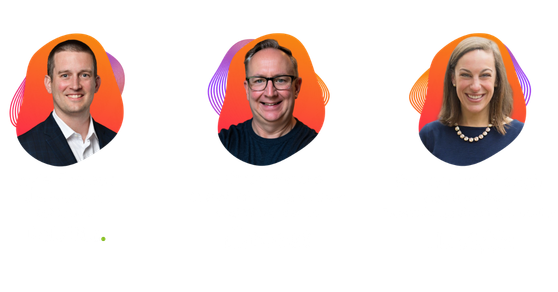
At Shine 2026, I sat down with Kyle Forrest, U.S. Future of HR Leader at Deloitte; Becky McCullough, VP of Talent Acquisition and Mobility at HubSpot; and Jeff Moore, SVP of Talent, Operations and Workspaces at Toast, to work through where TA functions have been chasing quality of hire the wrong way, and where AI is starting to change what’s possible.
Here’s what the panel had to say.
Rethinking quality of hire
Becky opened with a direct rejection of the most common way TA functions think about quality of hire: a metric.
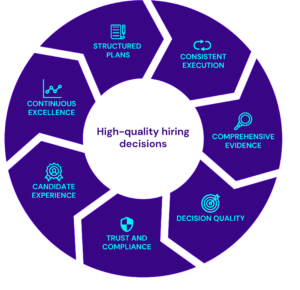
“I don’t believe there is a North Star quality-of-hire metric. We have a saying: if you can trust the process, you can trust the outcomes. So for me, quality of hire is a great process.” — Becky McCullough, VP of Talent Acquisition and Mobility at HubSpot
Jeff added that even among TA leaders who agree quality of hire matters, the definition shifts by role. What “great” looks like for an executive hire isn’t what it looks like for an early-career one. A single metric can’t carry that much weight across an organization, but a framework can.
Kyle raised a related complication: AI is making the target itself move faster. Three years ago, AI 101 didn’t exist as a training topic. Today many companies have one, and some have already updated it this year. The skills TA teams are hiring for in April aren’t the same ones they were assessing against in January.
A process can adapt to that pace. A metric can’t. And the same technology raising the pace is also reshaping how that process gets built.
Four ways AI is changing the process
If quality of hire is the output of a high-quality process, the question is what changes when AI is part of that process. The panel returned to four answers:
1. The cost of misalignment goes up with AI in the loop
2. Human judgment gets concentrated where it matters most
3. AI’s biggest gain is filtering candidates in, not out
4. More questions don’t make AI screening smarter
Let’s dig into each of these.
The cost of misalignment goes up with AI in the loop
When Jeff joined Toast, the sales leaders all said they were hiring for the same things. They used the same vocabulary. They cited the same traits. But when he put a stack of resumes in front of them and asked who looked good, they disagreed on every candidate, sometimes calling each other’s top performers terrible. As Jeff put it, “they weren’t speaking the same language.” The team had to run what he called a “really detailed, painful alignment session” to surface what people actually meant by words like “grit.” They still run it every time a new sales manager joins.
Kyle described what happens when AI enters that picture without the same alignment work upfront. An organization he knew had brought in AI tooling to filter fifty resumes down to ten. The hiring managers immediately pushed back. They didn’t trust the shortlist, and they didn’t know what “good” meant well enough to defend it. The team had to walk every manager back through what they were actually solving for before the tool could earn confidence.
AI scales whatever a team has aligned on, and exposes whatever they haven’t.
Human judgment gets concentrated where it matters most
For years, hiring teams have relied on human judgment at every step: recruiter screens, hiring manager calls, panel interviews, debriefs. Jeff’s argument is that spreading judgment that thin is exactly why decision conviction is so often weak. People hedge. They default to “soft yes” and “soft no” ratings because they don’t have enough signal to commit one way or the other.
At Toast, Jeff watches the rate of those middle-of-the-scale ratings as a signal of process quality. He’s said they’d rather see two strong yeses and one no than three soft yeses, because the disagreement is evidence that interviewers actually evaluated the candidate.
“My goal is to eliminate the soft yeses and soft no’s and actually use the full spectrum of the rating scale.” — Jeff Moore, SVP of Talent, Operations and Workspaces at Toast
AI is what makes that concentration possible. The high-volume steps where judgment has been spread thinnest, like early screens, are exactly where AI can produce signal at scale. By the time interviewers reach the decisions that matter, they have more data on the candidate, which is what makes real conviction possible.
AI’s biggest gain is filtering candidates in, not out
A lot of TA functions reach for AI at the top of the funnel to cut the noise. Kyle argues that’s the wrong instinct. Used to filter candidates out, AI’s gain is recruiter time. Used to filter candidates in, the gain is better candidates.
The difference is what the system is optimizing for. A filter-out tool looks for reasons to remove candidates: missing keywords, the wrong title, a non-traditional background. A filter-in tool looks for reasons to elevate them, including signal a recruiter wasn’t explicitly searching for, like a career-switcher whose previous role required the same underlying skills under a different name.
“If you can use technology at the top of the funnel to assess consistently around transferable skills or other things that a recruiter might miss, you expand the talent pool and can actually get better candidates in.” — Kyle Forrest, U.S. Future of HR Leader at Deloitte
When the starting pool gets stronger, quality of hire gets stronger with it.
More questions don’t make AI screening smarter
When AI handles screening, there’s a temptation to throw more questions at it. Toast tested that instinct.
Jeff’s team piloted BrightHire Screen on entry-level SDR roles last quarter, running 600 candidates through it. They started with four screening questions and kept adding more, expanding to nine, in the belief that more inputs would produce more signal. The data showed the opposite.
“There was an urge to throw as much as possible into the screen because we wanted to get as much signal as possible. What we found is there was no signal coming out of that. It was a whole bunch of noise.” — Jeff Moore, SVP of Talent, Operations and Workspaces at Toast
When the team ran the analysis, two of the original screening questions turned out to be the actual predictors of an offer. One assessed motivation. The other tested whether the candidate understood the role they were applying for. They stripped the screen down to those two and ran all the candidates through again. The false-negative rate, meaning candidates the screen rejected who would have gotten offers, came in at 0.2%.
The value isn’t in how many questions you ask. It’s in whether the screen captures real signal, at the scale AI makes possible.
Quality of hire is continuous work
The panel landed in different places on the specifics: what to measure, what to scrap, how to frame the metric. What they agreed on is that producing quality of hire is continuous work.
Roles change, definitions of “good” shift, and the signal that mattered in January may not be the signal that matters in April. A static metric can’t keep up with that pace, but a continuous process can.
That’s what AI now makes possible at scale. It’s what BrightHire’s Quality of Hiring System is built to support.