







AI is reshaping work at a pace we haven’t seen in modern history. The models keep getting better, the agents keep getting more capable, and there’s no sign of slowing down. For TA leaders, that raises a real question: what does this mean for the jobs and skills we’re hiring for and how does it impact TA as a function?
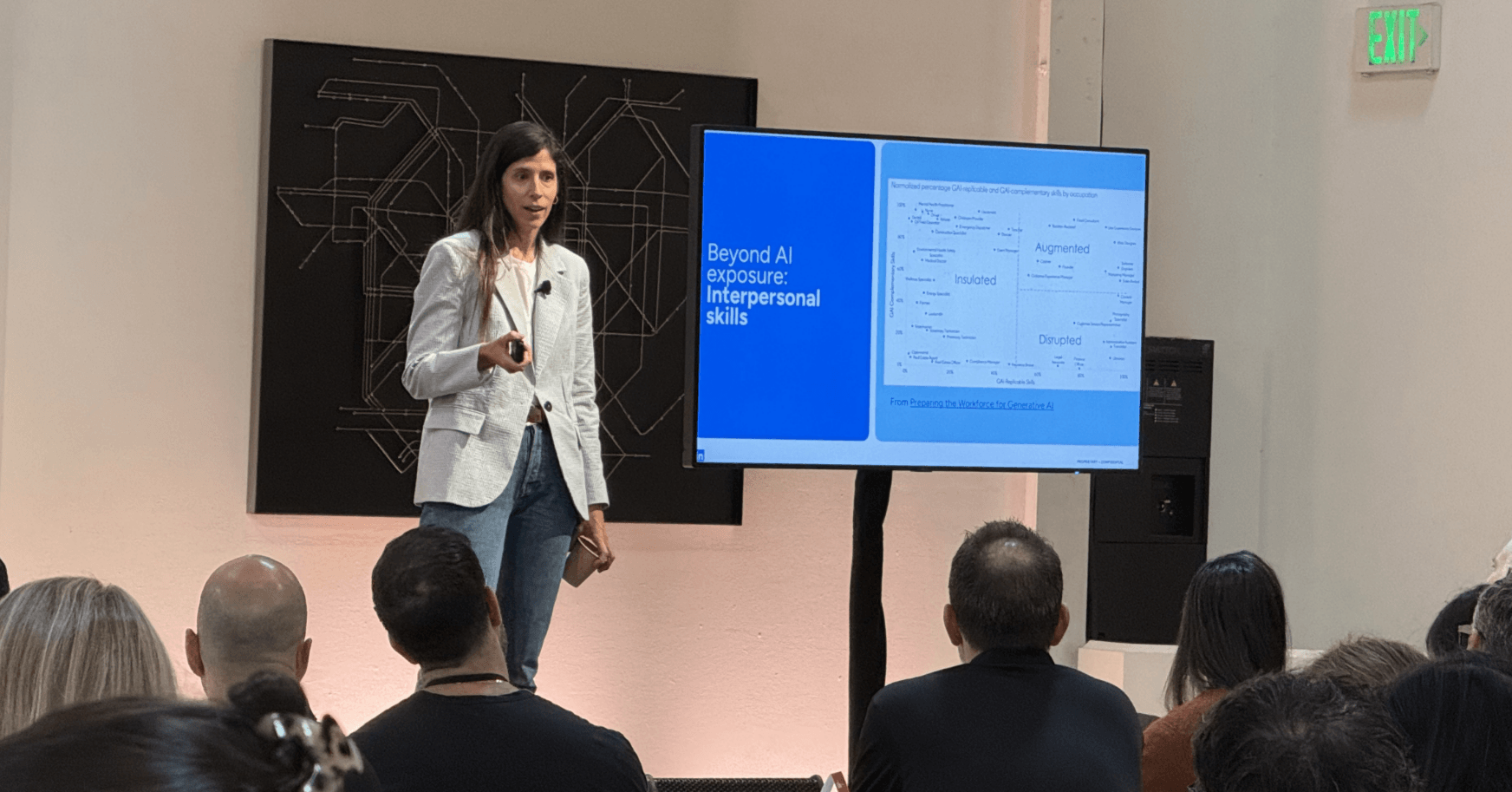
At Shine 2026, BrightHire CEO Ben Sesser sat down with two people who have unusually clear visibility into what’s actually happening: Maxim Massenkoff, Economist at Anthropic, and Mar Carpanelli, Head of AI and Skills Research at LinkedIn. Maxim’s team tracks how Claude AI is being used across millions of conversations and maps that work back to real occupations. At LinkedIn, Mar’s team has insight into LinkedIn’s 1.3 billion members and roughly 5 million profile updates per minute. Between them, they have the closest thing the industry has to a real-time read on how AI is reshaping work.
Three years into mainstream AI adoption, their findings paint a picture that looks different from what most headlines suggest.
Here’s what the data is telling us, and what it means for talent teams.
Unemployment hasn’t moved for AI-exposed jobs, but entry-level hiring is shifting
The most cited prediction about AI and the labor market is that it will eliminate a significant share of white-collar jobs in the next few years. Anthropic’s data doesn’t show that happening yet.
When Maxim’s team looked at which occupations are most exposed to AI today, the list was unsurprising: computer programming, financial analysis, data science, customer service. But the more interesting finding is how much of the theoretical AI opportunity is actually being realized, and that gap is significant.
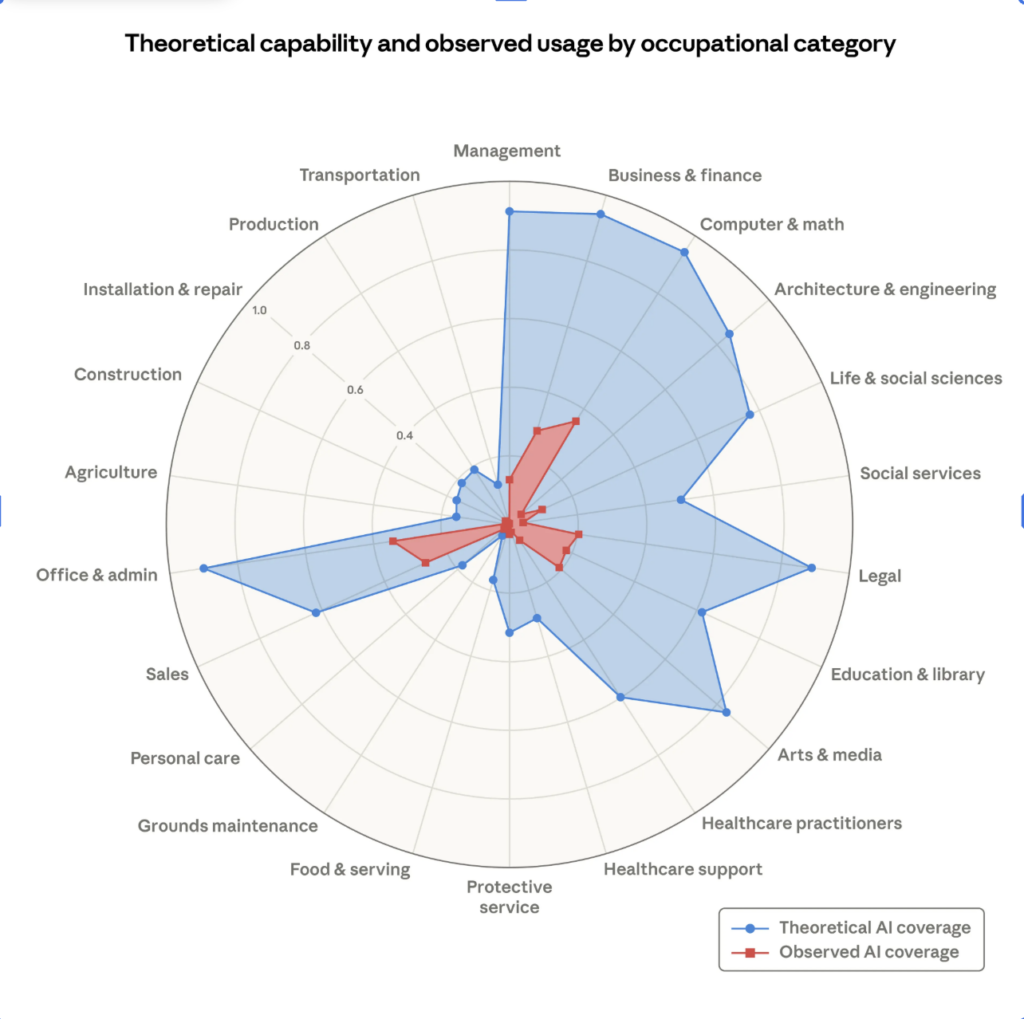
Anthropic, April 2026
The blue area shows where AI could theoretically help. The red shows where it’s actually showing up today, a small fraction of the possible. And the white space, which covers work like developing relationships, testing machinery, and positioning patients, is work AI can’t touch at all. AI’s footprint is still much smaller than the headlines suggest.
And when you look at unemployment rates for those exposed jobs, the line is essentially flat. “Ever since ChatGPT was released in 2022, there has been no increase in unemployment for these jobs,” says Maxim.
There is one place the data shows movement: hiring rates for workers ages 22 to 25 in the most AI-exposed jobs have dropped roughly 15%. But Maxim noted that it may not be a warning sign at all.
“The potential dip in hiring we see for these young workers could be part of a really healthy response, where the labor market diverts young workers into slightly different lines of work.” — Maxim Massenkoff, Economist at Anthropic
LinkedIn’s data points in the same direction. Mar’s team is seeing steady entry-level volume, but the mix is shifting. Roles combining technical and human skills are growing fastest, like sales engineering, account management, and investment banking. Roles AI does well, like medical scribe and contract analyst, are decelerating.
AI is augmenting work, not replacing it
The most direct test of “AI will replace this job” is software engineering. If any role should be shrinking under AI pressure, it’s the one AI is best at automating. But, the data shows the opposite.
Mar’s team ran a causal study by merging LinkedIn hiring data with GitHub data to identify which companies had adopted GitHub Copilot. The hypothesis was straightforward: if a tool can automate a meaningful share of an engineer’s work, those companies should hire fewer engineers.
The reverse turned out to be true. Companies adopting Copilot are hiring more engineers, including more women, more experienced engineers, and more entry-level engineers.
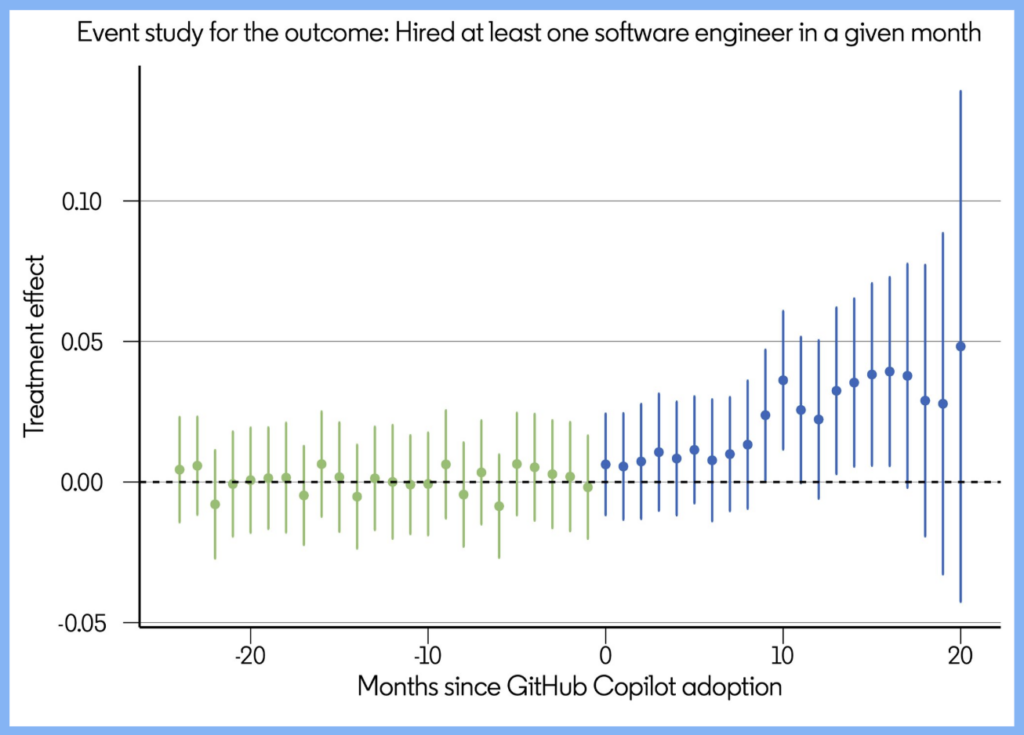
From Firm’s GHC adoption and labor market outcomes for SWEs
The chart shows the effect of Copilot adoption on a company’s likelihood of hiring software engineers. Before adoption (in green), there’s no meaningful difference between adopters and non-adopters. After adoption (in blue), the effect rises over time. The finding holds for entry-level engineers too, which matters given the broader concern about early-career hiring.
“It is kind of creative that more exposed jobs are actually adopting AI the most. You would expect that they are automated, but instead they’re leaning in and using AI more in a way that is augmenting their jobs rather than replacing them.” — Mar Carpanelli, Head of AI and Skills Research at LinkedIn
The pattern is augmentation outpacing automation. As Mar put it, companies are choosing to do more with the same team rather than the same with less, and she expects the ones who lean into that strategy to gain market share.
Mar’s research also shows this dynamic at the worker level. The most AI-exposed roles tend to be the most adaptable ones, meaning workers in those roles have skills that transfer easily to other occupations. Marketing managers are her example: highly exposed to AI, but their skills overlap with so many other roles that they can move into new work and pick up new tools quickly.
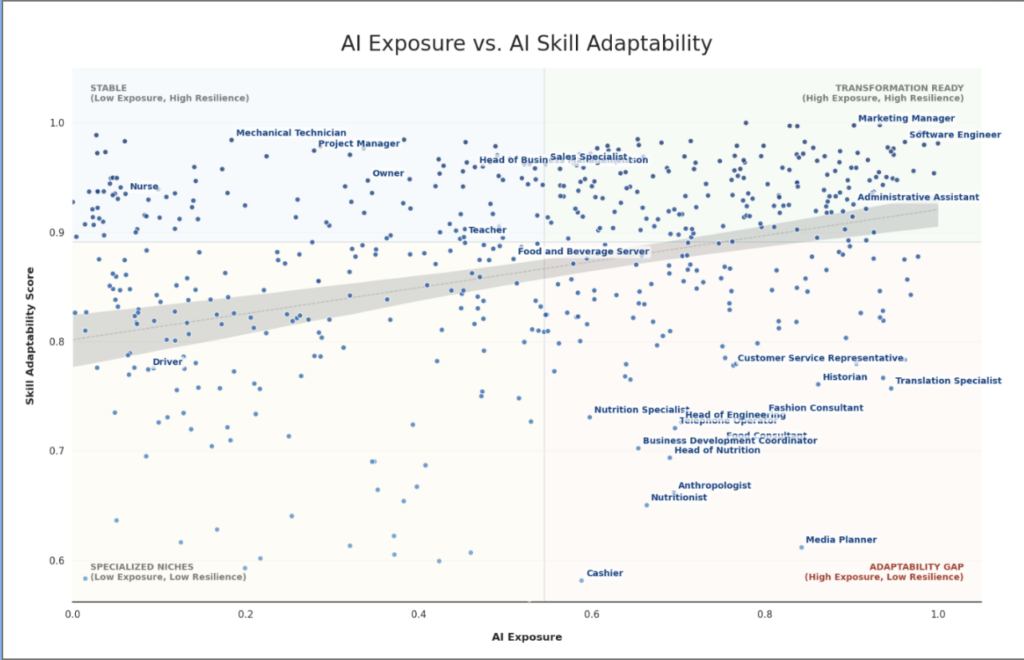
LinkedIn, April 2026
TA itself is a good illustration. Recruiters used to spend hours on interview note-taking and summarization. That time is now going to higher-quality conversations, deeper assessment, and the kind of judgment AI can’t replace. The role didn’t shrink. The work shifted to where humans add the most value.
The skills companies hire for are changing, and it’s not what you’d expect
If AI is automating technical tasks, the intuitive prediction is that companies will hire for more technical depth to stay ahead of it. LinkedIn’s data shows the opposite.
Every year, Mar’s team publishes Skills on the Rise, a ranking of the fastest-growing skills based on what job postings require, what newly hired members list on their profiles, and what existing members are adding. For years, the top of that list was dominated by technical skills like Python. In the most recent edition, three of the top five fastest-growing skills are people skills: leadership, people management, and strategy.
“Those technical skills that were kind of like the recommendation for a future-proof skilling are changing dramatically.” — Mar Carpanelli, Head of AI and Skills Research at LinkedIn
The shift shows up inside technical roles too. Mar’s team found that companies hiring more software engineers are also changing what they hire for. Postings are putting less weight on deep programming specialization and more on collaboration, end-to-end project ownership, and the ability to communicate with non-technical stakeholders.
This is where Mar’s research adds a useful nuance: AI exposure alone doesn’t predict what happens to a role. Two jobs with the same level of AI exposure can have very different futures depending on how much of the work is fundamentally human.
For example, Mar’s team plotted occupations on two axes: how much of the work AI can replicate, and how much depends on complementary human skills like judgment, communication, and interpersonal work. The result is four quadrants, showing roles like Web designers landing in the “Augmented” quadrant, with high AI exposure but also high human-skill exposure. Translators land in “Disrupted”, with high AI exposure but low human-skill content. Both are highly AI-exposed jobs, but the futures look very different.
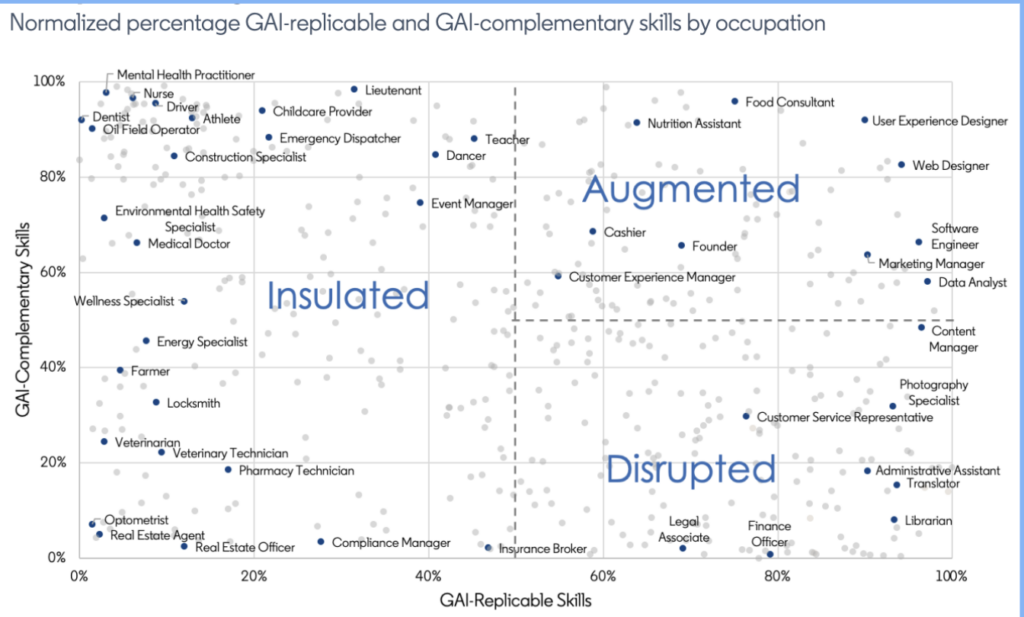
From Preparing the Workforce for Generative AI
AI fluency is also emerging as a distinct skill in job postings, not building AI models but using AI tools responsibly and effectively in day-to-day work. Year-over-year growth in postings requiring AI literacy is significant.
The pattern across all three findings: companies are hiring for the things AI can’t do.
What this means for Talent leaders
The data points to a labor market that’s adjusting, not collapsing. But the same shift that’s reshaping the labor market is also reshaping how teams should hire.
If the skills companies need are changing this quickly, the traditional signals for evaluating candidates start to lose their predictive power. Degrees, years of experience, and prestigious employers map to a version of the labor market that’s already shifting underneath them. Mar’s team is seeing recruiters move toward skills-first hiring as a result, looking for signals for skills that don’t show up cleanly on a resume.
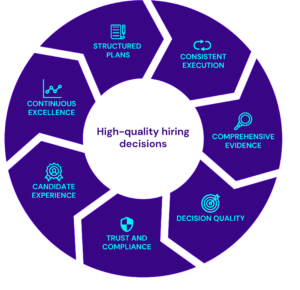
The evidence of someone’s actual capability lives in how they work, not what they claim to know. As resumes and screening signals get noisier, the interview is where the real signal lives — and getting that signal consistently means investing in the structure and quality of the interview itself.