




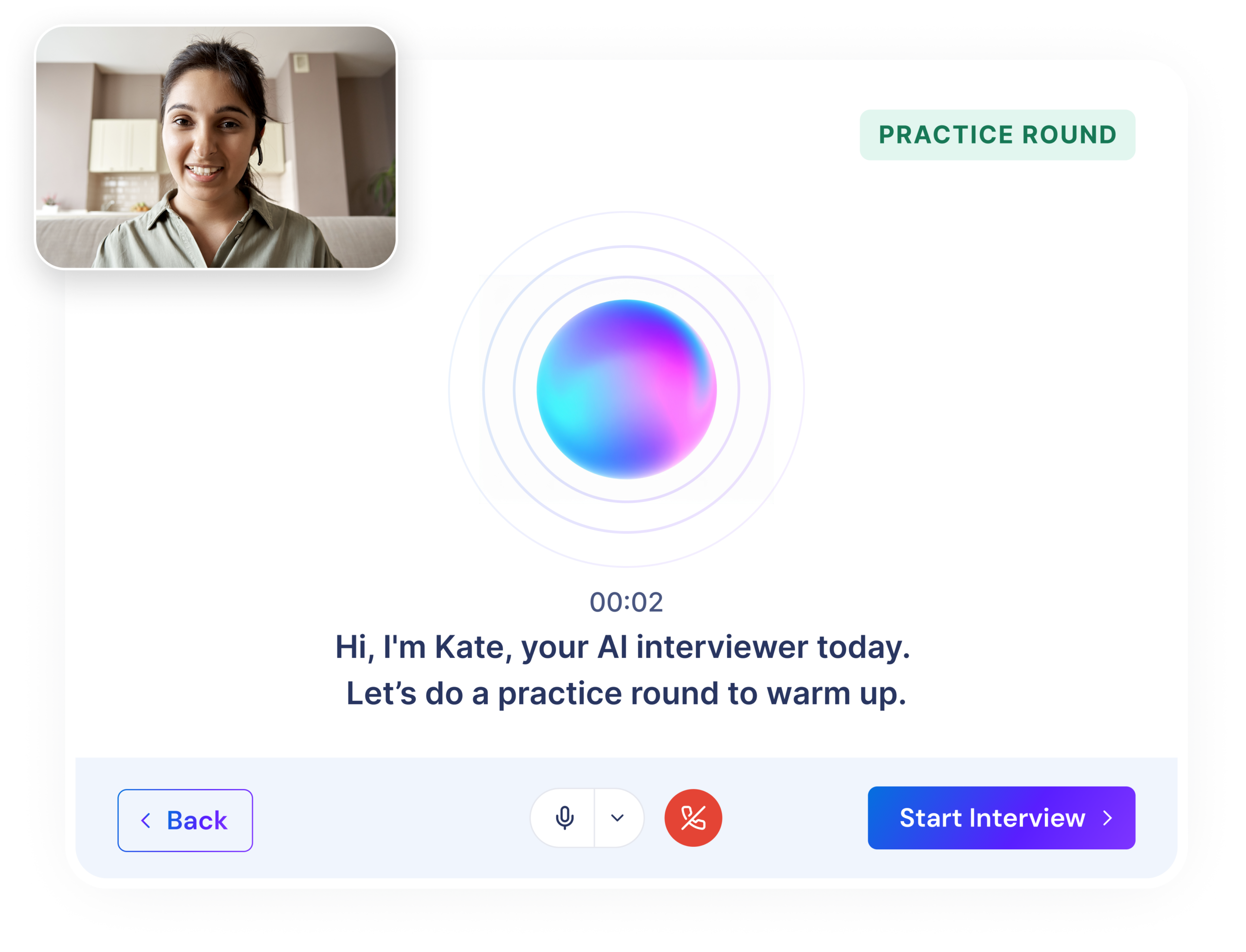


The strongest HireVue alternatives are two-way conversational AI interviewers that hold a real spoken screening interview instead of recording one-way video, including BrightHire Screen, Apriora’s Alex, HeyMilo, and Ribbon. The right fit depends on candidate acceptance, bias-audit posture, ATS integration, and whether you want a connected platform or a point tool.
These tools differ most in interview format. One-way recorded video has a candidate answer fixed prompts on camera, scored by AI with no one else in the conversation. A two-way interview lets the candidate talk through their answers in real time, with a person reviewing the result afterward. For many buyers, the format matters more than which vendor they choose.
Why teams switch off HireVue
In sales conversations with teams evaluating alternatives, a few reasons come up often.
- The contract is the glue, not the product. Current customers often stay, and even pilot new HireVue products, because an existing contract avoids new legal and procurement work, not because the team prefers the experience. Renewal windows are when the real evaluation happens.
- Slow to evolve. Long-time customers describe staying reluctantly, crediting HireVue’s assessment science while wishing the interviewing experience had kept pace.
- Candidate drop-off on one-way video. Former users describe candidates withdrawing rather than recording answers to a camera, senior candidates especially. In a 2026 Greenhouse survey of 2,950 active job seekers, 38% of US candidates said they had withdrawn from a hiring process because it used an AI interview, most often a pre-recorded video scored by AI with no human present (Greenhouse, 2026, vendor-sponsored).
- Mid-market teams feel deprioritized. Smaller teams describe enterprise-suite vendors treating them as a lower priority than larger accounts.
- The screen is a silo. Teams increasingly want the screening interview, the evidence behind it, and their live interview rounds on one candidate record, not a screening tool that stops at the screen.
One update worth knowing as you evaluate: HireVue added a two-way voice AI Interviewer in 2026.
If you’re staying inside the HireVue suite, evaluate that product on the same criteria below since it’s new, and ask the maturity questions you’d ask any new tool.
How to evaluate an AI interview platform
Eight checks (our full evaluation guide covers each in depth):
- Interview format. Is it a two-way conversation (voice or video) that adapts with follow-up questions, one-way recorded video with fixed prompts, or a text-based chatbot flow?
- Candidate acceptance. Is it disclosed and conversational, and can the vendor show completion and drop-off numbers?
- Independent bias audits. Run by a named third party, current, and readable, not self-certified.
- Human in the loop. Does a person make every advance-or-reject decision, in writing? Can the tool auto-reject on its own?
- Interview integrity. Can it flag possible impersonation, deepfakes, or AI-generated answers during the interview, and does scoring hold up against candidates gaming it?
- ATS integration. Does it write results back into your workflow, into scorecards, not a separate dashboard?
- Platform or point tool. Does the screening interview connect to the rest of your interview process, or live in its own system?
- Language and role coverage. Does it fit the roles, volumes, regions, and languages you actually hire for?
The best HireVue alternatives at a glance
Each row draws on the vendor’s own public materials or a reputable third party, current as of 2026-07-30. Unconfirmed details are marked as such. Table order isn’t a ranking.
| Platform | Format | Human in the loop | Bias audit | ATS integrations | Best for |
|---|---|---|---|---|---|
| BrightHire Screen | Two-way conversational (voice, optional video), connected to interview intelligence on one candidate record | Explicit: no auto-reject, stated in writing; a recruiter advances or rejects every candidate | Independent third-party AI bias audits | Greenhouse, Ashby, Workday scorecard write-back; ATS-less fast-pilot mode; ~15-min setup | High-volume screening interviews connected to the rest of your interview process |
| HireVue | One-way recorded video, live video, assessments, chat-based engagement, plus a two-way voice AI Interviewer added in 2026 | States AI assists rather than replaces decision-makers | DCI Consulting audited HireVue’s assessments for NYC LL144 in 2023 and 2024, per HireVue’s own statements; a current public audit artifact was not independently confirmed, and coverage of the new AI Interviewer is unconfirmed. | Workday, SAP SuccessFactors, Oracle, iCIMS, Greenhouse, Cornerstone | Enterprise teams that want assessments, video, and workflow in one suite |
| Apriora (Alex) | Two-way (phone, video, SMS, WhatsApp) | Explicit: states no candidate is auto-rejected by AI | States monthly bias audits with a public Warden AI dashboard; independently confirmed via our own research (BABL AI audit PDF + Warden dashboard) | Greenhouse, Ashby, Workday, Bullhorn, Lever confirmed; more claimed | Always-on first-round AI screening interviews |
| HeyMilo | Two-way (voice, video) | Recruiters set rubrics and decide; no explicit no-auto-reject statement found | Monthly audits published via a public Warden AI dashboard | Ashby, Bullhorn, Greenhouse, iCIMS, Lever, Workable, Workday | Multilingual, high-volume, staffing/BPO screening interviews |
| Ribbon | Two-way, voice-first | Candidate flow states a recruiter reviews responses | States a passed NYC LL144 audit with a dedicated page; auditor identity not confirmed [RESEARCH] | Greenhouse, Workday, Ashby, Lever, and others claimed | Frontline and high-volume screening interviews for staffing/RPO and franchises |
| Humanly | Chatbot plus structured AI interviews | Emphasizes recruiter review | States a FairNow partnership for AI audits | Greenhouse, iCIMS, Lever, JazzHR confirmed | High-volume candidate engagement across the funnel |
| Paradox (Olivia) (adjacent) | Text/chat apply and screening steps; not a screening-interview substitute | Implied | Not found | Workday, SAP | Conversational apply, scheduling, and text recruiting |
The alternatives, one by one
BrightHire Screen
BrightHire Screen is a two-way conversational AI interviewer for first-round screening interviews. It’s part of BrightHire’s interview intelligence platform, so the screening interview and your team’s later live interviews share one record of the candidate instead of sitting in separate tools.
Pros
- Never auto-rejects: every score, transcript, and summary goes through a person before any decision is made, stated in writing
- Independent third-party AI bias audits , SOC 2 Type II, GDPR, CCPA, and a Zero Data Retention option
- The screening interview, the evidence behind every evaluation, and your live interviews share one candidate record
- Surfaces interview-integrity signals, including possible impersonation, deepfakes, and AI-assisted answers, during the interview itself, built with Zoom
- Built for volume: sales, support, healthcare, hourly, and early-career screening interviews at scale.
- Candidates rate the experience 4.5 out of 5, platform-wide
Cons
- No async one-way video library; if candidates recording fixed prompts is a workflow requirement, that’s not what Screen does
- No standardized assessments; Screen evaluates the interview against the criteria your team defines, not test batteries
- Built for structured screening interviews at volume, not senior or executive conversations; keep those live, with interview intelligence capturing them
See how BrightHire Screen works »
Apriora (Alex)
Alex is Apriora’s AI recruiter, built around two-way conversational interviews across phone, video, SMS, and WhatsApp (Apriora, as of 2026-07-30).
Pros
- Explicit human-oversight language: “no candidate is auto-rejected by AI,” with final decisions staying with the customer team
- Confirmed integrations with Greenhouse, Ashby, Workday, Bullhorn, and Lever (more claimed)
- States monthly AI bias audits across 15+ protected classes, backed by a public BABL AI audit and a Warden AI dashboard
Cons
- Downloadable audit report was not independently confirmed in this pass
- Younger company (reported ~$20M total funding as of April 2026), so check references and support capacity at your volume before committing
- SOC 2 Type II and a trust center are referenced, but fuller security detail was not independently confirmed
HeyMilo
HeyMilo runs two-way voice and video interviews with adaptive follow-up questions, aimed at high-volume and multilingual hiring (HeyMilo, as of 2026-07-30).
Pros
- Broad ATS support: Ashby, Bullhorn, Greenhouse, iCIMS, Lever, Workable, Workday
- States independent monthly bias audits through a public Warden AI dashboard, and references EU AI Act classification work
- Visible compliance story for its size: SOC 2 Type I and II, GDPR, plus PIPEDA, Quebec Law 25, and CASL references
- Built for multilingual, high-volume, staffing and BPO screening interviews
Cons
- No explicit no-auto-reject statement found, unlike Apriora’s
- CCPA compliance not confirmed
- Younger company; check funding stage and customer references before committing
Ribbon
Ribbon is a voice-first two-way AI interviewer aimed at frontline and high-volume hiring, staffing, and franchises (Ribbon, as of 2026-07-30).
Pros
- States it passed a NYC Local Law 144 bias audit and hosts a dedicated bias-audit page, an unusually specific compliance claim in this group
- Candidate flow tells applicants a real recruiter will review their responses
- Built specifically for frontline, high-volume, staffing/RPO, and franchise hiring
Cons
- Auditor identity for the LL144 audit not confirmed [RESEARCH]
- Security certification is inconsistent across its own pages (homepage says SOC 2 Type II, other pages say Type I); confirm current status directly
- Full ATS integration list not independently verified; no formal no-auto-reject policy page found
Humanly
Humanly is a fuller-funnel AI recruiting platform spanning screening steps, scheduling, and structured interviews, combining chatbot screening with AI interviewing (Humanly, as of 2026-07-30).
Pros
- States a partnership with FairNow, a named third party, to audit its AI
- Confirmed ATS integrations with Greenhouse, iCIMS, Lever, and JazzHR, with Workday, UKG, and SuccessFactors referenced more broadly
- Built for high-volume candidate engagement across the full funnel, not just the interview step
Cons
- Default interview format (voice, video, or text) is not clearly stated, so it’s harder to know what candidates will actually experience
- Explicit no-auto-reject wording not verified
- SOC 2, GDPR, and CCPA claims appear in its own content but weren’t confirmed from a dedicated security page; verify directly
Compliance, bias audits, and whether the AI makes the decision
For most buyers, compliance has to be handled before anything else. Several laws now govern how an AI interview must be run, and they’re still changing:
- NYC Local Law 144 requires a bias audit within one year of using an automated employment decision tool, public posting of the audit, and notice to candidates. In effect since 2023.
- Illinois Artificial Intelligence Video Interview Act applies when an employer asks applicants to record video interviews analyzed by AI: notice, an explanation of how the AI works, consent, and deletion on request.
- Colorado repealed and reenacted its original AI law; automated-decision-technology duties covering employment begin January 1, 2027.
- EU AI Act points employment-related high-risk rules to December 2027, per a 2026 political agreement not yet published as a final regulation.
The core requirements repeat across all of them: notice and consent, an explanation candidates can understand, bias auditing, a human who can review and override, and a retained record. The vendors in this guide differ most on bias auditing: Apriora publishes an independently confirmed public audit, Ribbon and HeyMilo make specific public claims, and BrightHire runs independent third-party audits without a named auditor in our current register. Ask every vendor for the current report and confirm you can read it.
Whatever tool you choose, a person, not the AI, should make the final advance-or-reject call. This is general information, not legal advice; confirm the rules for where you hire with counsel.
For the detailed view, see Are AI Interviews Fair, Legal, and Compliant? »
Where HireVue is strong, and when to choose it
HireVue is the established enterprise option in this market. Its documented strengths:
- A broad product suite across assessments (deepened by its 2023 acquisition of Modern Hire), interviewing, and conversational AI, now including the two-way voice AI Interviewer added in 2026.
- A mature ATS ecosystem, including a long-standing Workday integration.
- Published science and explainability materials, and DCI Consulting bias audits for its assessments, per HireVue’s own statements.
- Enterprise security and compliance: SOC 2 Type II, ISO 27001:2022, ISO 27701:2019, and a FedRAMP reference (HireVue, as of 2026-07-30).
Choose HireVue if you need assessments and interviewing in a single enterprise suite from a vendor with a deep ATS integration footprint and public-sector or heavily regulated requirements, and if one-way and live video interviewing fit how your teams already work.
The trade-off to consider is the reaction to recorded video: for high-volume, candidate-facing roles where drop-off is costly, more candidates finish a two-way conversational interview. If the new AI Interviewer is the draw, evaluate it as the new product it is: ask for current bias-audit coverage, live references at your volume, and how evaluations reach your ATS.
How to switch off HireVue without disrupting your funnel
Switching interview tools is a change-management project more than a software install. A few practices reduce the disruption:
- Run a pilot on a defined set of roles before a full rollout.
- Bring in the right stakeholders early to design the workflow and plan what historical data moves, since interview records and integrations rarely migrate automatically.
- Treat the rollout as a change program with visible executive sponsorship, communication, and training.
- Run the new tool in parallel for a cycle so recruiters can compare completion rates, candidate feedback, and the quality of evidence reaching the scorecard, before you change over.
Framed as value rather than cost, the case for switching rests on candidate completion, time to first interview, the quality of signal your team gets, and whether the screen finally connects to the rest of your interview process.
Frequently asked questions (FAQs)
The strongest alternatives are two-way conversational AI interviewers: BrightHire Screen, Apriora’s Alex, HeyMilo, and Ribbon. Metaview and Paradox are often listed alongside them but serve adjacent jobs: Metaview summarizes live human interviews as an AI notetaker, and Paradox handles conversational apply, screening steps, and scheduling.
Yes. BrightHire Screen, Apriora’s Alex, HeyMilo, and Ribbon all run two-way conversational interviews that adapt with follow-up questions rather than recording answers to fixed prompts. HireVue itself added a two-way voice AI Interviewer in 2026 alongside its recorded-video formats.
Public research measures format, not brand. Candidates react most negatively to pre-recorded video scored by AI with no human present (Greenhouse, 2026). In a large field study, about 78% of applicants chose an AI voice interview over a human one when given the choice, though the study notes those who chose AI had somewhat lower language/analytical scores, so treat this as an acceptance signal rather than a preference ranking (Jabarian and Henkel, ssrn.com/abstract=5395709).
Compliance varies by vendor and jurisdiction, so verify each tool against the laws where you hire, including NYC Local Law 144, the Illinois AI Video Interview Act, and the EU AI Act. A responsible AI interviewer does not auto-reject candidates; a person makes the decision. BrightHire Screen states in writing that it never auto-rejects.
Some now surface signals worth a closer look: possible impersonation, deepfakes, or AI-generated answers during the interview, with a person reviewing the evidence before any decision.
Gartner projects up to 1 in 4 candidate profiles worldwide could be fake by 2028. BrightHire Screen surfaces these signals in the interview, built with Zoom. See our candidate fraud and interview integrity guide.
No. HireVue said on January 12, 2021 that it had removed visual analysis from its assessment models. The EPIC complaint that preceded this was filed with the FTC on November 6, 2019.