


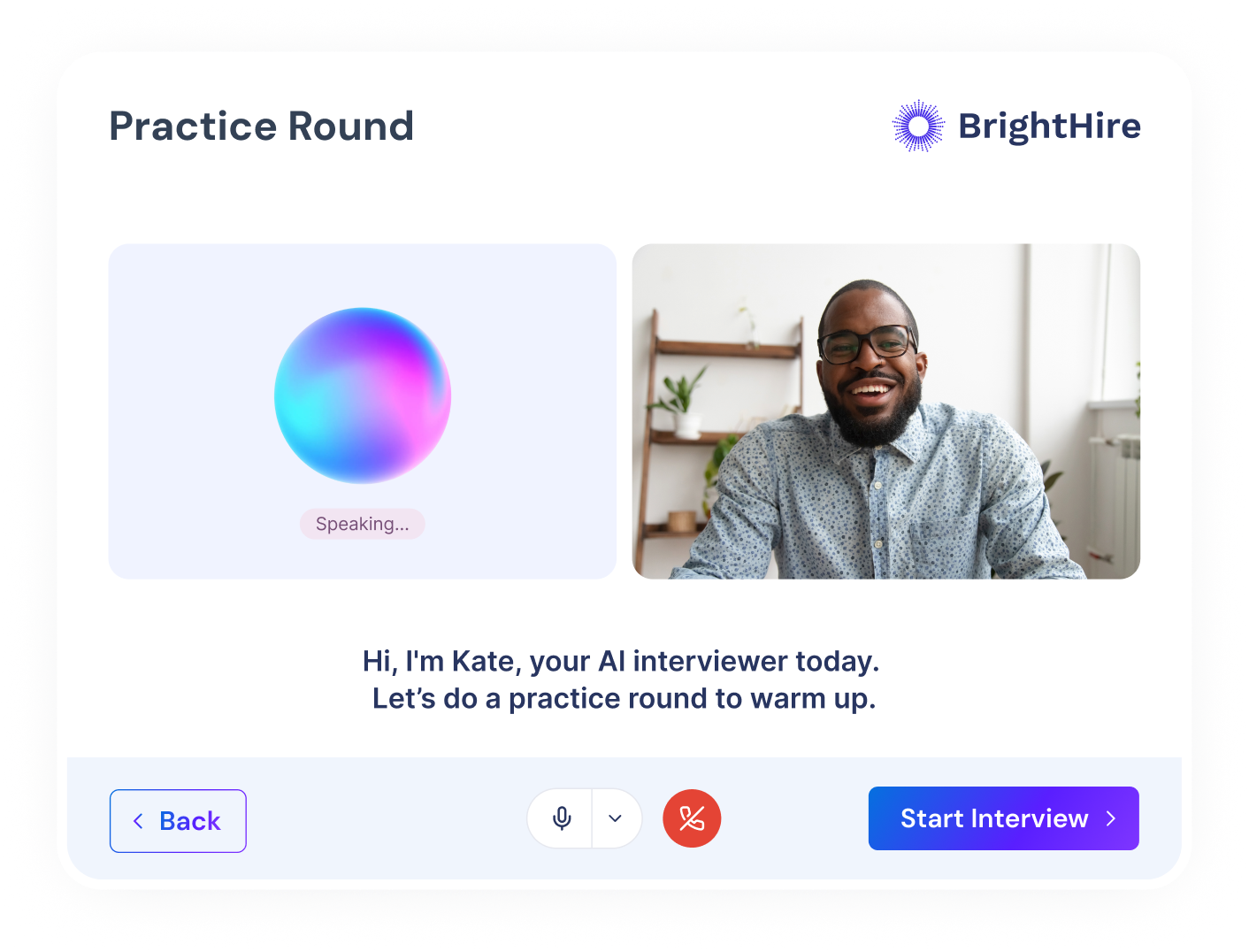


The best AI interviewer software runs a structured screening interview, scores each answer against the criteria your team sets, and leaves the hiring decision to a person. Strong options include BrightHire Screen, HireVue, Apriora, HeyMilo, Ribbon, and Humanly. The right fit depends on interview format, candidate experience, bias-audit and compliance posture, ATS integration, and role volume.
Most recruiting teams can’t screen everyone who applies: based on a BrightHire study of 17,000 positions, only 1 in 10 applicants typically gets a recruiter screen, so strong candidates may be missed entirely. An AI interviewer gives every applicant a real first-round conversation without adding recruiter time. Candidates can explain their experience and answer follow-up questions instead of being filtered by a resume alone.
What an AI interviewer actually is (and what it isn’t)
An AI interviewer conducts a screening interview and evaluates the answers against criteria your team set, it isn’t just software that touches the interview process. A few other product types get sold alongside “AI interview software,” and none of them belong on this list:
- Chat-based workflow automation. These handle apply, screen, and schedule over text or chat, without running a structured interview. Paradox is the clearest example.
- Interview intelligence and note-taking. These record and summarize live interviews that humans run, then write notes and scorecards back to the ATS, without conducting or deciding anything themselves. Metaview is an example.
- Skills and technical assessments. These test a specific skill, often coding, rather than run a screening conversation. CodeSignal is an example, and HireVue also sells assessments alongside its interview products.
Watch the word “screening,” too. A screening interview evaluates a candidate against your criteria; resume screening ranks applications before anyone speaks. BrightHire Screen runs the interview and evaluates what was said, it does not filter resumes.
How to evaluate AI interviewer software: nine buyer criteria
Before comparing vendors, decide which of these matter most for your roles. Each criterion is a question you can ask a vendor and check against a live demo.
Format and candidate experience
1. Interview format. Does it hold a real two-way conversation, or does it record answers to fixed prompts with no back-and-forth? A recorded video captures a candidate performing; a conversation lets them explain and get followed up with. Most tools now hold a real conversation, so treat this as a baseline check rather than the deciding factor. Also covers language coverage: does it support the languages you hire in?
2. Candidate experience. Will candidates finish it, and do they know they’re talking to AI? Ask for completion rates, drop-off, and the vendor’s disclosure language.
Trust and compliance
3. Fairness, bias auditing, and regulation readiness. Can the vendor show a current, third-party bias audit you can actually open, and are they ready for laws like NYC Local Law 144, the Illinois AI Video Interview Act, Colorado’s SB26-189, and the EU AI Act?
4. Security, data, and enterprise trust. Does it hold SOC 2, GDPR, and CCPA, what’s the data-retention default, and is candidate data used to train the vendor’s models?
5. Interview integrity and fraud detection. Can the vendor flag signs of impersonation, deepfakes, or AI-generated answers during the interview itself, and does a person review what it surfaces? Gartner projects that by 2028, as many as 1 in 4 candidate profiles worldwide could be fake. Ask what signals a vendor surfaces and what a recruiter actually sees when something looks off. See our full guide to candidate fraud and interview integrity.
Decisioning and evaluation
6. Human in the loop. Does a person make the final call, and does the vendor state in writing that the AI does not auto-reject candidates?
7. Evaluation depth. Does the tool score answers against the criteria your team defined and produce a comparable scorecard, or does it only transcribe, schedule, or run an assessment? Also covers role fit: does it suit the roles and volume you hire for?
Integration
8. Platform or point tool. Does the screening interview share a record with your live interviews and hiring notes, or does your team have to check a separate system to see it?
9. ATS integration. Does it connect to your applicant tracking system’s data and workflows, whether that’s Greenhouse, Workday, Ashby, or another, and how long does setup take?
The best AI interviewer software at a glance
To help you decide, here’s how each tool compares on format, decisioning, bias audits, security, and ATS integrations.
| Software | Interview format | Human in the loop | Independent bias audit | Security and compliance | ATS integrations | Best for |
|---|---|---|---|---|---|---|
| BrightHire Screen | Two-way conversational screening interviews, with interview intelligence on one candidate record | Humans decide; no auto-disposition, no auto-reject, no recommendation to advance | Independent third-party audits | SOC 2 Type II, GDPR, CCPA, Zero Data Retention option, no training on customer data; interview integrity and fraud-detection signals | Greenhouse, Ashby, Workday; ATS-less mode; setup in about 15 minutes | High-volume and enterprise teams wanting a candidate-first screening interview that evaluates and sits alongside their live interviews |
| HireVue | Recorded and live video, assessments, chat, and a two-way voice AI Interviewer | States AI assists rather than replaces decision-makers; candidate notice built in | External audits stated (DCI Consulting, 2023 and 2024) | ISO 27001, ISO 27701, annual SOC 2 Type 2; ask for retention and model-training terms | Workday, SAP SuccessFactors, Oracle, iCIMS, Greenhouse, Cornerstone, and more | Large enterprise and global, high-volume, assessment-heavy hiring in one suite |
| Apriora (Alex) | Two-way AI interviews over video, phone, SMS, and WhatsApp | States no candidate is auto-rejected by AI without human input | Public third-party audit (BABL) and a Warden AI dashboard | References SOC 2 Type II and GDPR controls | 33+ integrations, including Workday and Bullhorn | Staffing, early careers, and technical or high-volume screening |
| HeyMilo | Two-way voice and video AI interviews; SMS and phone | AI is advisory; recruiters set rubrics and make the final call | Monthly third-party audits published via Warden AI | States SOC 2 Type II, GDPR, no training on customer data | Bullhorn, Greenhouse, Ashby, Lever, iCIMS, Workday, and more | Staffing, BPO, and multilingual high-volume hiring |
| Ribbon | AI interviews over phone and video, plus email and SMS, with ATS write-back | Recruiters set standards and review outputs | References annual third-party audits (Holistic AI) | GDPR posture published; confirm SOC 2 type with the vendor | 60+ integrations, including Greenhouse, Workday, Ashby, Lever | ATS-centric AI screening for high-volume and staffing teams |
| Humanly | AI interviews across chat, voice, and video; ATS and CRM | Emphasizes recruiter review and human oversight | States fairness checks; ask for a current independent report | References SOC 2, GDPR, CCPA; confirm certification type | Greenhouse, Workday, iCIMS | Hourly, frontline, and high-volume hiring teams |
Metaview, Paradox, CodeSignal, and Eightfold come up in the same searches, but none conduct and evaluate a screening interview, so none are a screening-interviewer substitute (see “what an AI interviewer actually is” above). For multilingual hiring, Apriora, HeyMilo, HireVue, and Ribbon all publish multi-language support; confirm the specific languages you need.
The decisive question: does the AI decide, and can the vendor prove it’s fair?
Start with who makes the decision. Responsible AI surfaces signal for a recruiter to act on, and a person should make every hire, pass, or rejection. Read the vendor’s exact wording, since some only say the AI “assists” without ruling out auto-rejection.
Then look at what proves the tool is fair. An independent, third-party bias audit is different from a governance page or a self-certification. Ask any vendor for its current audit report, confirm it’s independent, and confirm you can read it.
The tools, profiled
BrightHire Screen. Screen conducts a two-way conversational screening interview and evaluates each answer against the criteria your team defined, then shares that record with BrightHire’s Interview Intelligence. As part of a connected platform that unifies screening and live interviews, Screen gives hiring teams full candidate context for every hiring decision. AI surfaces signal, and a person makes every hire, pass, or rejection. Screen also surfaces interview integrity and fraud signals during the interview itself.
BrightHire runs independent third-party bias audits and holds SOC 2 Type II, GDPR, and CCPA, with a Zero Data Retention option. It’s a fit for high-volume and enterprise teams that want depth in the interview itself. For a full head-to-head, see our full BrightHire vs HireVue comparison.
HireVue. HireVue is a broad enterprise suite spanning recorded and live video, assessments, chat, and, since 2026, a two-way voice AI Interviewer. It reports serving more than 1,150 customers, including over 60% of the Fortune 100. It once offered facial analysis in its assessments and discontinued that feature in January 2021. HireVue fits large, global teams that want validated assessments and interviewing in one platform. Our HireVue alternatives guide covers switching considerations in more detail.
Apriora (Alex) and HeyMilo. Both run two-way conversational AI interviews built for high-volume and multilingual hiring, and both publish clear human-in-the-loop language and third-party assurance dashboards. Apriora extends across video, phone, and messaging channels, while HeyMilo focuses on staffing and BPO workflows. Either suits a team screening at scale that wants a published audit trail.
Ribbon and Humanly. Both are ATS-centric interviewers aimed at high-volume and staffing teams. Ribbon connects to more than 60 systems and references an annual Holistic AI audit, which is worth asking to see. Humanly focuses on hourly and frontline hiring with an emphasis on recruiter review. Confirm each vendor’s current SOC 2 status directly, since public materials are not always specific.
What candidates actually think about AI interviews
Candidates come out ahead after an AI-led screen. A field experiment of about 70,000 applicants found that candidates who went through AI-led screening were 12% more likely to receive an offer, 18% more likely to start, and 18% more likely to still be in the role after one month. Structured, consistent first rounds appear to help candidates as well as recruiters.
Trust still depends on how the interview is run. A 2026 Greenhouse report found that 63% of US job seekers have already done an AI interview, 70% said it was not clearly disclosed, and only 8% believed AI makes hiring fairer. Candidates accept AI interviews more readily when the format is a real conversation, when the use of AI is disclosed up front, and when a person reviews the result. Disclosure and human review are worth building into any rollout.
Compliance, bias audits, and regulation: what to verify before you buy
AI interviewing is regulated now. Before you sign, confirm the vendor can support the basics below, and check the region-specific rules for anywhere you hire:
- An independent bias audit you can open. Some jurisdictions require this explicitly. NYC Local Law 144, for example, requires that an automated employment decision tool have a bias audit within one year, that the audit information be posted publicly, and that candidates get notice before use.
- Notice and consent for recorded interviews. Several states require this explicitly. Illinois’s AI Video Interview Act, for example, requires notice, an explanation of how the AI works, candidate consent, and deletion on request when AI analyzes recorded video interviews.
- Reasonable care for high-risk AI. Colorado’s SB26-189, for example, places new automated-decision-technology duties on developers and deployers for consequential decisions, including employment, starting January 1, 2027. Confirm the current requirements with counsel, since these laws vary by state and change often.
- A path to international compliance. The EU AI Act, for example, applies to high-risk employment systems from December 2, 2027, under the current timeline. Confirm the latest date and any other country-specific rules with counsel.
- Security and data terms in writing. Confirm SOC 2, GDPR, and CCPA posture, the data-retention default, and whether candidate data is used to train the vendor’s models.
BrightHire supports this list directly: independent third-party bias audits, SOC 2 Type II, GDPR, CCPA, a Zero Data Retention option, candidate consent and opt-out, and a policy that the AI does not make hiring decisions or train on customer data.
How to run a two-week pilot
A two-week pilot tells you what a demo can’t, if you measure the right thing. Define success in quality-of-hire terms before you start, rather than defaulting to speed, since a faster first round that lowers the bar is not a win. A workable pilot design looks like this:
- Run the AI interviewer in parallel with your current first round, and compare results on the same roles before you hand over any decisions.
- Set the evaluation bar and the questions up front, so the pilot tests your criteria rather than the vendor’s defaults.
- Keep recruiters in the loop and test the human-review workflow, including overrides and exceptions, rather than the scores alone.
- Add a candidate-experience check to the scorecard: completion rates, drop-off, and candidate feedback.
- Get retention and model-training terms in writing during procurement, because public pages are often thinner than the contract.
Frequently asked questions (FAQs)
The strongest fit runs a structured screening interview, evaluates answers against your criteria, keeps a person in the decision, and connects to your ATS. BrightHire Screen, HireVue, Apriora, HeyMilo, Ribbon, and Humanly are all worth evaluating, depending on your roles.
Weigh evaluation depth, candidate experience, an independent bias audit, human-in-the-loop decisioning, ATS integration, whether it is a platform or a point tool, and language and role coverage.
Look for a written statement that the AI does not auto-reject candidates. BrightHire and Apriora publish clear language to that effect, and HireVue states that AI assists rather than replaces decision-makers. Confirm the exact wording with any vendor.
Some tools now surface integrity signals during the interview itself, flags for possible impersonation, deepfakes, or AI-generated answers, for a person to review before anyone advances. BrightHire Screen does this. See our full guide to candidate fraud and interview integrity.
It can be, with the right controls. Ask for a current independent bias audit, confirm SOC 2, GDPR, and CCPA posture, and check the rules that apply to you, including NYC Local Law 144, the Illinois AI Video Interview Act, Colorado’s SB26-189, and the EU AI Act.
An AI interviewer holds a two-way conversation and evaluates the answers. A notetaker records and summarizes interviews that humans run. A chat-based tool automates apply, screen, and schedule without running a structured interview. A one-way video tool has candidates record answers to fixed prompts with no back-and-forth.