







Updated October 27, 2026
TL;DR: In vendor calls, ask each vendor to show evidence for its answers. The strongest signals: candidate consent built into the interview flow by default, a named list of ATS fields that sync in each direction and at what trigger, written disclosure of transcription limits alongside third-party bias audit results, and interview guides that surface live during calls rather than in pre-call documents. BrightHire’s Greenhouse integration is one example of the field-level answer to look for: it pulls interview guides from the ATS before each call and pushes scorecards, summaries, clips, and scores back to the candidate record when the call ends. On cost, get minimums, escalators, and overage rates before the contract stage. Score every vendor on adoption risk too, since a tool interviewers stop opening delivers nothing.
Interview intelligence tools look similar in a demo. The differences show up months later, in whether scorecards sync to the ATS and whether interviewers keep using the tool.
How vendors answer specific questions shows more than their feature lists about whether a tool only documents interviews or improves hiring decisions. This guide covers the questions to ask, what a strong answer sounds like, and which answers should raise a flag. A disclosure up front: BrightHire wrote this guide, so it reflects the framework BrightHire built its own product around.
The matrix below turns those questions into a scorecard. Use it in vendor calls to compare answers side by side and note red flags as they come up:
| Category | Key question | What a good answer sounds like | Red flags |
|---|---|---|---|
| Data protection | How does candidate consent work? | Built into interview flow by default, opt-out available, consent record stored with interview | “Configurable” or “available upon request” |
| ATS integration | Which fields sync and in which direction? | Names which fields pull before the call and which push back after it | “We integrate” without field-level specifics |
| AI consistency | How accurate is transcription? | Honest about limitations, provides verification method, shows third-party bias audit results | “Highly accurate” without acknowledging edge cases |
| Process rigor | How do you prevent off-script interviews? | Live interview guides during calls, plus compliance flags for high-risk questions | Pre-call emails or separate documents |
| Metrics | What can you show about interviewer performance? | Standardized reports with interviewer-level benchmarks and stage-level drop-off | Usage counts only |
| Implementation | How long until we’re live, and who adopted without a mandate? | Setup measured in days, plus named customer references | “Adoption is easy” with no references |
| Pricing | What’s your pricing model? | Clear split between seats and usage, with minimums and overages disclosed upfront | Won’t discuss overages until contract stage |
Evaluate vendor data protection protocols
Data protection is a pass/fail check in procurement: a vendor that can’t answer these questions won’t clear a security review, whatever its feature set. When interview records are incomplete or inconsistent, TA teams can end up holding the compliance risk, even with Legal and HR involved. These questions show whether a vendor has built compliance into the product or only into the sales deck.
Confirm candidate consent is built in
Recording consent is the first thing to check. A strong answer: consent workflows run inside the interview flow by default, candidates can decline without penalty, and the consent record is stored with the interview. If the vendor describes consent as “available” or “configurable,” it’s an optional setting, and optional settings are easy to miss during a rollout. BrightHire notifies candidates before and during the interview and lets them opt out at any time, as listed in its compliance and security overview.
Check where interview data lives
Ask where interview data is stored, who can access it, and whether customer data trains AI models. Look for named certifications (SOC 2 Type II, GDPR, CCPA), zero data retention options, and a written commitment that customer interview data stays out of model training. BrightHire holds SOC 2 Type II certification, complies with GDPR and CCPA, offers zero data retention options, and states that it does not use customer data to train third-party AI models.
Ask for a defensible hiring record
If a hiring decision is challenged, what does the audit trail look like? Each interview should have a searchable, replayable record tied to the candidate, with scorecards and notes on the ATS candidate record. Evidence stored in a separate tool that someone has to log into leaves a gap in that record. BrightHire writes interview summaries, highlight clips, and candidate scores to the ATS record, so the evidence sits next to the hiring decision.
Evaluate ATS platform compatibility
When the ATS is your system of record, integration depth decides whether an interview intelligence tool saves time or creates re-entry work. Ask the vendor to show a scorecard syncing and a candidate record staying intact, rather than describing it. “We integrate with Greenhouse” doesn’t answer the question until the vendor names the fields, the sync direction, and the trigger.
Separate deep ATS integration from shallow
Ask whether the integration is bidirectional and which fields move in each direction. The answer you want: interview guides pull from the ATS before each call, and AI-generated scorecards push back to the candidate record when the call ends. Watch for “we have an integration” or “we can build a custom connection” with no field-level detail. BrightHire offers deep ATS integrations with Greenhouse, Lever, Ashby, Workday, iCIMS, Rippling, SmartRecruiters, Gem, and more, with one-click scorecard completion available from within the ATS.
Confirm scorecard sync is automatic
Two follow-ups matter here: what triggers the sync, and what happens when a sync fails. The sync should fire automatically at call end, and the vendor should have documented error handling. “Our team will help you set up a workflow” usually means someone on your side will be moving data by hand. BrightHire’s Greenhouse integration pushes scorecards, summaries, clips, and scores back to the candidate record when the call ends, as described in BrightHire’s guide to AI recruiting tools.
Request field-level integration documentation
Before procurement review, ask which ATS platforms have the deepest integration and request the sync documentation for yours. Vendors with deep integrations name the platforms and send the documentation. A hedge such as “it depends on your setup” suggests the integration is shallower than the marketing page implies. BrightHire’s Greenhouse integration follows the pull-before, push-after pattern described above. For Lever, Ashby, Workday, or another ATS, ask for the same field-level detail during evaluation.
Measure AI consistency in candidate reviews
The AI layer is where a notetaker and a decision-support platform diverge. Its output has to be accurate enough to act on and defensible enough to hold up in a compliance review.
Check how AI maps responses to job criteria
Ask how the AI connects candidate answers to role-specific competencies. The mapping should run through the interview guide and scorecard criteria. Keyword matching only measures whether certain words came up, which says little about competency. BrightHire’s AI scorecard auto-fill maps to your evaluation criteria, so the output follows your rubric.
Validate AI scorecard data integrity
Can interviewers edit AI-generated scorecards, and is there an audit trail of changes? Interviewers should review and edit everything the AI produces, with the original transcript always available. AI surfaces signals for human review, but humans make the final call. Ask the vendor to put its transcription limits in writing, such as how it handles accents, crosstalk, and technical terms, and how interviewers can check the transcript against the recording. BrightHire pre-fills scorecards for interviewers to review and edit, and the interview recording and transcript stay available for reference.
Review third-party bias audits
Request the vendor’s third-party bias audit results and ask how it measures AI accuracy. Look for audits that run annually and are documented and available for review. BrightHire runs annual third-party AI bias audits with babl.ai, an independent AI auditor, as listed in its compliance and security overview.
Hold process rigor on every candidate call
Process can slip when req volume spikes. Three common signs:
- Intake meetings get skipped
- Scorecards get filled from memory
- Debriefs get decided by whoever spoke loudest
Ask the vendor to show how the platform keeps the process consistent at volume without someone enforcing it by hand.
Look for real-time interviewer prompting
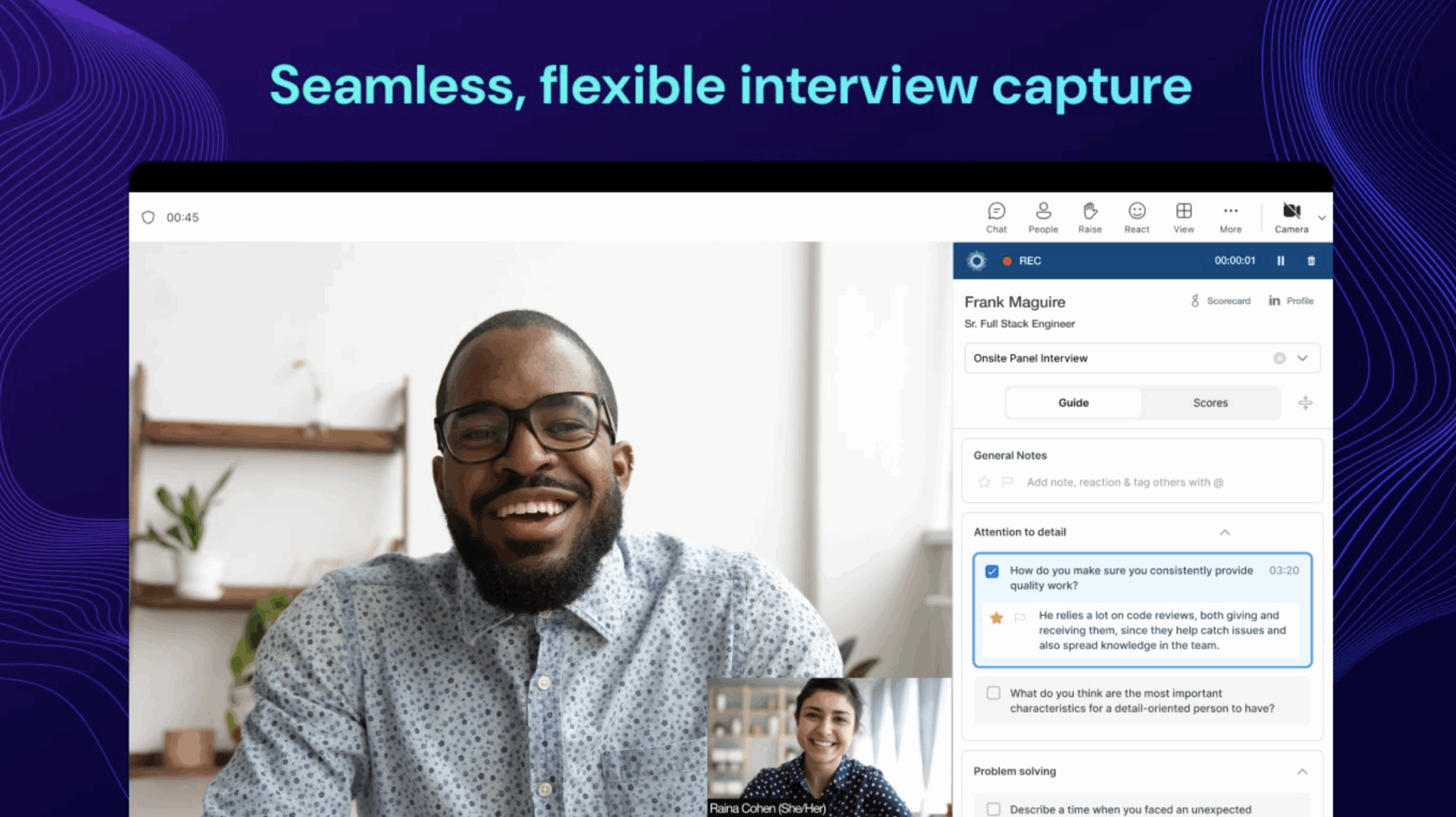
Ask whether interview guides surface live during the call and whether they tie questions to the competencies the role requires. Interviewers should see the structured plan in real time, so every candidate is assessed against the same rubric while the conversation continues. A guide sent as a pre-call email or a separate document tends to get skipped under pressure. BrightHire’s structured interview plans tie questions to role competencies, and its in-interview guidance keeps each interviewer on that plan during the call, which makes debrief comparisons more reliable.
Flag inconsistent questioning
Off-script questions are hard to catch after the fact. The platform should flag high-risk or off-plan questions for admin review, because a single legally problematic question can create exposure that no one notices without a flag. BrightHire’s compliance flags surface high-risk questions for admin review, so you can coach interviewers before a pattern becomes a liability.
Identify interviewer skill gaps
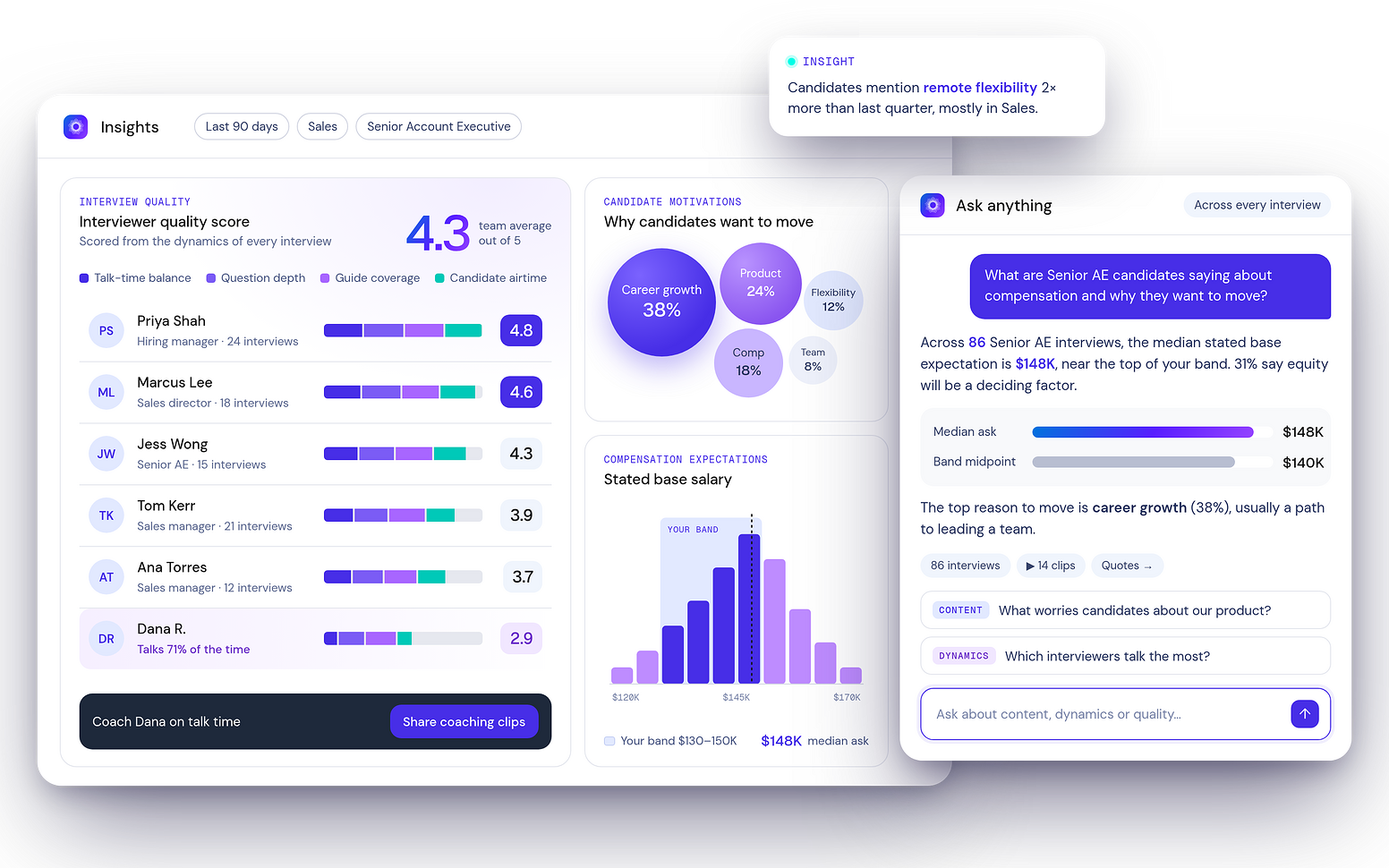
Per-interviewer analytics should show which interviewers need coaching and on what, beyond completion rates. Ask the vendor to walk through that view for a sample team. BrightHire’s Interview Insights reports on per-interviewer performance across the interview corpus, giving TA leaders visibility into which interviewers need support and where. Tracy St. Dic, Global Head of Talent at Zapier, describes how that works for her team:
“Interview Insights gives me a powerful bird’s-eye view for executive conversations and highlighting trends, while also letting me zoom in on specific areas for improvement.” – Tracy St. Dic, Global Head of Talent, Zapier, on BrightHire Interview Insights
Ask for coaching built on recorded interviews
Generic training content is hard to apply because it isn’t tied to the interviewer’s own calls. Ask whether coaching is generated from each interviewer’s recorded interviews. BrightHire’s automated, personalized coaching works this way, helping interviewers build more consistent, calibrated habits over time.
Evaluate interviewer performance and metrics
Usage numbers show the tool was switched on. To make an internal case to a CPO or CFO, you need data that links interview quality to hiring outcomes.
Track pipeline conversion by stage
Stage-level drop-off data shows where candidates stall between interviews, which top-of-funnel counts can’t. Ask the vendor whether its analytics break conversion down by interview stage.
Link interview data to quality of hire
Time-to-fill measures speed, but it can’t tell you whether the hire worked out. Ask how structured interview data feeds quality-of-hire reporting. Interviews per hire is one place the link shows up, because fewer rounds per hire means less interviewer time per role and a shorter process for candidates.
Measure interviewer calibration
Consistent scoring across a panel is what makes debrief comparisons fair. Calibration analytics should compare each interviewer’s scoring pattern against the rest of the panel. When one interviewer scores everyone harshly and another scores everyone generously, debrief scores stop meaning much. BrightHire surfaces interviewer-level benchmarks, so you can see where individual interviewers diverge and raise it in a calibration session before it affects a decision.
Improve interviewer feedback quality
Vague feedback slows debriefs. Look for AI-generated notes and highlight clips that give interviewers evidence to cite instead of memory. When scorecards are written from memory, the debrief reflects recall more than candidate performance. With BrightHire, notes, highlight clips, and pre-populated scorecards tie the debrief to what the candidate said, so the discussion shifts from a general impression like “I thought she was strong” to a specific moment like “here’s the clip where she explained how she approached it.”
Track scorecard submission rates
Scorecard submission rates are a leading indicator of process health. Ask how the platform gets scorecards completed and submitted within SLA. Pre-populating scorecards from the transcript reduces the blank-page effort that delays submission. BrightHire’s AI scorecard auto-fill drafts the scorecard from the interview transcript for the interviewer to review and submit.
Set benchmarks for hiring quality
Improvement is hard to show without a starting point. Ask whether the platform gives you a baseline to measure against, so you can show progress over quarters and defend the tooling budget. BrightHire’s library of standardized reports covers interview quality, what candidates care about, and interviewer capacity, which gives TA leaders the numbers to make the business case internally.
Estimate the admin effort implementation requires
Adoption is the main implementation risk, because the value depends on interviewers using the tool on every call. If a vendor says adoption is easy, ask them to show how it worked at a company of similar size.
Pin down the setup timeline
Ask how long until the team is fully operational and what setup involves. Timelines measured in weeks, such as “a typical implementation takes four to six weeks,” point to heavy configuration or change management. BrightHire states on its pricing page that most customers are fully set up in less than one day, with no disruption to existing workflows and no extra fees for training or implementation.
Drive interviewer buy-in without mandates
Ask the vendor for named customers where interviewers, not only recruiters, adopted the tool without a top-down mandate. If the vendor can’t name one, your team would be the test case. Peer reviews are a second check: BrightHire holds a 4.7/5 rating on G2 across 187 verified reviews.
“I love the transcription aspect of BrightHire as it allows me to concentrate on the conversation within the interview instead of taking perfect notes. I also like the ability to review the captured pieces later if I’ve forgotten something important.” – Meghan K. on G2
Plan for ongoing maintenance
Week-to-week admin should be close to zero: no per-interview configuration and no manual data entry after calls. Ask the vendor what an admin’s typical week looks like once the tool is live. BrightHire joins calls automatically and syncs to the ATS without manual intervention, which removes the friction that stalls adoption.
Assess platform costs and licensing flexibility
Finance reviews of TA tooling often ask for a cost model and an ROI case before sign-off. Get both from the vendor early, so the numbers are ready before the contract stage.
Compare per-seat and per-interview pricing
Get the pricing model on the table early: seats, interview volume, or both. Then ask the vendor to estimate total cost from your hiring volume. Vendr’s aggregated contract data describes the model as seat-based licensing plus usage components tied to interview volume, and estimates annual contracts at $15,000 to $35,000 for teams of five to 15 users running fewer than 100 interviews a month, $35,000 to $75,000 for 15 to 50 users, and $75,000 to $150,000 and up for enterprise deployments above 50 users.
Negotiate licensing minimums
Ask about minimums, escalators, and overage rates, and whether the contract can scale with hiring volume. If the vendor won’t share the overage rate until contract negotiations, push for it earlier.
Justify tooling costs to Finance
Ask which ROI metrics the vendor can provide for a Finance review, and tie each one to a metric your team already reports. This framework maps each metric to a BrightHire-reported result:
| Metric | How to measure | BrightHire-reported result |
|---|---|---|
| Feedback submission speed | Time from interview end to scorecard submitted | 28% faster feedback submission |
| Interviews per hire | Total interviews divided by hires | 27% fewer interviews per hire |
| Candidate drop-off | Candidates who withdraw between interview and offer | 19% reduction in drop-offs |
Source: BrightHire study across 25,000+ candidates, reported on its quality hiring page.
Bring this table to the Finance review alongside your own baseline for each metric.
Request a demo to see how BrightHire syncs with your ATS and what an AI-generated scorecard looks like in your candidate record.
FAQs
Setup time depends on how much per-interview configuration the tool needs and how deep the ATS integration goes. BrightHire teams can start in ATS-less mode, without connecting an ATS, and add full integration when they’re ready.
Ask the vendor for named customers at a similar company size where interviewers adopted the tool without a mandate. BrightHire keeps the behavior change small: it appears on interviews automatically and shows the interview guide during the call.
BrightHire works across Zoom, Microsoft Teams, and Google Meet for remote video interviews. For in-person interviews, confirm capture options with each vendor during evaluation.
Track scorecard submission rates, time-to-fill, interviews per hire, and candidate drop-off, and compare each against a baseline from before rollout. BrightHire reports 28% faster feedback submission, 27% fewer interviews per hire, and a 19% reduction in candidate drop-offs.
Conversation intelligence tools are built for sales calls and revenue teams. Interview intelligence platforms are purpose-built for hiring, with structured interview guides, scorecard auto-fill, ATS sync, and interviewer coaching.
Key terms glossary
Interview intelligence platform: Software that captures and transcribes structured interviews, pushes AI-generated notes and scorecards into the ATS, and surfaces insights and coaching that help TA leaders improve how interviews are run.
Scorecard auto-fill: AI-generated scorecards pre-populated from the interview transcript and mapped to evaluation criteria. Interviewers review and edit before submission.
In-interview guidance: Live interview guides surfaced during the call to keep interviewers on track and ensure every candidate is assessed against the same criteria.
Competency-based interviewing: A structured interviewing approach where questions are tied to specific competencies required for the role, so candidates are evaluated consistently.
Calibration session: A structured debrief where the interview panel aligns on what good looks like and evaluates candidates against shared criteria, reducing individual bias.
ATS-less mode: Running BrightHire without connecting an ATS, so teams can pilot before full integration.