








Updated October 27, 2026
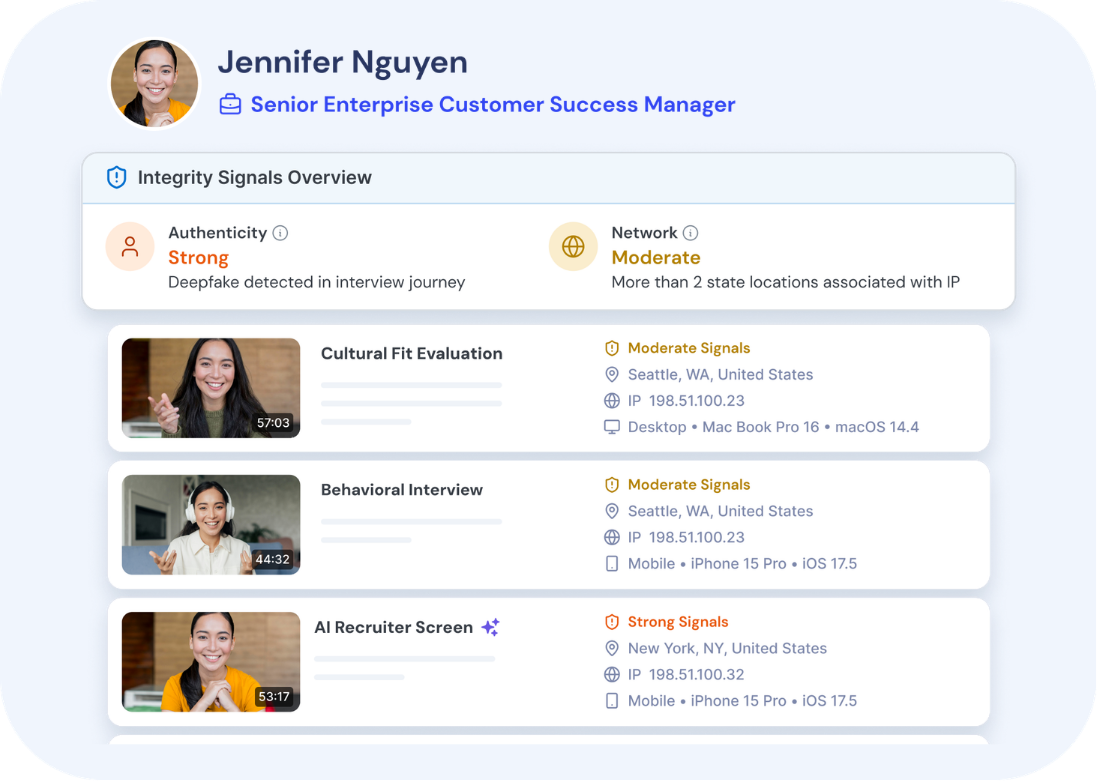
TL;DR: A fraudulent hire costs everything a bad hire does, plus a security exposure that grows with what the person could access. Use the calculator below to build a line-item estimate from your own salary bands and hiring costs. In an illustrative example at a $120,000 salary, the hiring cost alone comes to $62,500 before any security exposure is added. Compare your total with the annual cost of detection, and connect it to metrics talent acquisition (TA) already reports, such as time-to-fill. BrightHire’s candidate fraud detection analyzes each interview, and the new application review adds fraud checks to each application. Both flag risk signals for the hiring team to investigate, and humans make the final call.
An imposter who gets through the interview loop and accepts an offer becomes an employee with a fabricated identity and real access to your systems. This guide gives you a line-item model for what one fraudulent hire costs and a way to frame detection spend for Finance.
How candidate fraud differs from a bad hire
A bad hire is a real candidate who turns out to be wrong for the role, while a fraudulent hire was never the person they claimed to be, which changes the cost, the security exposure, and the response.
Three common patterns carry different costs:
- Synthetic identities can pass a background check, so the recruiting, onboarding, and salary spend is already gone when the deception comes to light.
- Proxy interviews leave behind scorecards and a debrief that describe a person who never actually interviewed.
- AI-assisted cheating means a candidate uses real-time AI tools to answer questions they couldn’t answer alone, so the panel evaluates skills the hire doesn’t have.
In Checkr’s Hiring Hoax 2026 survey of 3,000 U.S. managers involved in hiring, 40% said they had interviewed a candidate later found to be using a fake identity, up from 31% in 2025. Just 23% were extremely confident their hiring process would catch a fraudulent candidate.
Build your fraudulent hire cost estimate
The cost of a fraudulent hire splits into two parts: the hiring cost, which TA owns, and the security exposure, which Security owns. Presenting both gives Finance a risk case that spans two cost centers.
Fill in the line items
Each line is a cost Finance can trace to a budget category. The example column shows how the costs add up for a hypothetical $120,000 role. The figures are illustrative, so replace them with your own before you present.
| Cost category | Formula | Illustrative example at $120K salary |
|---|---|---|
| Recruiting spend | Job board fees + agency fees + recruiter hours × hourly rate | $8,000 |
| Interview hours | Panel hours × fully loaded hourly cost × number of rounds | $4,500 |
| Onboarding | IT provisioning + equipment + training hours | $3,500 |
| Salary paid | Gross salary for the employment period | $30,000 (three months) |
| Benefits | Employer share of benefits for the employment period | $4,500 (three months) |
| Equipment | Laptop, monitors, software licenses | $3,000 |
| Re-hire time | Recruiter hours + panel hours for the replacement search | $9,000 |
| Subtotal: hiring cost | – | $62,500 |
| Security exposure | Incident response + legal review + potential fines | Estimate from the role’s access and regulatory exposure |
| Total: fraudulent hire cost | – | $62,500 plus security exposure |
The example assumes three months of employment before discovery. Each additional month adds salary, benefits, and system access time, so use a longer window for remote roles or positions with little day-to-day oversight, and a shorter one where close supervision would surface the mismatch sooner.
Estimate the security exposure line
Security exposure depends on what the hire could gain access to. A role with no access to systems or data carries little, while a role with access to customer data, financial systems, or proprietary code can bring incident response costs, legal review, and regulatory penalties. Build this line from the role’s actual access profile, with input from your security team.
A standard bad hire uses the same line items without this one, so the security exposure estimate is the gap between the two, and that gap is the figure to bring to Finance.
Close gaps in the interview record
When a fraudulent hire comes to light, the interview record becomes evidence. If interviews weren’t documented, or scorecards were filled in from memory, TA has little to show for how the decision was made. Recorded, structured interviews capture what was asked and what the candidate answered.
Size the security and legal exposure
GetReal Security’s Deepfake Readiness Benchmark Report found that 41% of IT, cybersecurity, risk, and fraud leaders say their company has hired and onboarded a fraudulent candidate. The survey covered 668 leaders at organizations with at least 1,000 employees in September 2025.
Scope access-driven security exposure
Once hired, a fraudulent candidate with system credentials is an insider threat. On BrightHire’s candidate fraud panel, workplace investigator Meric Bloch described that exposure as IP theft, data loss, and even sanctions violations.
Factor sanctions and data-protection fines into the exposure line
Under the International Emergency Economic Powers Act, OFAC’s maximum civil penalty is $377,700 per violation or twice the value of the transaction, whichever is greater. OFAC can impose civil penalties on a strict liability basis, so an employer can be liable even if it didn’t know the person was sanctioned. That risk is concrete in hiring: in March 2026, OFAC sanctioned facilitators of North Korean IT worker schemes that defraud U.S. businesses.
If a fraudulent hire turns out to be tied to a sanctioned party, that penalty can land on top of the hiring cost. If the hire accessed personal data covered by the General Data Protection Regulation (GDPR) or the California Consumer Privacy Act (CCPA), data protection penalties can apply as well.
Make the case for detection spend
Early detection as cost avoidance. The calculator gives you the cost of one fraudulent hire, and vendor quotes at your interview volume give you the annual cost of detection. If one avoided hire costs more than a year of detection, the spend pays for itself, even if fraud is rare at your company.
Tie the cost to metrics TA already reports
A fraudulent hire discovered after the offer reopens the req, and time-to-fill for that role starts again. Adding that delay to the cost estimate links fraud to a number TA already tracks.
How BrightHire detects fraud across the hiring process
BrightHire flags fraud signals at three stages: applications, AI screening interviews, and live interviews. In interviews, its candidate fraud detection analyzes three signal categories: deepfake detection, network risk, and interview behavior, including answers that match the characteristics of AI-generated responses. Risk signals reach the hiring team after the call and before the candidate advances. Every flag carries a severity rating and the evidence behind it, and flagged moments link back to the point in the interview that triggered them.
Bloch also warned against letting software make the call:
“You do not want to have the technology be the verdict on rejecting the candidate.” – Meric Bloch, Professor at Fordham University School of Law and Principal at Winter Investigations
BrightHire works the same way. AI surfaces signals for human review, but humans make the final call.
Application review
Fraud detection starts before anyone gets on a call. BrightHire’s application review checks every application against criteria your team approves, and flags likely fraud and spam at the first stage of the process. Each flag shows the signals behind it, including phone and email reputation, and recruiters can filter applicants by level of fraud risk. As with interview signals, the tool never advances or rejects a candidate on its own. Recruiters decide who moves forward, and decisions sync back to Greenhouse, Ashby, or Workday.
Screening interviews
BrightHire Screen, BrightHire’s AI interviewer, has a robust signal set because BrightHire powers the session from start to finish. Candidates complete a structured voice interview on their own schedule, and any risk flags arrive with the interview results. Candidates rated BrightHire Screen 4.8 out of 5 at Angi and 4.4 out of 5 at Overjet.
Live interviews
For live interviews, signal depth depends on the video platform:
| Platform | Signals |
|---|---|
| Zoom | A proprietary deepfake model plus session metadata, available only to Zoom customers with a BrightHire subscription |
| Microsoft Teams | Deepfake detection plus IP-derived geolocation and VPN signals |
| Google Meet | Deepfake detection today, with more signals planned as Google exposes additional session data |
Ben Sesser, co-founder and CEO of BrightHire, described what prompted the work in an interview with Biometric Update: “Our customers have told us that candidate fraud is one of the biggest challenges they’re facing today, and it’s been increasingly hard to catch.”
Keep the evidence on the candidate record
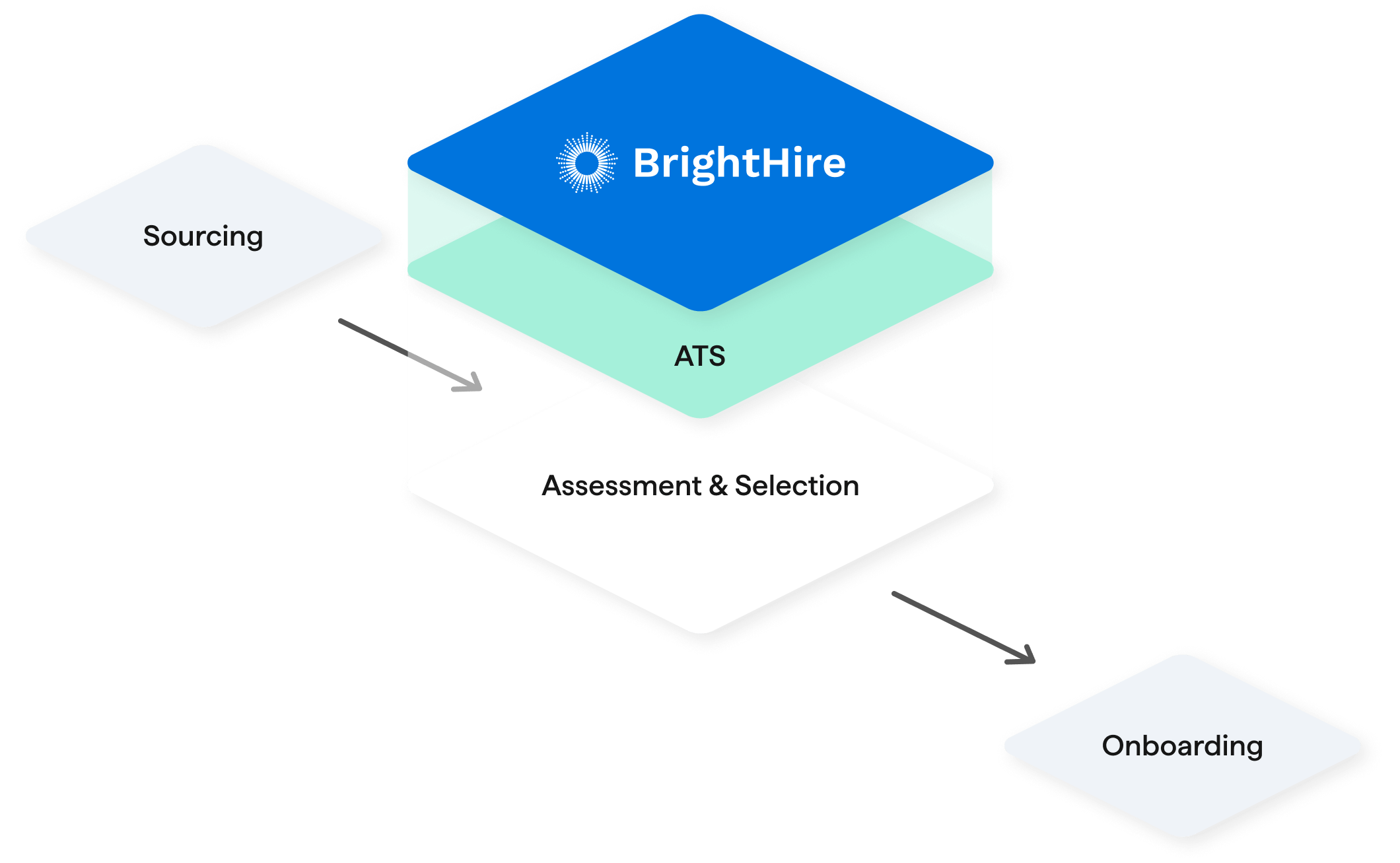
BrightHire’s ATS integrations with Greenhouse, Lever, Ashby, Workday, and more put the interview recording, notes, and scorecard on the candidate record, so recruiters can review the evidence without logging into a separate system.
Request a demo to see how BrightHire’s fraud detection works across your own applications and interviews.
FAQs
Roles that combine remote work with access to sensitive systems or data. A proxy interview is easier to run when the panel never meets the candidate in person, and the hire’s access sets the size of the security cost.
Yes. BrightHire connects to 18 ATS platforms and more than 30 integrations overall, all listed in its integration directory.
Often longer than employers think. In Checkr’s 2026 survey, 38% of managers suspected a fraudulent employee was already working at their company undetected. Catching signals at the application or interview stage stops the cost model above before salary and system access start adding up.
Key terms glossary
Synthetic identity: An identity built from a mix of real and fabricated information.
Proxy interview: An interview completed by someone other than the named candidate.
Deepfake: Synthetic media created with AI to manipulate video or audio. In hiring, deepfakes are used to impersonate a candidate during a video interview.
Strict liability: Legal liability that applies regardless of intent or knowledge.