






Updated October 27, 2026
TL;DR: Spark Hire’s core product is the one-way video interview, where candidates record answers to set prompts without a scheduled call. Enterprise TA teams comparing Spark Hire alternatives usually weigh two categories: conversational AI interviewers for early-round screening interviews, and interview intelligence for the live interviews that follow. ATS sync depth, compliance credentials, and interviewer adoption matter more than feature count. BrightHire offers both, with BrightHire Screen as its AI interviewer and interview intelligence that pushes AI-generated scorecards into Greenhouse, Lever, Ashby, Workday, and more.
One-way video interviews took scheduling out of the first round, but candidates still answer fixed prompts with no follow-up, and the live interviews later in the process run without the same structure.
This guide compares the two categories of Spark Hire alternatives, the criteria to evaluate them on, and how to run a pilot.
Where one-way video falls short for enterprise teams
The trade-offs of the one-way format show up for candidates, hiring managers, and the teams responsible for compliance.
Offer candidates a two-way interview
In a one-way interview, the candidate sets up a camera and answers prompts with no one responding. A conversational AI interviewer asks follow-up questions in real time, and the candidate still chooses when to take it. Candidates rate BrightHire Screen, BrightHire’s AI interviewer, 4.5 out of 5 on average at scale.
Give hiring managers comparable evidence
A stack of recordings asks the hiring manager to watch and compare each one, which takes time and leaves the comparison to their own judgment. When the scorecard fills from a structured interview, the debrief starts from scored evidence for every candidate. In a study across more than 25,000 candidates, BrightHire customers ran 27% fewer interviews per hire, because structured evidence earlier in the process means fewer rounds are needed to reach a decision.
Close the compliance and fraud gaps in live interviews
A one-way recording gives reviewers a record of the screening stage. The live interviews that follow often have no equivalent. Off-script questions, inconsistent consent workflows, and missing audit trails at the live-interview stage create compliance exposure, and that exposure grows with interview volume.
Undocumented live interviews also leave room for imposters. In Checkr’s Hiring Hoax 2026 survey of 3,000 U.S. managers involved in hiring, 40% said they had interviewed a candidate later found to be using a fake identity. An imposter who gets through the process becomes a hire with access to your systems, data, and internal infrastructure.
BrightHire’s candidate fraud detection analyzes those live interviews and surfaces risk signals for the hiring team to review.
What to look for in an interview platform
Start the evaluation with two questions: whether the tool produces interview evidence that syncs to the ATS, and whether interviewers keep using it.
Ask exactly what syncs to your ATS
Bidirectional sync means interview guides pull from the ATS before the call and completed scorecards push back to the candidate record when the call ends. Recruiters then review interview evidence in Greenhouse, Lever, Workday, or Ashby, and more, without logging into a separate system.
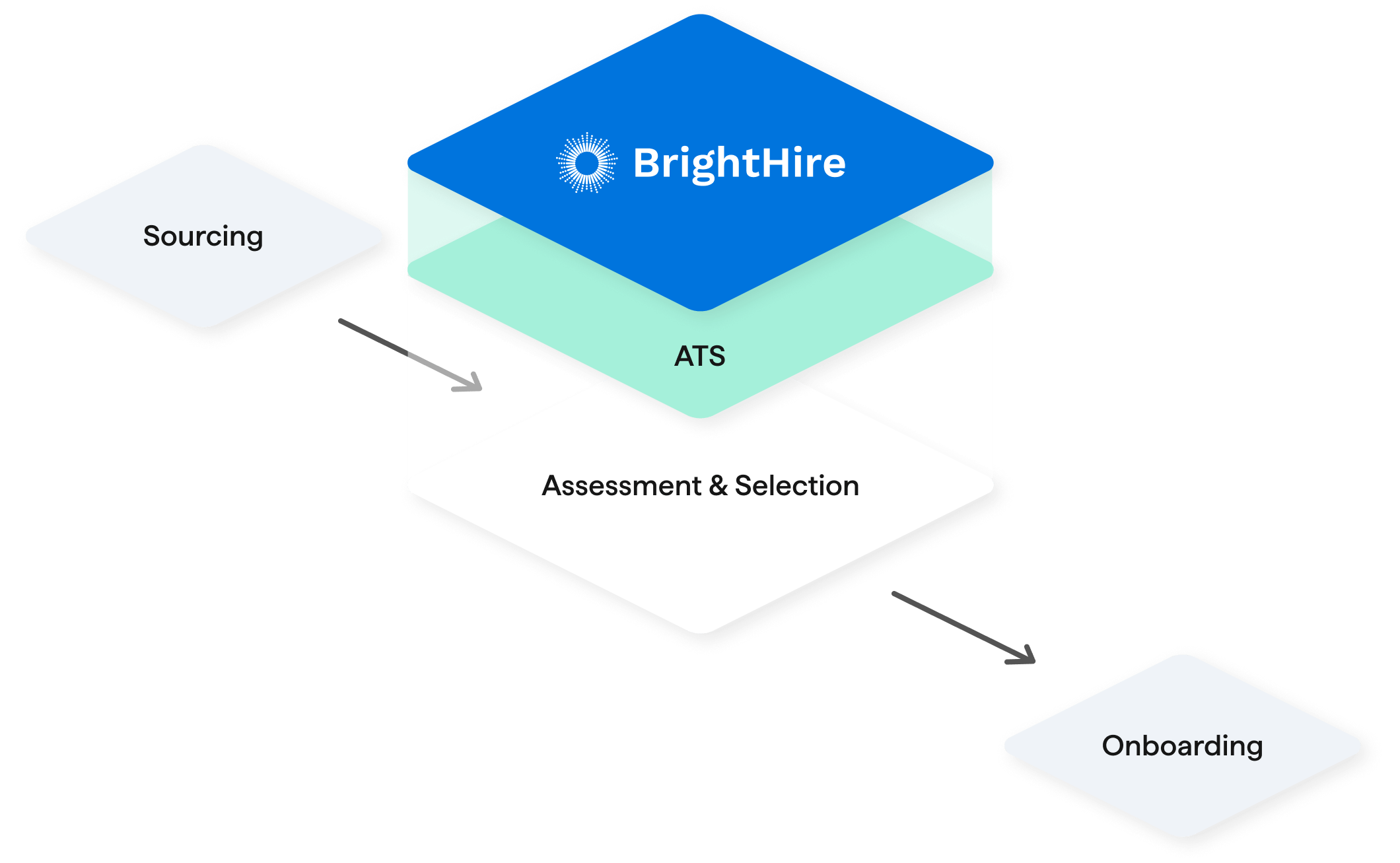
BrightHire’s integrations support one-click scorecard completion, highlights that play directly in the ATS, and synced roles and permissions across 18 ATS platforms, including Greenhouse, Lever, Ashby, and Workday. Ask every vendor which fields sync, in which direction, and at what trigger.
Drive adoption by removing interviewer work
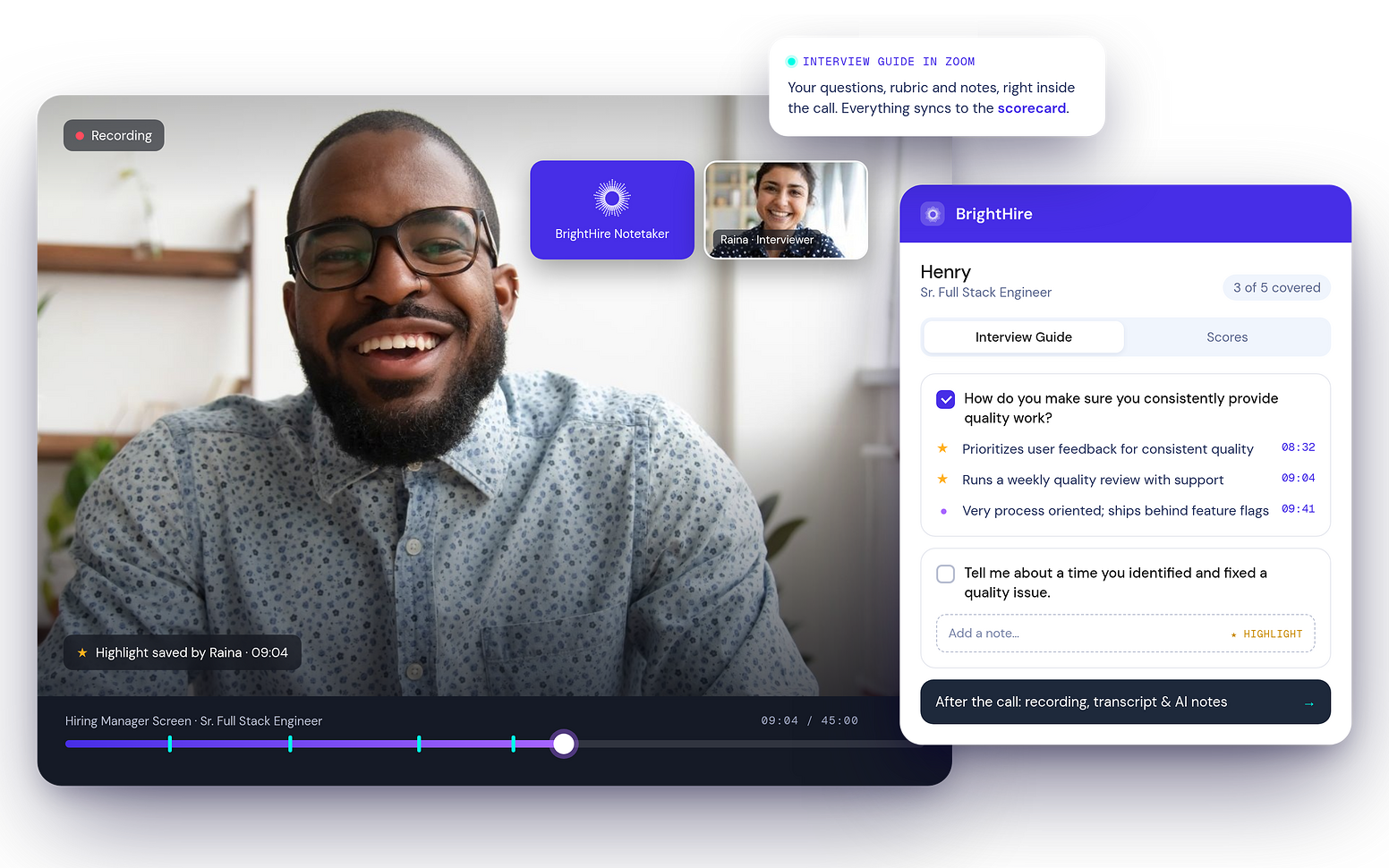
A mandate from TA leadership may not hold up with a busy engineering panel, so adoption depends on whether the tool saves interviewers time. BrightHire syncs with your recruiting calendar and ATS, so it knows which meetings are interviews and joins them without the interviewer doing anything. Interviewers can then stay focused on the candidate while BrightHire takes notes, as shown in BrightHire’s guide to interview notes for Zoom.
Reduce bias with structured interviews
When every candidate for a role answers the same competency-based questions and is scored against the same rubric, there’s less room for bias to enter the decision. AI surfaces signals for human review, but humans make the final call. BrightHire’s scores are based only on the inputs and criteria your team defines, as set out in its approach to AI in hiring.
Start the debrief from shared evidence
AI-generated notes, highlight clips mapped to competencies, and pre-filled scorecards give every interviewer the same starting point for the debrief. The interviewer reviews and adjusts the pre-filled scorecard instead of writing feedback from a blank form after the call. Interviewers using BrightHire submit feedback 28% faster with AI scorecard auto-fill, according to BrightHire’s platform data, which makes a feedback SLA easier to hold.
“Brighthire has been a great partner for us because it takes care of many of the legal and compliance considerations around privacy, as well as video and transcription storage. It’s also been invaluable for our interviewers, helping them submit scorecards faster and provide more thoughtful, insightful feedback.” – Magen C. on G2
Run early-round screening interviews with BrightHire Screen
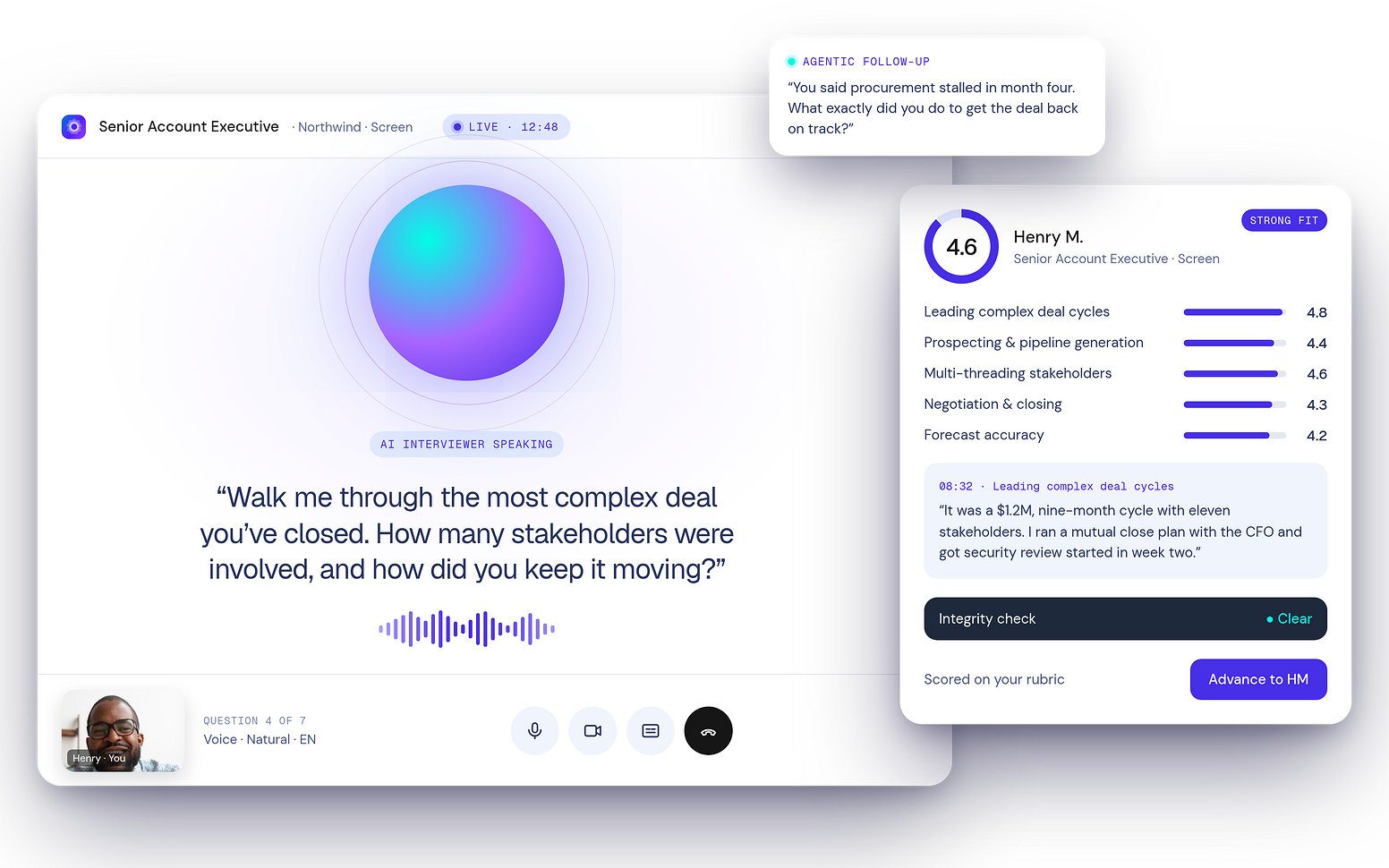
BrightHire Screen runs early-round screening interviews without a recruiter on the call. Candidates receive an email and complete a structured two-way voice interview on their own schedule.
Take recruiter phone screens off the calendar
30-minute phone screens across 50 candidates for one req take 25 hours of recruiter time before any notes are written up. BrightHire Screen asks the questions, scores each answer against your rubric, and returns a scored summary for the recruiter to review, as covered in BrightHire’s AI video interview overview.
BrightHire Screen saved Overjet 17+ recruiter hours
Overjet’s recruiting function faced a capacity gap during a leadership change and couldn’t slow hiring. In Q4 2025, BrightHire Screen supported two of Overjet’s four Solutions Engineer hires and saved more than 17 hours of recruiting time, according to Overjet’s customer story.
Send every result to the candidate record
Every BrightHire Screen result includes a score, summary, rubric comparison, and full recording, and all of it lands on the candidate record in your ATS automatically. The AI interviewer playbook covers how teams already running AI screening interviews at scale set them up.
How Spark Hire alternatives compare
The table compares one-way video with BrightHire’s two products, from the first round through the live interviews.
| Format | Candidate experience | Output |
|---|---|---|
| One-way video interview | Candidate records answers to set prompts, with no follow-up questions | Video recordings for reviewers |
| BrightHire Screen | Two-way voice interview with follow-up questions | Scored summary and recording |
| BrightHire interview intelligence | Live interview with an interviewer guide on screen | AI notes, highlights, and pre-filled scorecards |
Where one-way interviews still fit
One-way video still suits a fast first-stage check of verbal communication across a large pool when no structured comparison is required. When early-round screening interviews need comparable scores and ATS-synced results, BrightHire Screen keeps on-demand access for candidates and adds a two-way conversation scored against your competencies.
Add structure to live interviews
Hiring decisions rest on the live interviews after the first round. Interview intelligence captures, structures, and analyzes those conversations.
Have every interviewer follow the same guide
Without a live interview guide, interviewers run their own version of the process, and the debrief becomes a negotiation between different standards rather than a decision grounded in shared criteria. BrightHire shows the interview guide during the call, so interviewers stay on the agreed questions without opening a separate document. Angi’s engineering team didn’t have enough interviewers to move candidates through the process on time, so it used BrightHire to train interviewers and give them evidence for hiring decisions, and increased overall engineering hiring by 300%.
Use interview analytics to coach interviewers
BrightHire Insights gives TA leaders per-interviewer performance reports, competency coverage reports, and flags on high-risk questions, which show where the interview process breaks down and which interviewers need coaching.
“Interview Insights gives me a powerful bird’s-eye view for executive conversations and highlighting trends, while also letting me zoom in on specific areas for improvement.” – Tracy St. Dic, VP, Global Talent and Sponsor of HR at Zapier
Build your shortlist and pilot plan
Use these steps to build a shortlist you can take to Finance or IT, with each step tied to a metric TA already reports.
Map your current hiring bottlenecks
Find where your funnel stalls before you evaluate tools, because the bottleneck decides which capability matters most.
| Bottleneck | Capability to prioritize |
|---|---|
| Scheduling delays | On-demand screening interviews with no calendar coordination |
| Slow scorecard submission | AI scorecard auto-fill |
| Inconsistent debriefs | Structured interview guides and shared interview evidence |
| Recruiter time spent on phone screens | A conversational AI interviewer |
Test the ATS sync on a candidate record
Put the three sync questions to each vendor, then ask to see the sync run on a test candidate in your own ATS, whether that’s Greenhouse, Workday, Ashby, or another system. A vendor that can’t give field-level answers may only offer an export.
Pilot on your highest-volume roles
Start with the roles that carry the most screening interview volume, where time savings and completion rates are easiest to measure. Track candidate completion rate, recruiter hours saved, scorecard submission rate, and time-to-fill for the pilot group against your current baseline.
Build the ROI case for approval
Turn the pilot results into the business case by converting recruiter hours saved into cost at your loaded hourly rate. BrightHire is rated 4.7 out of 5 on G2 across 182 verified reviews, with customer support rated 9.8 out of 10.
Request a demo to see BrightHire Screen run an early-round interview and what its results look like on a candidate record.
FAQs
The difference is follow-up. A one-way format captures the first answer to each prompt, while a conversational AI interviewer can probe an answer that needs more detail before scoring it against your rubric.
Yes, for early-round screening interviews. Recruiters review each score, summary, and recording and decide who moves forward.
Verify SOC 2 Type II certification (an independent audit of a vendor’s security controls over time), GDPR and CCPA compliance (the EU and California data-privacy laws governing candidate data), candidate consent workflows, annual third-party bias audits, and data retention policies. BrightHire’s compliance documentation covers each of these, along with a Zero Data Retention partner and a policy of not using customer data to train AI models.
Most teams are fully operational on BrightHire in under one day. Teams can start in ATS-less mode with a shareable interview link and add full ATS integration when they’re ready.
Key terms glossary
One-way video interview: A screening interview format where candidates record answers to pre-set questions without an interviewer present.
Conversational AI interviewer: Software that runs a structured, two-way screening interview, asks follow-up questions, and returns a scored summary for human review.
Interview intelligence: Software that captures interviews, structures the evidence into notes and scorecards, and surfaces insights for interviewer coaching and process improvement.