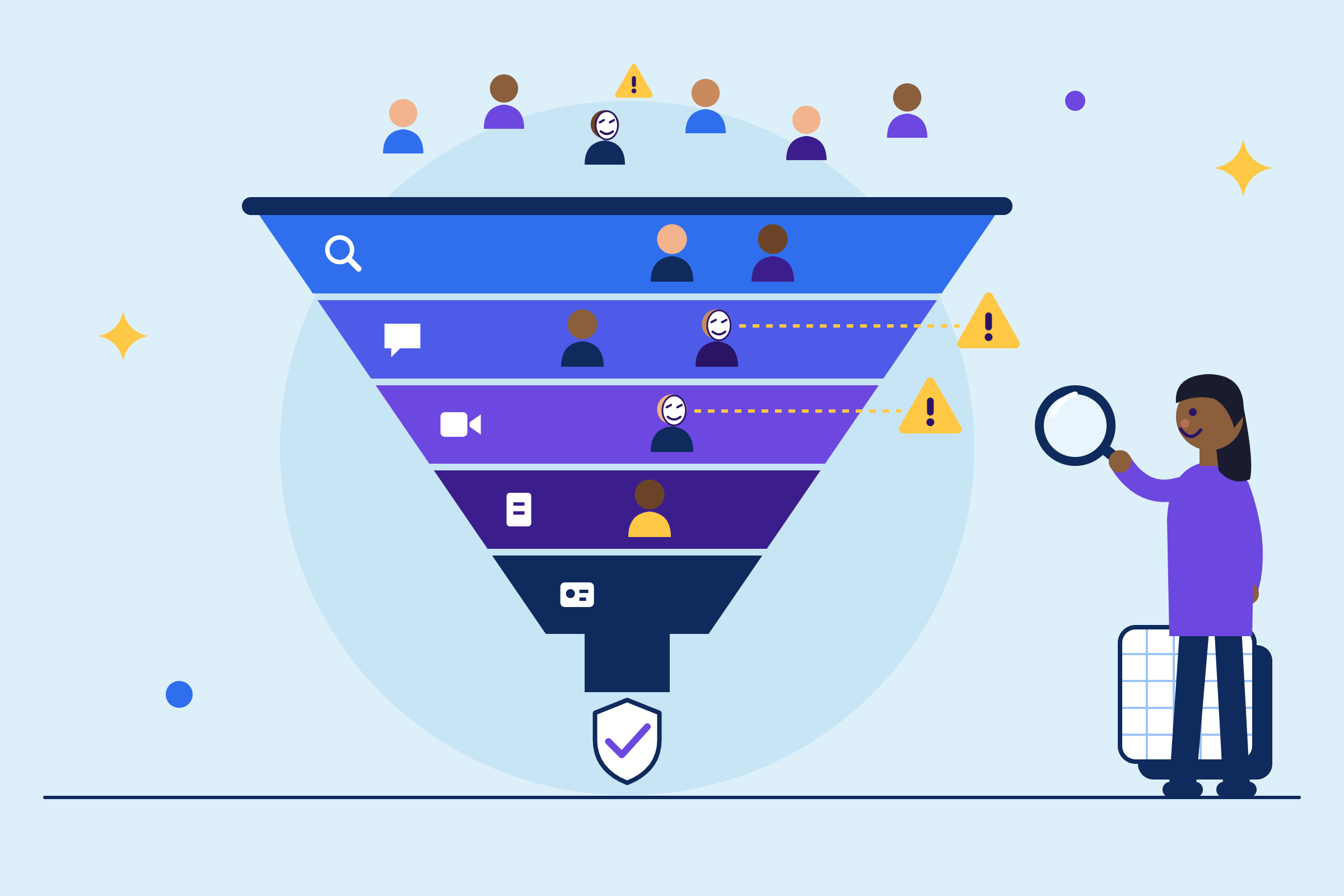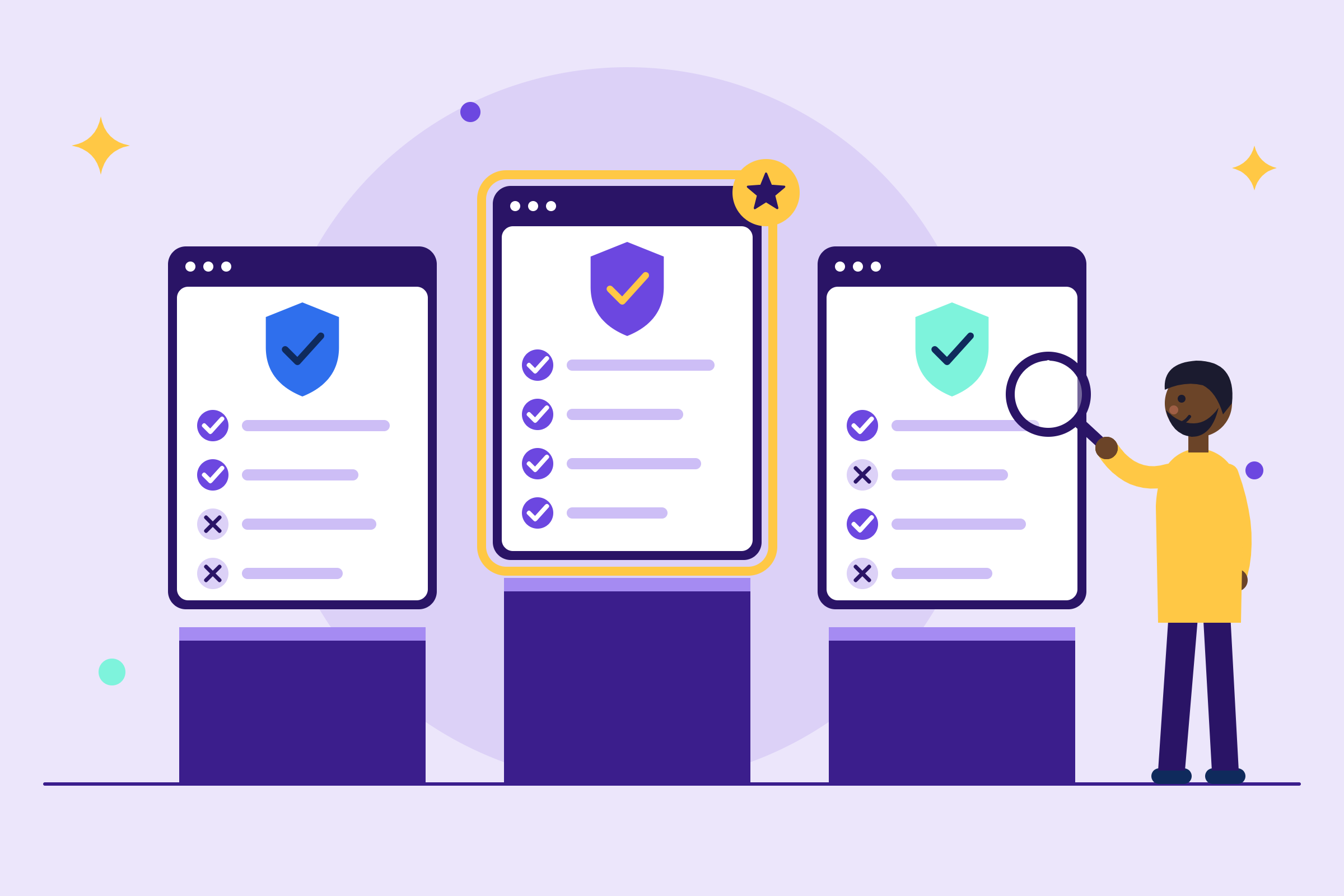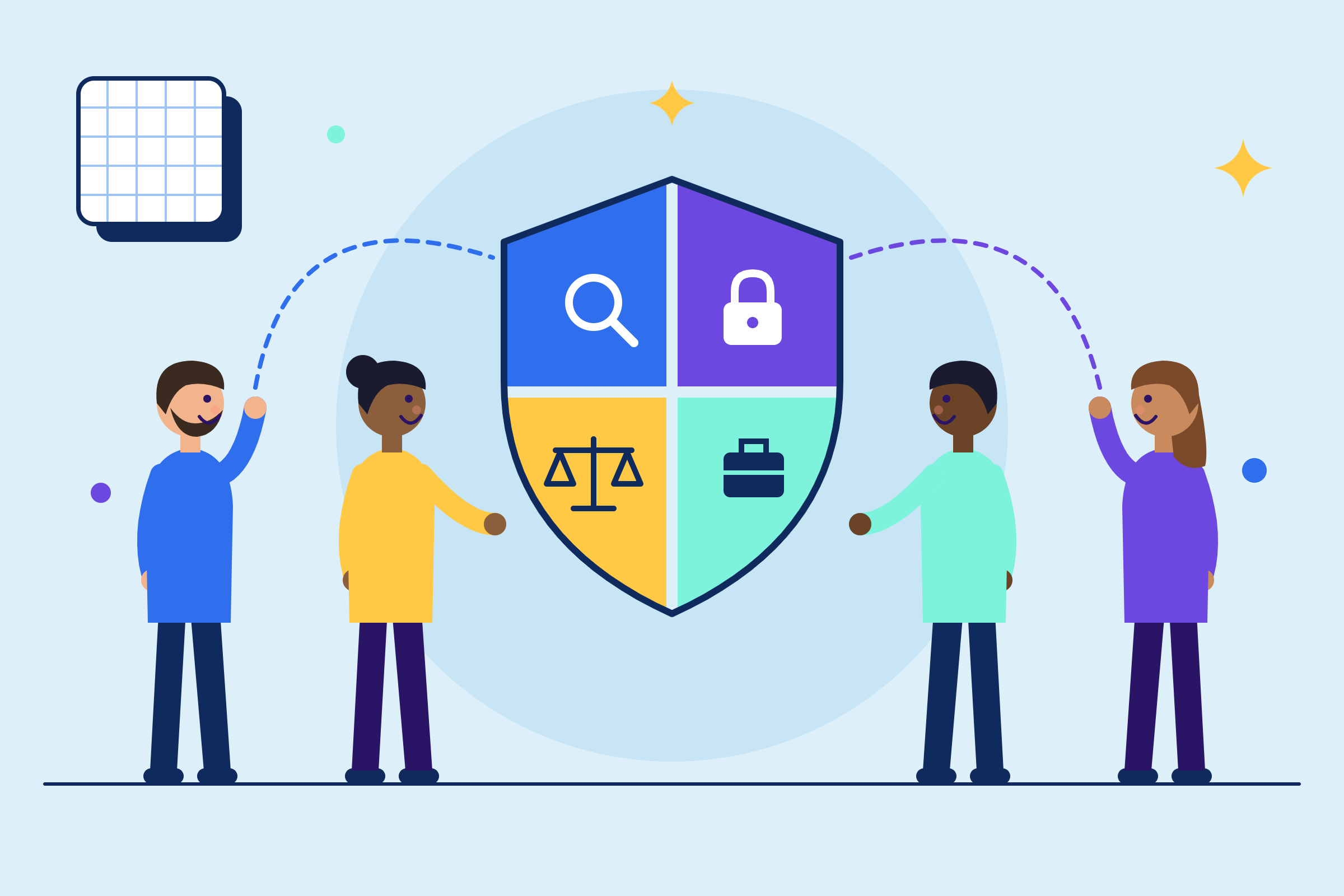





TL;DR: AI and human interviewers are strongest at different parts of the process. AI gathers consistent signal at volume, asking every candidate the same questions, scoring them against the same rubric, and documenting the answers the same way every time. Humans review that signal, decide who advances, and run the interviews that follow. For high-volume hiring, that means AI conducts the first-round screening interview and people handle every judgment call from there. The data below comes from I-O psychology research and third-party platform benchmarks.
The AI interview vs human interview debate often centers on which one produces better signal. The research points somewhere else: what makes an interview predictive is structure, not who runs it. Structured human interviews are meaningfully more predictive of job performance than unstructured ones, according to Schmidt and Hunter’s meta-analysis. And AI screeners match human scores 60 to 90% of the time when they’re calibrated against a structured rubric, per Fabric’s analysis of 19,000 interviews. Structure is the variable in both cases.
So the question isn’t AI or humans. It’s which parts of the process each should own, and how to keep both structured.
This piece compares AI and human interviews across consistency, bias, candidate experience, and time to hire, citing research and platform data throughout. It ends with a framework for when to use which. If you’re weighing two AI formats against each other rather than AI against humans, BrightHire covers that separately in the conversational AI vs one-way video comparison.
| Dimension | AI interviewer | Human interviewer |
| Consistency | Same rubric every candidate, no fatigue drift | Ratings vary by interviewer |
| Decision bias | Auditable at system level, can inherit training-data bias | Affinity and halo effects, hard to measure |
| Candidate experience | 70 to 85% completion, on-demand scheduling | Lower completion, scheduling friction |
| Best use case | High-volume first-round screening interviews | Judgment-heavy evaluation, culture fit, closing |
| Where it’s strongest | First-round screening interviews where criteria are objective and volume is high | Later-stage rounds where context, rapport, and judgment determine the outcome |
What the research shows: AI vs human interviewer performance
A century of I-O psychology research tells us what makes interviews predictive. A growing body of platform data tells us how AI performs against that standard. The findings below draw on both.
Measuring AI interview effectiveness
The most useful measure of AI interview effectiveness is how closely it tracks calibrated human judgment at scale. Fabric’s analysis of 19,000 interviews puts AI-to-human score alignment at 60 to 90% when calibrated against a structured rubric, and their writeup of Meesho’s direct comparison found 80% alignment in practice. The spread isn’t explained by AI capability, it’s explained by rubric quality. Strong rubrics with clear behavioral anchors sit at the top of the range. Weak or ambiguous rubrics compress it.
That finding has a practical implication. The question isn’t whether to trust AI or human judgment at the first-round screening interview. It’s whether the rubric both are scoring against is strong enough to make either reliable. Teams that invest in rubric calibration before deploying AI screening get alignment rates in the upper half of that range. Teams that don’t get the same variability they’d get from an undertrained human panel.
Accelerating time to fill with AI
The time gap is the most measurable difference. AI screening interviews complete in a median 3.2 hours from invitation, with 60% finishing within six hours, per Outhire’s 2025-2026 platform data. Human phone screening interviews take two to five business days once scheduling back-and-forth is factored in. Per-interview duration compounds the difference further: AI screening interviews average 12 minutes versus 45 minutes for a traditional screening interview, per Ntrvsta’s efficiency benchmarks. At scale, that gap converts to recruiter capacity. The 436 hours Classet documents one team recovering in 2.5 months shifted to sourcing, stakeholder alignment, and the later-stage conversations that still need humans.
At 12 minutes per AI screening interview versus 45 minutes per human screening interview, the arithmetic compounds fast across a full req load. The 436 recruiter hours Classet documents one team recovering in 2.5 months did not disappear into overhead. They shifted to sourcing, stakeholder alignment, and the later-stage conversations that still need humans.
Do AI interviews affect abandonment?
AI screening interviews generally complete at higher rates than human screening interviews, because scheduling dependency introduces drop-off at every rescheduling touchpoint before the interview even begins. The blended completion rate for AI screening interviews is 70 to 85%, per Outhire’s benchmarks, but format drives most of the variance: phone-based conversational screening interviews reach above 95% in some implementations, while video-format AI screening interviews typically land between 40 and 60%. Fabric puts the broader video interview industry average at 60 to 70% and cites its own 90% as an above-average result within that format. Format choice matters more than the AI versus human question when completion is the priority. The more important finding from Greenhouse’s 2026 candidate AI interview report is what drives abandonment: pre-recorded video scored by AI with no human present (33%), undisclosed AI use (27%), and AI monitoring (26%). Candidates don’t abandon AI. They abandon opacity.
The caveat matters. Greenhouse’s 2026 candidate AI interview report found the top abandonment triggers are pre-recorded video scored by AI with no human present (33%), undisclosed AI use (27%), and AI monitoring (26%). Candidates don’t abandon AI. They abandon opacity.
Predicting hire success and retention
Structure is the variable that predicts hiring outcomes, not interview format. Structured interviews, where every candidate answers the same rubric-mapped questions scored against behavioral anchors, rank joint top among 19 selection methods for predicting job performance, roughly double the predictive power of unstructured interviews. A meta-analysis of 111 inter-rater reliability coefficients puts the validity ceiling for highly structured interviews at nearly twice that of unstructured ones. The practical implication for AI screening is direct: an AI screening interview built on a structured, rubric-mapped question set operates inside the format the research validates. An AI screening interview without one is an unstructured interview with extra steps, and the predictive validity data treats it accordingly.
Where AI screening interviews hold a structural advantage
AI is strongest where volume, repetition, and consistency demand the most: processing a high-volume req load against a shared rubric, at speed, without drift.
AI screening interviews for high-volume roles
A recruiter running six to eight screening calls a day handles roughly 40 candidates a week, while an AI platform processes that volume in hours, per Fabric’s analysis. Candidate exposure reflects the shift: 63% of US candidates experienced an AI-conducted interview in the past year, up 12 points from six months earlier.
Evaluating AI and human interview quality
AI’s structural advantage is that it applies the same criteria to every candidate. Human interviewers are susceptible to affinity bias, halo effects, and fatigue-driven inconsistency, and structured AI scoring removes those specific distortions. The AI interviewer vs human interviewer comparison on quality is really a comparison between a rubric applied uniformly and a rubric applied variably.
Assessing culture fit: human vs AI data
Culture fit is where the comparison inverts. AI tools today can’t read the relational and contextual signals that experienced interviewers pick up: how a candidate handles ambiguity, whether their working style fits a specific manager, what they are like when the script runs out. The practitioner consensus, per Fabric’s analysis, is that AI replaces the first-round screening interview while final rounds and culture-fit conversations still need humans.
How AI and human recruiters compare on equity
Both approaches carry bias risk. They differ in where the bias lives and whether you can measure it.
How human bias impacts hiring
Human bias is distributed, undocumented, and nearly impossible to audit retroactively. Affinity bias and halo effects operate at the individual interviewer level, and without recorded, structured evidence there’s no systematic way to detect them. US candidates report nearly identical perceived bias rates from AI and human interviewers in Greenhouse’s 2026 candidate data: 36% flagged age bias for both, and 27% flagged race or ethnicity bias for both.
Comparing AI and human bias patterns
AI’s risk is concentrated and inherited. Systems trained on historical hiring data can replicate biased patterns in those past decisions. The counterweight is auditability: teams can measure, monitor, and correct AI bias at the system level rather than interviewer by interviewer.
Ensuring defensible hiring records
Regulation is settling this question operationally. NYC Local Law 144 requires an independent annual bias audit, published results, and 10 business days’ candidate notice for automated screening tools, with fines of $375 to $1,500 per violation.
Audits apply the Equal Employment Opportunity Commission (EEOC) four-fifths rule, flagging impact ratios below 0.80 as potential adverse impact. Federal EEOC guidance puts responsibility on the employer, even when a vendor administers the tool. An undocumented human process can’t produce an audit trail, but a structured AI process can, which is why BrightHire treats consent workflows and audit trails as defaults in the compliance infrastructure, not add-ons.
Candidate experience benchmarks for AI and human screening interviews
How AI interviews impact candidate sentiment
Candidates report neutral to positive experiences when the process is clear, relevant, and respectful of their time, and they report the same frustrations with human-led processes when those are confusing or disrespectful. BrightHire Screen earns a 4.5 out of 5 candidate rating at scale, and the company has documented a 19% reduction in candidate drop-offs associated with it.
Scheduling speed and candidate choice
Scheduling friction compounds across every stage: each reschedule extends the time-to-fill clock and adds administrative load that compounds across a full pipeline. AI screening interviews let candidates complete on their own schedule, which is why phone-based AI screening interviews hit completion rates above 95% in some implementations.
How AI vs human interviews impact anxiety
Candidate survey data shows that disclosure drives comfort: candidates told upfront how AI will be used complete at higher rates, while undisclosed AI use ranks among the top three abandonment triggers in Greenhouse’s candidate data. Some candidates will always prefer human interaction, and a well-designed process gives them a path to one.
Do AI screening interviews hurt your brand?
It can, when implemented as a barrier rather than a choice. The brand damage cases share a pattern: static scripts, no disclosure, no human escalation path. Implemented transparently, AI screening interviews are associated with better brand outcomes, not worse, because candidates get faster responses and more consistent treatment. BrightHire’s customer outcomes data shows teams pairing AI screening with structured human follow-up see candidate experience improve alongside speed.
Where human interviewers are strongest
Where human judgment adds the most value
Experienced interviewers bring contextual judgment that operates beyond the rubric: reading how a candidate handles ambiguity, recognising a career pivot as a signal of adaptability, or advocating for an unconventional background that a hiring manager would value once they understand the full picture. That judgment is most valuable at the stages where the decision is most consequential: hiring manager rounds, final-stage evaluation, and closing conversations with candidates weighing multiple offers.
Where human rapport creates the strongest signal
Humans are stronger at rapport, stress detection, and real-time adjustment, and the difference is measurable. Curtin University research found a meaningfully higher sense of connection in human-moderated interviews than in AI-moderated ones, even as both conditions scored similarly on trustworthiness and willingness to disclose. That’s a genuine human strength. The inverse framing from Fabric’s analysis is equally instructive: AI maintains consistent pacing, applies criteria without fatigue, and doesn’t favor candidates with similar backgrounds regardless of volume. Both reflect real strengths, they just apply at different stages.
Where AI interviews miss key signals
| Signal | AI screen | Human interview |
| Rubric-mapped competencies | Consistent, documented | Variable by interviewer |
| Contextual career narrative | Limited | Captures |
| Rapport and trust building | Moderate | Stronger (Curtin University: human-moderated interviews score meaningfully higher on connection) |
| Unconventional backgrounds | Scores against rubric only | Can advocate for outlier candidates |
| Fatigue-resistant consistency | Strong | Degrades under volume |
AI’s structural advantage at volume is consistency: the same rubric, the same pacing, and the same documentation quality on the hundredth screen as on the first.
Maintaining consistency across a distributed panel
Across a distributed panel, different interviewers naturally apply the same rubric differently, which makes debrief comparisons harder unless every evaluator is calibrated to the same criteria. This is the problem BrightHire’s interview intelligence platform addresses for live interviews: structured plans, in-interview guidance, and per-interviewer analytics that surface drift before it distorts decisions.
Why real-time documentation strengthens debrief quality
Scorecards submitted closest to the interview reflect the sharpest evidence. The longer the gap between interview and evaluation, the more the feedback reflects recall rather than what the candidate actually said. Rescheduling delays compound this, and when a significant portion of screening interviews slip, the gap between interview and evaluation widens. Teams using BrightHire’s platform submit interviewer feedback 28% faster because AI-generated notes and pre-filled scorecards remove the memory step.
Scaling interview volume without quality loss
AI screening interviews maintain the same quality on the hundredth screening interview as on the first, which is where its consistency advantage compounds across a full req load. That’s the core economic argument for the hybrid model, and it holds regardless of role type. Structured, evidence-based screening is hardest to maintain manually at exactly the moments when volume and candidate diversity are highest.
Decision framework: when to use AI vs human interviewers
| Scenario | Recommended approach | Why |
| High-volume first-round screening interviews (50+ applicants per req) | AI-led | Consistency and speed where human fatigue is worst |
| Judgment-heavy evaluation, senior hires | Human-led with structured capture | Contextual reading and rapport matter most |
| Culture fit and final rounds | Human-led | AI cannot assess relational signal reliably |
| Rubric edge cases and outlier candidates | Human review | Catches candidates the scoring model undersold |
| Regulated industries, audit requirements | Structured process with documentation | Defensibility requires evidence at every stage |
Optimizing AI for high-volume screening interviews
Deploy AI where the evaluation criteria are objective and the volume is high: first-round screening interviews for roles with clear competency rubrics. Invest in rubric calibration upfront, because the 60 to 90% alignment range depends on it. Disclose AI use to candidates before the interview.
When to prioritize human interviews
Humans make every advance decision. Keep human-led interviews at the stages where the evaluation depends most on context: hiring manager rounds, culture assessment, executive evaluation, and closing conversations with candidates weighing multiple offers. Structure those interviews so the human judgment they produce is documented and comparable.
When to integrate AI and human input
The hybrid default: AI screens every applicant against the rubric and flags edge cases. A human reviews the results and makes every advance decision. Every downstream human interview runs with structured capture so the debrief works from evidence.
Conversational AI vs one-way video: a comparison
Not all AI interviews are equal, and the format choice changes candidate outcomes. One-way video, where candidates record answers to static prompts, sits behind the worst abandonment numbers in Greenhouse’s candidate data, with pre-recorded AI-scored video named as the top abandonment trigger at 33%. Conversational AI runs a structured two-way dialogue, which is why phone-based conversational screening interviews reach completion rates above 95% while video formats typically land between 40 and 60%.
How BrightHire operationalizes the hybrid model
BrightHire Screen uses a structured two-way voice interview format, which is how it sustains a 4.5 out of 5 candidate rating rather than the drop-off static formats produce. The company breaks down the format-level evidence in the conversational AI vs one-way video comparison.
Building the business case for a hybrid model? Request a demo to see how BrightHire Screen and Interview Intelligence fit your hiring workflow, and what an AI-conducted screening interview looks like from the candidate’s side.
Frequently asked questions (FAQs)
Calibrated AI matches human scores 60 to 90% of the time, per Fabric’s 19,000-interview analysis, while inter-rater reliability research confirms that human interviewers rating the same candidate produce meaningfully different scores depending on who runs the screening interview. Accuracy depends on rubric quality, not interviewer type.
Completion data favors AI, but the range depends on format. Phone-based conversational screening interviews reach above 95%. Video-format AI screening interviews typically land between 40 and 60%. The 70 to 85% figure from Outhire’s platform benchmarks reflects a blended average across formats. Fabric documents the video interview industry average at 60 to 70%, against which its own 90% completion rate is measured. Human screening interview completion sits below all of these, with scheduling friction as the primary drop-off driver.
Teams can audit and correct AI bias at the system level, while human bias is distributed and hard to measure. AI trained on biased historical data can reproduce that bias, which is why NYC Local Law 144 mandates annual independent bias audits.
High-volume roles with objective, rubric-mappable criteria: sales development, customer support, early-career engineering screening interviews. Senior, judgment-heavy, and culture-dependent hires still need human-led structured interviews.
Key terms glossary
Structured interview: An interview where every candidate answers the same rubric-mapped questions scored against behavioral anchors. Meta-analytic validity reaches r=.51, roughly double unstructured formats.
Inter-rater reliability: The degree to which two interviewers scoring the same candidate agree. Human variance is measurable in screening contexts.
Impact ratio: The selection rate for a protected group divided by the rate for the highest-selected group. Ratios below 0.80 flag potential adverse impact under the EEOC’s four-fifths rule.
Bias audit: An independent annual evaluation of an automated hiring tool’s selection rates by demographic group, required under NYC Local Law 144.
Adaptive questioning: AI interview behavior where follow-up questions adjust based on the candidate’s previous answers, rather than following a static script.
Hybrid hiring model: A process assigning AI to high-volume, criteria-based screening interviews and humans to judgment-heavy evaluation, with documented handoffs between stages.