





Choosing an AI interviewer comes down to eight criteria: interview format, candidate experience, fairness and bias auditing, human-in-the-loop decision making, platform versus point solution, ATS integration, security and trust, and interview quality. The strongest tools run a real two-way screening interview, evaluate answers against your hiring bar, and keep a person in every decision. The RFP checklist below holds every vendor to the same standard.
Most vendor demos look similar for the first twenty minutes. The tool asks questions, generates a score, and produces a summary. What decides if it works or not is harder to see: how the tool holds up once it’s live across every role, recruiter, and candidate population you hire for. A written rubric tests for that; a good sales call does not.
Why choosing an AI interviewer is challenging
First round interviews broke before AI interviewers arrived to fix it. Application volume climbed, AI-written résumés made the application itself a weaker signal, and the initial screen became the bottleneck. Only about 1 in 10 applicants typically gets a recruiter screen, based on a BrightHire study of 17,000 positions, so most candidates are decided on by their résumé alone, and most of your candidate funnel never has a conversation with anyone.
That’s the job an AI interviewer is bought to do. The problem is two products can both call themselves an AI interviewer and share almost no capabilities: one holds a real conversation, evaluates the answers against your criteria, and hands a recruiter a comparable score; another just schedules, transcribes, or assesses around the edges of the interview. The label “AI interviewer” no longer points to one kind of tool; too many different products share it now.
So the useful question is not “which tool is best.” It’s “which tool will still work once it is live across every role, every recruiter, and every candidate population we hire for, and can we prove to a candidate or a regulator how it made its calls.” The eight criteria below are built to answer that.
For high-volume context, see AI Screening for High-Volume Hiring », and for why the top of the funnel got noisier, see AI Interviews and Candidate Fraud »
The 8 criteria that predict success with an AI interviewer
Use these as your evaluation framework, and structure your RFP around them. Each one is a question you can put to every vendor and score the same way.
- Interview format. Does it run a two-way conversational screening interview, or one-way recorded video?
- Candidate experience and acceptance. Will candidates finish it, and not call it a scam?
- Fairness, bias auditing, and regulation readiness. Can the vendor show an independent third-party bias audit, and are they ready for the laws that apply to you?
- Human-in-the-loop. Does the AI score, or does it decide?
- Platform versus point solution. Does screening connect to your live interviews and your ATS on one record?
- ATS integration depth. Does it fit your stack and your stage flow?
- Security, data, and enterprise trust. SOC 2, GDPR, CCPA, retention, and no training on your data, in writing?
- Interview quality and structure. Does it make hiring better, not just faster?
The rest of this guide takes each criterion in turn: what it is, why it predicts success, what to ask, and what a good answer looks like.
Criterion 1: Interview format, two-way conversational versus one-way recorded
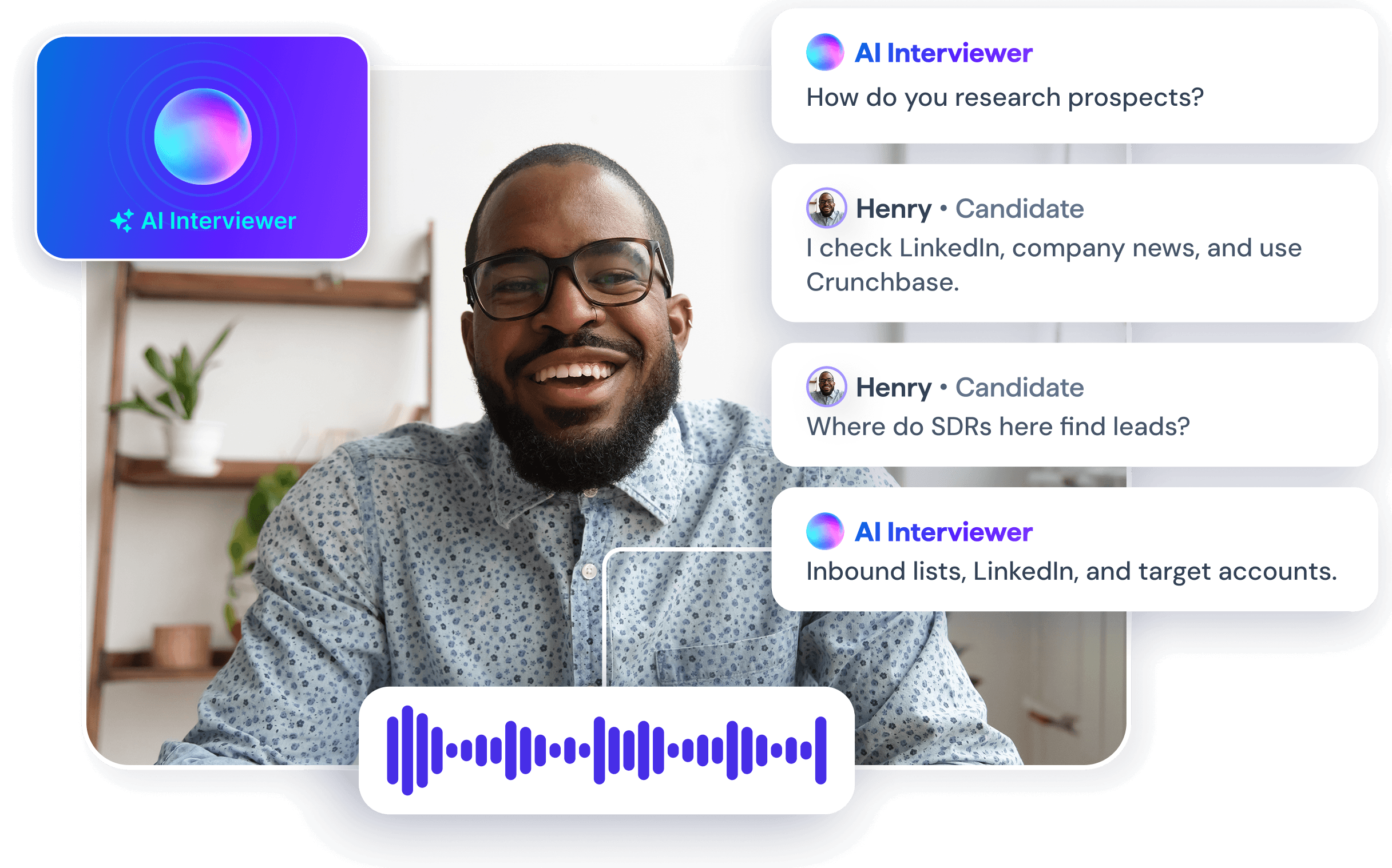
What it is. The format is how the interview actually runs. A two-way conversational interview is a real back-and-forth: the AI asks a question, listens, and asks a relevant follow-up based on the answer. A one-way recorded interview has the candidate record answers to fixed prompts with no response on the other side.
Why it predicts success. Why it predicts success. Most tools now run a two-way conversation, so format alone won’t separate them, but it still matters. In a 2026 University of Exeter field experiment that randomized more than 3,000 applicants, asynchronous, one-way interviews caused an over-50% decrease in application continuation, including among the most qualified applicants, with the sharpest drop among women. A two-way conversation also produces richer signal: a follow-up question is where a thin answer holds up or falls apart, something a résumé alone can’t test.
What to ask. Is the interview two-way and adaptive, or a set of fixed prompts the candidate records against? Can it interview by voice, and in the languages our candidates actually speak?
What good looks like. A structured, two-way voice interview that adapts its follow-ups to what the candidate says, offered in the languages your roles require. For a full side-by-side of the formats, see Conversational AI Interviews vs. One-Way Video »
Criterion 2: Candidate experience and acceptance
What it is. Whether candidates will complete the interview and come away trusting the process, rather than abandoning it or calling it a scam.
Why it predicts success. An AI interviewer that candidates don’t finish isn’t worth using. In Greenhouse’s 2026 research, 63% of US job seekers have already done an AI interview, 70% say it was not clearly disclosed to them, and only 8% believe AI makes hiring fairer. Candidates are skeptical going in, and not disclosing the AI is what turns that skepticism into drop-off.
Done well, AI-led screening interviews produced 12% more offers, 18% more starts, and 18% higher retention at one month, in a 70,000-applicant field experiment (Jabarian and Henkel). BrightHire Screen carries a 4.5 out of 5 platform-wide candidate rating, which is the kind of proof point to ask any vendor for.
What to ask. How is the candidate told they are in an AI interview, and when? What is your completion rate, and how is it measured? Can candidates ask for a human alternative?
What good looks like. Clear disclosure before the interview starts, a conversation candidates rate well, and a stated path to a human. For depth, see AI Interviews and Candidate Experience ».
Criterion 3: Fairness, bias auditing, and regulation readiness
What it is. Whether the tool is tested for bias by someone other than the vendor, and whether the vendor is ready for the hiring laws that apply where you operate.
Why it predicts success. Fairness is the criterion most likely to fail under scrutiny, so don’t take it on faith. Ask for the independent third-party bias audit itself, not a line on a webpage claiming the tool is audited. The vendor should also hold SOC 2 Type II, be GDPR and CCPA compliant, and support candidate consent and opt-out. The regulatory floor is rising:
- New York City’s Local Law 144 requires a bias audit within one year, public posting, and candidate notice for automated employment decision tools.
- llinois regulates AI analysis of recorded video interviews through notice, consent, and deletion.
- Colorado’s SB24-205 places reasonable-care duties on high-risk AI used in employment.
- The EU AI Act treats employment AI as high-risk under a staged timeline.
BrightHire runs independent third-party AI bias audits and publishes its compliance posture.
What to ask. Can you send us your most recent independent third-party bias audit? Which of NYC Local Law 144, the Illinois AI Video Interview Act, Colorado SB24-205, and the EU AI Act do you support, and how?
What good looks like. A vendor that hands over the audit without friction and can name the specific laws it helps you meet. For the full regulatory picture, see Are AI Interviews Fair, Legal, and Compliant? »
Criterion 4: Human-in-the-loop, does the AI score or does it decide?
What it is. Whether a person makes the advance-or-reject call, or the software does. This is the question that fails the most vendors, so ask it directly and pin down the answer.
Why it predicts success. An AI interviewer should surface signal and not verdicts. The design you want is one where the AI scores each answer against your criteria and a recruiter reads that score, the summary, and the recording before deciding, so the tool never auto-advances or auto-rejects anyone.
That design also makes each decision explainable later: a person reviewed the evidence and made the call, using the score as one input. BrightHire follows this principle. Its AI does not make hiring decisions, recommend which candidates to advance, or train on customer data. A tool that decides on its own is a liability.
What to ask. Does the AI ever auto-reject or auto-advance a candidate without a human review? Is “no auto-reject” stated in writing? Who is accountable for the decision?
What good looks like. An explicit, written no-auto-reject commitment, scores treated as inputs, and an accountable human on every decision.
Criterion 5: Platform versus point solution
What it is. Whether screening lives on the same candidate record as the rest of your interview process, or in a separate tool you bolt on and reconcile later.
Why it predicts success. A point tool screens candidates and stops. When the screening interview and the later live interviews sit on one record, the recruiter reviewing a finalist can see how that person answered in the first round, and nothing gets re-keyed or lost between systems.
BrightHire is built this way: Screen conducts the screening interview, Interview Intelligence captures the live interviews that follow, and both write to the same candidate record, more than 3 million hiring conversations across more than 1.5 million candidates.
What to ask. Does screening share a record with our live interviews, or is it a separate system? What has to be reconciled by hand between the two?
What good looks like. One candidate record spanning the screening interview and the live interviews, with no manual stitching. See the AI interviewer category guide » for how platforms and point tools differ.
Criterion 6: ATS integration depth
What it is. How well the tool fits your applicant tracking system and the way your stages actually move.
Why it predicts success. An AI interviewer that does not integrate with your ATS creates manual work: exporting candidates, chasing invitations, and re-keying results. BrightHire Screen connects to Greenhouse, Ashby, Workday, and others, and detects the ATS stage change to send the invitation. Setting up the Greenhouse or Ashby integration typically takes about 15 minutes, and an ATS-less shareable-link mode is available from day one.
What to ask. Do you integrate with our ATS? When a candidate moves to the screening stage, does the invitation go out automatically, or does a recruiter have to send it manually? How long does setup take on our stack?
What good looks like. Automatic, stage-triggered invitations on your ATS, a fast setup, and a fallback mode for roles or teams that sit outside the ATS.
Criterion 7: Security, data, and enterprise trust
What it is. How the vendor secures candidate data, how long it keeps it, and whether it uses your interviews to train its models.
Why it predicts success. Criterion 3 covers fairness and regulatory compliance; the related infrastructure question is what happens to candidate information after an interview. At minimum, a vendor should hold SOC 2 Type II certification, comply with GDPR and CCPA, support candidate consent and opt-out, and provide a clear retention policy. Candidates’ interviews should not become training data for the vendor’s models.
BrightHire meets these standards: it holds SOC 2 Type II certification, is GDPR and CCPA compliant, supports candidate consent and opt-out, offers a Zero Data Retention option, and does not train AI models on customer data. Ask every vendor to put its retention defaults and model-training terms in writing, as procurement documents often provide more detail than public-facing pages.
What to ask. What are your default data-retention periods, and are they configurable? Do you train any model on our candidates’ interviews? Can we get the retention and training terms in the contract?
What good looks like. SOC 2 Type II, GDPR and CCPA, a configurable or zero-retention option, and a written commitment not to train on your data.
Criterion 8: Interview quality and structure
What it is. Some tools evaluate every candidate’s answers against the criteria your team set and produce a comparable scorecard. Others do less, only scheduling and recording interviews, or scoring proxy signals like tone and speaking pace instead of judging what the candidate actually said.
Why it predicts success. This is where similar-looking tools diverge. A note-taker records and summarizes a conversation, while an interviewer evaluates each answer against your team’s criteria and produces a scorecard that can be compared across candidates. The value here is that candidates are assessed against a consistent rubric, making comparisons more meaningful.
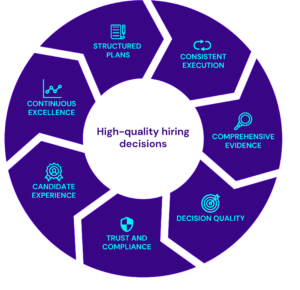
“BrightHire offers the most compelling technology I’ve ever seen for making better hiring decisions,” says Wharton organizational psychologist Adam Grant. Structured interviewing is the reason why, and it improves both hiring speed and hiring quality. It also creates a repeatable process, one of the seven pillars of the quality of hiring system, which treats quality of hire as the product of process quality.
When comparing tools, test whether this approach fits the roles you actually hire for.
What to ask. Does the tool evaluate each answer against our defined criteria and return a comparable score, or does it summarize? Can we see a sample scorecard? How is the rubric set for a role?
What good looks like. A rubric-based, comparable scorecard tied to your criteria, not a transcript with a summary attached.
Red flags and disqualifying answers to watch for in vendor demos
Some answers should end the evaluation, or at least drop the vendor down your list. Each of these maps back to a criterion above:
- “We’re audited for bias,” with no artifact. If the vendor cannot send you the independent third-party audit report, treat the claim as unverified (Criterion 3).
- Vague or missing “no auto-reject” language. If no one will state in writing that a human makes every advance-or-reject call, assume the tool decides (Criterion 4).
- “The AI advances the best candidates automatically.” Automation of the decision itself is the disqualifier, not a feature (Criterion 4).
- A scorecard that summarizes but does not evaluate. If the output is a transcript and a summary with no score against your criteria, it’s a note-taker, not an interviewer (Criterion 8).
- Retention and training terms only “on request.” If you cannot get data-retention defaults and model-training terms in writing before signing, expect the defaults to favor the vendor (Criterion 7).
- A one-way recorded format sold as a conversation. If candidates record into a void, expect drop-off, especially among your strongest applicants (Criterion 1).
Your AI interviewer RFP checklist
Copy these questions into your RFP and score every vendor on the same scale. They follow the eight criteria in order.
1. Interview format
- Is the interview two-way and adaptive, or fixed recorded prompts?
- Can it interview by voice, and in which languages?
2. Candidate experience and acceptance
- How and when are candidates told they are in an AI interview?
- What is your completion rate, and how is it measured?
- Can a candidate request a human alternative?
3. Fairness, bias auditing, and regulation readiness
- Send us your most recent independent third-party bias audit report.
- Which of NYC Local Law 144, the Illinois AI Video Interview Act, Colorado SB24-205, and the EU AI Act do you support, and how?
- How do candidates give consent, and how do they opt out?
4. Human-in-the-loop
- Does the AI ever auto-reject or auto-advance without a human review?
- Is “no auto-reject” stated in your contract?
- Do you train any model on our candidates’ interviews?
5. Platform versus point solution
- Does screening share one record with our live interviews?
- What has to be reconciled by hand between screening and the rest of the process?
6. ATS integration depth
- Do you integrate with our ATS, and do invitations trigger automatically on a stage change?
- How long does setup take on our stack, and is there an ATS-less mode?
7. Security, data, and enterprise trust
- What are your default retention periods, and are they configurable?
- Provide SOC 2 Type II, GDPR, and CCPA documentation.
- Put retention and model-training terms in the contract.
8. Interview quality and structure
- Does the tool score each answer against our criteria and return a comparable scorecard?
- Show us a sample scorecard and explain how a role’s rubric is set.
How leading AI interviewers compare on these criteria
Once you’ve scored vendors against the eight criteria, the next step is to compare specific tools.
For a fuller, fit-based roundup of the category, see our roundup of the best AI interview software ». If you’re evaluating a switch from a named incumbent, see HireVue alternatives »
Frequently asked questions (FAQs)
How do I choose an AI interviewer?
Score every vendor against eight criteria: interview format, candidate experience, fairness and bias auditing, human-in-the-loop decisioning, platform versus point solution, ATS integration, security and trust, and interview quality. Use one written rubric and one RFP so the comparison is consistent, and insist on an independent bias audit and a written no-auto-reject commitment before you shortlist.
What questions should I ask AI interview vendors in an RFP?
Ask for the independent third-party bias audit, whether the AI can auto-reject or auto-advance without a human, default data-retention periods, whether they train models on your candidates’ interviews, which hiring laws they support, and whether screening shares one record with your live interviews. The checklist above lists these by criterion.
Does the AI make the hiring decision?
It should not. A responsible AI interviewer scores each answer against your criteria and gives a recruiter the evidence to decide. The AI does not auto-reject, does not recommend who to hire, and treats scores as inputs. A person makes the call. If a vendor cannot state that in writing, treat it as a red flag.
Is a two-way AI interview better than one-way recorded video?
For most screening, yes. A two-way conversation adapts to the candidate’s answers and produces richer signal, and one-way recorded formats have been shown to reduce application continuation, including among stronger candidates. See Conversational AI Interviews vs. One-Way Video »
Are AI interviews fair and compliant?
They can be, and the burden is on the vendor to prove it. Require an independent third-party bias audit, SOC 2 Type II, GDPR and CCPA compliance, and support for the laws that apply to you, including NYC Local Law 144 and the Illinois AI Video Interview Act. See Are AI Interviews Fair, Legal, and Compliant? »