




Candidates do not automatically accept or reject AI interviews. Acceptance is conditional. Most start out skeptical, and only 8% believe that AI makes hiring fairer. What earns their trust is a specific design: disclosed AI use, a two-way conversation rather than a one-way recording, and a human who reviews the result and makes the decision. Deploy it that way and outcomes improve. Deploy a one-way format and candidates drop off.
The gap between the design that candidates accept and the one they abandon is the whole subject of this page. It’s also the part a hiring team controls.
Why candidate experience makes or breaks AI screening interviews
AI screening interviews are becoming the first real interaction a candidate has with a company today. And the format talent teams pick determines whether or not it leaves a good first impression and if candidates finish the process at all.
In a 2026 University of Exeter field experiment, asynchronous one-way interview formats were followed by a drop of more than 50% in application continuation, and the fall-off reached more-qualified applicants, not only marginal ones.
A format that loses candidates at that rate works against the reason most teams adopt an AI interviewer in the first place, which is to screen more candidates faster. A team that protects the candidate experience keeps its funnel and its employer brand intact while it scales.
This guide covers what candidates actually think, the questions your recruiters field, and a deployment playbook for keeping acceptance high.
What candidates actually think about AI interviews
In Greenhouse’s 2026 candidate research, 63% of US job seekers said they had already been through an AI interview, so the format is now common rather than novel. But 70% said the AI use was not clearly disclosed to them, and only 8% believed AI makes hiring fairer. The typical candidate has done this before, wasn’t always told up front, and isn’t convinced it helps them.
For an employer, this skepticism is an opportunity. A candidate who expects an opaque, one-sided process is a candidate you can win over by doing the opposite. Being transparent with candidates, providing a two-way conversation, and ensuring they understand there is a human decision-maker can create a more positive experience.
“Is this AI interview legit or a scam?”
Recruiters now hear a version of this question often.
A legitimate AI screening interview comes from a company the candidate applied to, is disclosed as AI-led before it begins, explains how the conversation will be used, and leads to a human review.
A scam tends to fail those tests: no named employer, a request for payment or sensitive personal information, or pressure to act immediately.
The employer’s job is to remove the doubt:
- Send the interview invitation from a recognizable company address and name the role and the team.
- State plainly that the interview is AI-led, roughly how long it takes, and who reviews the result.
- Give the candidate a way to reach a real person with questions.
- Never ask for payment, government identification, or financial details as part of a screening interview.
Candidate fraud, the mirror-image question of whether the candidate is genuine, is a large topic of its own. We cover it on Candidate Fraud » rather than here.
Do humans actually review AI interviews, or does the AI auto-reject?
A responsible AI screening interview is built so a person reviews the result, and the AI does not reject anyone on its own. The system scores each answer against the criteria the hiring team defined and writes a summary and a transcript. Those are inputs a recruiter or hiring manager reads before deciding whether to advance the candidate. AI surfaces signal; humans make the decision.
This is the single most reassuring thing a team can tell a candidate, but it’s also worth being specific about what a responsible AI interviewer does not do. It does not make the hire-or-pass call, does not recommend who to advance, does not auto-reject, and does not train on your candidates’ data.
Having a recruiter review every advance and every rejection is also what lets a team explain any decision later, because a human read the evidence and made the call, with the AI’s score as one input among several. When you tell candidates a person is reviewing their interview, it needs to be true in the product, not just in the policy.
Two-way conversational vs. one-way recorded video: why interview format drives acceptance
Whether a candidate accepts an AI interview depends less on the fact that it uses AI and more on the shape of the interview itself.
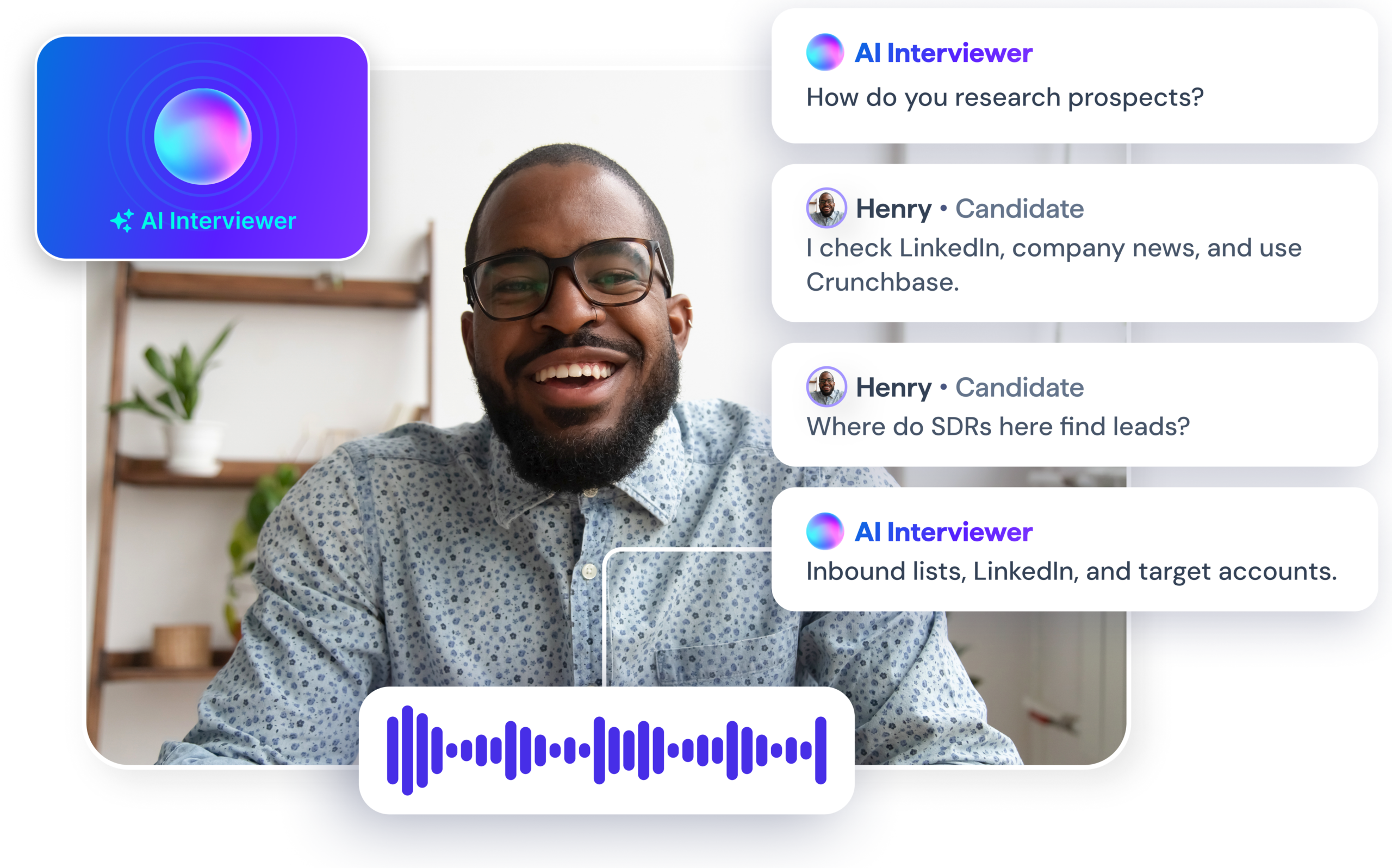
- A two-way conversational interview adapts to what the candidate says, asks follow-up questions, and lets them ask their own.
- A one-way recorded format asks the candidate to talk to a camera against a timer with no response on the other side, and that is the format candidates most often describe as cold.
Asynchronous one-way formats drove that more-than-50% drop-off, which is why format, not the use of AI, decides whether candidates stay in the process.
A two-way format also gives candidates room to ask about the role inside the interview. In BrightHire Screen interviews, candidates regularly use that room to raise practical questions before or between their answers, including compensation, company values, and what the working environment is like. A one-way recording offers no equivalent moment, which is part of why it feels one-sided.
The full comparison of conversational AI, one-way recorded video, text chatbots, and human phone screens, including where each one fits, can be found at Conversational AI Interviews vs. One-Way Video »
The fairness and access case
There’s a fairness argument for AI screening interviews, and it starts from how few candidates reach a live conversation today. By BrightHire’s study of 17,000 positions, only about one in 10 applicants typically gets a recruiter screen. The other nine are filtered out on paper, often by a resume rather than by anything they said.
An AI interviewer that runs first-round screening interviews at scale can give many more of those applicants a real, structured conversation against the same criteria, which is a fairer starting point than a resume filter for candidates whose experience does not read well on a page.
The outcomes back this up. In a field experiment of roughly 70,000 applicants, candidates who went through AI-led screening were 12% more likely to receive an offer, 18% more likely to start the job, and 18% more likely to still be employed a month later, compared with the standard process. Structure applied consistently helps candidates who would otherwise never have been heard, and it does so without lowering the bar, because every candidate answers the same questions against the same rubric.
The same study also gave some applicants a real, disclosed choice between an AI-led interview and a human recruiter: about 78% chose the AI option. Applicants who chose AI scored somewhat lower on language and analytical measures than those who chose a human interviewer, so the number is best read as evidence that a genuine, disclosed choice earns acceptance, not that top candidates prefer AI.
Reducing drop-off: the deployment playbook
Hiring teams can solve the acceptance problem before the interview starts. These moves map directly onto what candidates say they are missing, starting with the disclosure gap:
- Disclose the AI up front. Tell candidates the interview is AI-led before they begin, explain how it works and who reviews it, and put it in the invitation rather than burying it. The 70% who say they were not told are describing an avoidable failure.
- Offer a practice round. A short, low-stakes Practice Round lets candidates get comfortable with the format before the real conversation, which takes the edge off for anyone who has never done one.
- Use asynchronous flexibility well. Letting candidates take a two-way conversational interview on their own schedule and device is a genuine convenience. The flexibility should come from timing, not from stripping out the back-and-forth that makes it feel like a conversation.
- Add a hiring-manager introduction. A brief Hiring Manager Introduction, even a short recorded welcome, signals that a real team is behind the process and that a person is paying attention.
- Keep a human on every decision. Candidates accept a machine-run conversation far more readily when they know a person makes the call. Say so, and mean it.
Rolled out this way, an AI interviewer can raise completion and reach more candidates at once, which is exactly what the format is supposed to deliver.
Bias, compliance, and trust: what to tell candidates and your legal team
Candidates and legal reviewers ask overlapping questions about fairness, and a team should be ready to answer both without overpromising.
- On the candidate side: the interview is structured so everyone is measured against the same criteria, a person makes every decision, and the candidate can raise concerns or request an accommodation.
- On the legal side, the questions run to bias testing, disclosure, consent, and data handling.
BrightHire’s answer to the legal questions is a set of controls a reviewer can point to: independent third-party AI bias audits, SOC 2 Type II, GDPR and CCPA compliance, a Zero Data Retention option, and candidate consent and opt-out. The specific laws that govern AI interviews, including notice and bias-audit requirements in several jurisdictions, are their own subject.
How BrightHire Screen is built for a positive candidate experience
BrightHire Screen is a two-way conversational AI interviewer, which puts it on the side of the format candidates prefer. It runs a structured first-round screening interview, adapts with follow-up questions, and hands a recruiter a transcript, a summary, and a rubric-based score to review. Across the platform, candidates rate the Screen experience 4.5 out of 5.
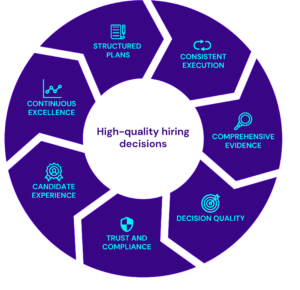
What Screen does not do matters just as much to candidates. It doesn’t make hiring decisions, does not recommend who to advance, does not auto-reject anyone, and does not train on customer data. Every hiring decision is made by a human. Candidate experience is one of the seven pillars of the quality of hiring system, and Screen is built to that standard rather than treating the candidate side as an afterthought.
Candidates who have been through Screen describe it in similar terms. A Senior Support Engineer candidate at Overjet called it “very intuitive and easy to work with” and said it let them “take an interview on their own time.” Another candidate, for a Product Manager role, said “it felt like a real interview, so much better than just uploading a resume or answering multiple choice questions.”
To see how Screen fits alongside live interviews in one connected process, visit the BrightHire Screen product page ».
Candidate-experience rollout checklist
A short checklist to protect acceptance when you deploy an AI interviewer:
- Disclose the AI-led format in the invitation, with the time it takes and who reviews it.
- Offer a practice round so candidates can get comfortable before the real conversation.
- Use a two-way conversational format; let flexibility come from timing, not from removing the back-and-forth.
- Add a hiring-manager introduction so candidates know a real team is behind the process.
- Keep a human review on every advance and every rejection, and tell candidates so.
- Publish your fairness posture: bias audits, consent and opt-out, and how data is handled.
- Baseline completion and drop-off rates before and after rollout so you can prove the experience held.
Frequently asked questions (FAQs)
It depends on how the interview is run. Candidates are skeptical by default, and in Greenhouse’s 2026 research only 8% believed AI makes hiring fairer. Acceptance rises sharply when the AI use is disclosed, the interview is a two-way conversation rather than a one-way recording, and a human reviews the result and makes the decision.
A legitimate AI interview comes from a company you applied to, is disclosed as AI-led before it starts, and leads to a human review. Signs of a scam include no named employer, a request for payment or government identification, or pressure to act immediately. A real screening interview never asks a candidate to pay or hand over financial details.
A person reviews the result of every responsible AI screening interview. The AI scores answers against the hiring team’s criteria and writes a summary, but it does not make the hiring decision, does not recommend candidates, and does not auto-reject. A recruiter or hiring manager decides whether to advance the candidate.
Responsible AI interviewers include candidate consent and an opt-out, and a candidate can request an accommodation or an alternative.
Format is the main driver. A 2026 field experiment found asynchronous one-way formats were followed by a drop of more than 50% in application continuation, including among more-qualified applicants. Two-way conversational interviews, disclosed in advance and paired with a practice round, are designed to keep completion high.
Tell candidates the interview is AI-led before it begins, ideally in the invitation. Explain how the conversation is used, who reviews it, and how to reach a person with questions. Clear disclosure directly addresses the 70% of candidates who told Greenhouse their AI interview was not clearly disclosed.