





For years, the human phone screen was the first real interview a candidate got. It’s also the format that doesn’t scale. Not all recruiting teams can run a live screen for every applicant, so many candidates never get one. That gap is what pulled automation into the first round.
Four formats now compete for that slot: a two-way conversational AI interview, a one-way recorded video, a text chatbot, and the human phone screen itself. They look similar on a feature list yet behave very differently for both the candidate and the recruiter.
This page draws the lines between them, on candidate experience, signal quality, fairness, compliance, scale, and recruiter time, so you can pick a format that scales volume without the trade-offs candidates dislike. In every format, a person makes the hiring decision. Where AI is involved, it surfaces signal, but does not decide.
What are the four screening-interview formats?
A screening interview is the first structured conversation that decides who moves forward. The four ways teams run it at volume today differ on one question above all: does the format hold a real, adapting conversation, or does it collect answers in one direction?
| Format | What it is | Who does the talking | Adapts in real time? |
|---|---|---|---|
| Two-way conversational AI interview | A spoken, structured interview an AI conducts, with follow-up questions, reviewed by a human | Candidate and AI Interviewer | Yes |
| One-way recorded video interview | The candidate records answers to fixed prompts; no interviewer is present | Candidate only | No |
| Text chatbot or resume-screener | A text exchange that screens, schedules, or answers questions; not a spoken interview | Candidate types short replies | Limited, scripted |
| Human phone screen | A recruiter interviews the candidate live by phone | Recruiter and candidate | Yes |
The rest of this page takes each format in turn, then compares them side by side.
One-way recorded video interviews
In a one-way recorded video interview, the candidate reads a set of fixed prompts on screen and records answers into a camera. No interviewer is on the other end. There is no follow-up question when an answer is interesting or incomplete, and no chance for the candidate to ask anything back. A reviewer watches the recordings later.
This format is fast for recruiters and available around the clock, which is why it became a staple of high-volume hiring. But, it doesn’t support a great candidate experience. A 2026 University of Exeter working paper that randomized more than 3,000 applicants across asynchronous, live, and control interviews found that the asynchronous format caused an over 50% decrease in application continuation, with the largest decline among women and the most qualified applicants. The study measured whether candidates continued the process, not how they rated it afterward, so treat it as evidence of who a one-way format loses rather than a full readout of candidate sentiment.
Text chatbots and resume-screeners
A text chatbot screens, schedules, or answers candidate questions through a typed exchange. Some tools in this category also screen resumes or dismiss candidates on basic criteria before anyone speaks to them. These are useful for moving applicants through the top of the funnel quickly, and for hourly and frontline roles that carry a lot of volume.
What they are not is a spoken, structured interview. A chatbot collects short typed replies against a script; it does not run an adapting conversation or evaluate how a candidate reasons through a question out loud. Paradox, for example, is positioned around conversational apply, screening, scheduling, and workflow automation rather than a live, adaptive spoken interview. A chatbot can simply confirm that a candidate meets the basic requirements and can schedule the next step.
Human phone screens
The human phone screen is the quality benchmark. A recruiter talks to the candidate live, follows up on whatever is worth following up on, and forms a judgment from a real conversation. Nothing on this list matches it for depth on a single candidate.
But, human phone screening doesn’t scale. Only about 1 in 10 applicants typically gets a recruiter screen, based on a BrightHire study of 17,000 positions. The other nine are filtered on a resume alone or never reach a person at all. This is the gap every hiring automation format is trying to close: how to give more candidates a real first-round conversation without adding recruiter hours the team does not have.
The operational detail of running that at scale belongs to the high-volume hiring guide; here it’s enough to say the human screen sets the quality bar and cannot meet the volume.
Conversational AI interviews
A conversational AI interview is a spoken, structured interview format that an AI conducts and a human reviews. It asks a planned set of questions, listens to the answers, and adapts with follow-up questions when something needs to be probed, the way a recruiter would. Because it’s a real conversation rather than a recording, it surfaces signal a resume or a fixed prompt leaves out, and it does it for every candidate rather than one in ten. Responsible implementations reduce bias through independent audits and human review.
Many vendors now run this format. Alex, HeyMilo, Ribbon, Humanly, and HireVue’s newer AI Interviewer all conduct two-way conversational voice or video interviews. What separates products within the format is how deep the conversation goes, whether a human stays in the loop, and what the product does with the interview afterward.
Those questions, rather than the format label, are what a buyer should compare products on. BrightHire Screen is one of them, and where it fits is covered below.
Format by format: how they compare
Here is how the four formats compare on the criteria buyers weigh most. Each row answers one question a buyer actually asks. Vendor names are left out of the grid on purpose; the formats, not the products, are what this table compares.
| Criterion | Two-way conversational AI | One-way recorded video | Text chatbot / resume-screener | Human phone screen |
|---|---|---|---|---|
| Candidate experience | A back-and-forth conversation; more like an interview than a test | One-sided; a 2026 field study found over 50% lower application continuation than live interviews | Fast and low-effort, but not a real interview | Best experience on depth, when a candidate gets one |
| Signal quality | Structured and adaptive; follow-ups surface reasoning beyond the resume | Fixed prompts, no follow-up; misses what a probe would reveal | Screens basic criteria; little signal on how a candidate thinks | High on depth, but only for the few who reach it |
| Fairness and bias | Same structured questions for every candidate; requires bias audits and review to be responsible | Consistent prompts, but visual recording raises added scrutiny | Rules-based screens can encode bias without review | Consistent only as far as the individual recruiter is |
| Compliance | AI-mediated: bias-audit, notice, and consent duties apply | AI analysis of recorded video triggers specific video-interview laws | Automated screening decisions can fall under AI-hiring rules | Lightest regulatory load, being human-led |
| Scale | Gives every candidate a first-round conversation without adding recruiter hours | Scales, but at the cost of candidate experience | Scales highest for basic qualification and scheduling | Does not scale; about 1 in 10 applicants gets one |
| Recruiter time | Recruiter reviews evaluated interviews instead of running each one | Recruiter watches recordings; review time grows with volume | Minimal recruiter time; minimal depth in return | Highest recruiter time per candidate |
The pattern is consistent:
- the human phone screen wins on depth and loses on scale
- the one-way and chatbot formats win on speed and give up candidate experience or signal
- the two-way conversational interview is the one designed to hold onto a real conversation while still reaching every candidate.
What makes any of these responsible rather than risky is covered in the next two sections: what candidates actually accept, and who stays in the loop on the decision.
Which format do candidates accept?
Candidates don’t reject AI interviews across the board, but they don’t always embrace them either. A 2026 Greenhouse report found that 63% of US job seekers have already done an AI interview, that 70% say it was not clearly disclosed, and that only 8% believe AI makes hiring fairer.
Read together, those numbers say acceptance is already here but conditional: candidates will sit through an AI interview, and they are wary of one that’s hidden from them or presented as more objective than it is.
The Jabarian and Henkel field experiment also found that when applicants were given an actual choice between an AI voice interviewer and a human recruiter, about 78% chose the AI. Applicants who chose AI tended to score lower on language and analytical measures in the same study, so read this as evidence that AI is broadly acceptable, not proof that the strongest candidates prefer it.
The conditions that move an interview format from resented to accepted are consistent: tell candidates plainly that AI is part of the process, make it a genuine two-way conversation rather than a recording, and keep a human reviewing the outcome.
Where those conditions hold, the experience can be positive; BrightHire Screen carries a 4.5 out of 5 average candidate rating platform-wide. A field experiment of about 70,000 applicants found that candidates who went through AI-led screening were 12% more likely to get an offer, 18% more likely to start, and 18% more likely to still be employed a month later.
The deeper question of how candidates experience each stage belongs to the candidate-experience guide; the takeaway here is that format and disclosure, not AI on its own, drive whether candidates accept the process.
Does the AI make the decision?
The concern under every AI format is the same: will a machine reject someone with no human involved? It’s the right question to ask of any AI-led interview format, because a tool that scores and routes candidates without review is a black box regardless of whether it’s video, voice, or text.
With BrightHire, AI surfaces signal and a human makes the decision, and BrightHire Screen never auto-rejects a candidate, doesn’t recommend candidates, and doesn’t train on customer data. Every pass, advance, or rejection is a person’s call, with the AI’s evaluation as one input among several.
When you compare formats, look at how a given product handles this: whether a human reviews before anyone is cut, and whether you can see and explain how a candidate was evaluated. A responsible implementation of any of these formats keeps a person in the loop; the format alone does not guarantee it.
How to choose a format for high-volume screening interviews
Start from your constraints, not from a vendor demo. Here are a few questions to help you settle on a decision:
How much do candidate experience and your employer brand weigh? If they are central, especially for early-career or customer-facing roles, a two-way conversation is the safer format and a one-way recording is the riskier one.
How much signal do you need beyond the resume? If the first round has to tell you how a candidate thinks, not just whether they meet basic criteria, a conversational format earns its place and a chatbot does not.
What is your compliance exposure? Any AI-mediated format carries bias-audit, notice, and consent duties, and recorded-video formats carry additional ones. The more regulated your hiring, the more the responsible-AI posture of the format matters.
How much recruiter review capacity do you have? Every automated format shifts recruiter time from running interviews to reviewing them. A format that produces a clear, evaluated interview is lighter to review than a stack of raw recordings.
Where BrightHire Screen fits
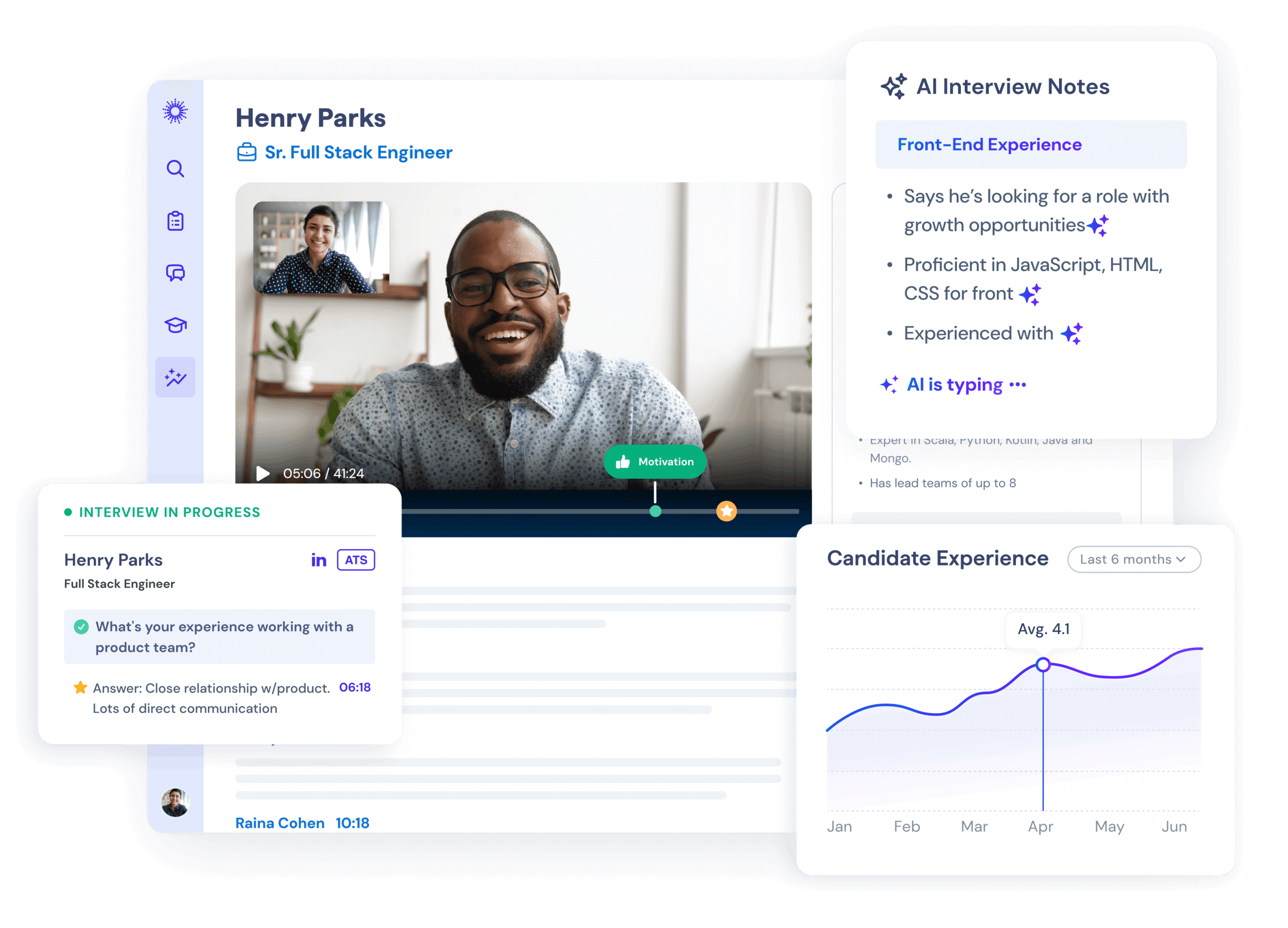
BrightHire Screen is a two-way conversational AI interviewer that runs first-round screening interviews for roles where volume, consistency, or speed is a constraint. It holds a structured, adaptive conversation and evaluates what a candidate says against the criteria your team defined.
- Screen and Interview Intelligence share one candidate record. The screening interview and the live human rounds live on the same record, drawn from more than 3 million hiring conversations and 1.5 million candidates supported.
- Follow-up questions surface what a resume can’t. A broad opening question, like walking through the most complex problem a candidate owned end to end, is followed by questions that adapt to the answer: what tools or logs they actually used, their own day-to-day role in a team outcome, or how they checked an AI tool’s output before acting on it.
- Every candidate answers the same core questions. The follow-ups adjust to what each person says, and that’s where the signal a resume leaves out tends to surface: a resume lists the outcome, the follow-up shows the candidate’s actual part in it.
- AI surfaces signal, humans make the decision, and Screen never auto-rejects. BrightHire runs independent third-party AI bias audits, holds SOC 2 Type II, GDPR, and CCPA coverage, offers a Zero Data Retention option, supports candidate consent and opt-out, and does not train on customer data.
- Adam Grant, the Wharton organizational psychologist, has said structured interviews beat gut instinct. Structure is what Screen brings to a first round that would otherwise vary by the day.
Frequently asked questions
No. A one-way video interview records a candidate’s answers to fixed prompts with no interviewer and no follow-up. A conversational AI interview is a two-way, spoken, structured interview that adapts with follow-up questions and is reviewed by a human. They are different formats with different candidate experiences.
Not in the sense of a screening interview. A text chatbot screens basic criteria, answers questions, or schedules interviews through typed replies. It does not hold a spoken, adaptive conversation or evaluate how a candidate reasons through a question, which is what a screening interview is for.
With BrightHire Screen, a human decides. AI surfaces signal and evaluates responses against your team’s criteria, and Screen never auto-rejects a candidate. For any format, confirm that a person reviews before anyone is cut and that you can explain how a candidate was evaluated.
It depends on what the first round has to do. For volume with real candidate experience and signal beyond the resume, a two-way conversational interview fits best. Chatbots suit basic qualification and scheduling, and one-way recorded video trades candidate experience for speed. Human phone screens give the most depth but cannot cover the volume.
A 2026 field experiment that randomized applicants across formats found that one-way asynchronous interviews caused an over 50% drop in application continuation compared to live interviews, with the steepest decline among women and the most qualified candidates. That measures who a format loses, not a satisfaction score, but it points the same direction as the anecdotal complaints about one-way video. Separately, a different field experiment found that AI-led screening has not disadvantaged the candidates who complete it: it was associated with 12% more offers, 18% more starts, and 18% higher retention a month later.
They can be, and it takes work. Fairness depends on structured questions, independent bias audits, and human review. Compliance depends on where you hire and is still evolving: New York City’s Local Law 144 requires a bias audit, public posting, and candidate notice today, and Illinois’ AI Video Interview Act requires notice, consent, and deletion on request for AI analysis of recorded video interviews today. Colorado and the EU are each moving toward AI-specific duties for employment decisions, with new requirements set to begin in 2027. Confirm current requirements with counsel and ask any vendor for its most recent independent bias audit.