










TL;DR: A usable interview scorecard template has four components: weighted competencies (three to five per role), a defined 1 to 5 scoring scale, behavioral anchors per competency, and a required evidence field for every rating. Scorecard quality degrades without calibration, because panels that never align on what “strong” means produce data that looks consistent but is not comparable. Submit feedback within 30 minutes of the interview for the highest data fidelity. BrightHire automates this by generating a pre-filled scorecard from the interview recording the moment the call ends, so the debrief starts from evidence instead of memory.
An interview scorecard is what turns a conversation into comparable data. The trouble starts when one interviewer’s 4 means “solid, no concerns” and another’s means “impressive, would hire on the spot.” Both land in the ATS looking identical, so the debrief compares numbers that were never measuring the same thing.
Timing makes it worse. Interviewers are rarely filling out scorecards while the conversation is fresh. By the time feedback gets submitted, the specific evidence is gone and what’s left is an overall impression.
The sections below cover weighted competencies, a 1 to 5 scale with defined behavioral descriptions, anchors, and role-specific examples for engineering, sales, and leadership. The sections after that cover the discipline that keeps scoring consistent: how to calibrate your panel on what each score level means, when to get feedback in, and how to spot bias patterns in the scores you’re already collecting.
The interview scorecard template
This scorecard structure is built for TA teams who need a starting point they can adapt for any role. The template is structured to work alongside any ATS that supports competency-based scorecards, which BrightHire integrates with natively.
The template includes:
- Weighted criteria columns: each competency carries a percentage weight that reflects how much it predicts success in the role.
- A 1 to 5 scoring scale: every level has a defined behavioral description, not an adjective.
- Behavioral anchor rows: observable examples of what each score level looks like in practice.
- A required evidence field: every rating requires a specific quote, example, or observation from the interview. If you want an interview evaluation template your panel will actually use, you need the system around it as much as the structure itself. The sections below explain both.
Anatomy of a structured interview rubric
A structured rubric has four working parts: competencies, weights, a scoring scale, and behavioral anchors. Competency frameworks research from Hire.school recommends three to five categories: fewer than three leaves important signals unmeasured, and more becomes unmanageable in a single interview. You should anchor each level to observable behavior rather than labels like “good” or “excellent,” a standard that improves scoring consistency across panels.
Here is an example of how this structure looks in BrightHire, using an engineering scorecard:
| Competency | Weight* | Behavioral anchor (score 4) | Score (1-5) | Evidence |
| System design | 30% | Candidate explains architecture decisions with explicit tradeoffs named, including what was rejected and why | ||
| Technical collaboration | 20% | Candidate rephrases a technical concept without prompting when the interviewer signals confusion, and asks a clarifying question before answering an ambiguous prompt | ||
| Problem solving | 25% | Candidate names a specific problem they owned, states the measurable outcome their solution produced, and identifies what they would change if they approached it again | ||
| Communication | 15% | Candidate sequences a multi-step technical approach in a logical order, defines any terms the interviewer would not be expected to know, and checks for understanding before moving to the next step | ||
| Ownership | 10% | Candidate describes a specific failure they were accountable for, names the decision or action that caused it, and states what they changed in their approach as a direct result |
*Weights shown are illustrative. Set weights with your hiring manager at the intake meeting based on what predicts success in the specific role.
Treat the weights and anchors above as a starting point, not a standard. Your intake meeting with the hiring manager should set both.
Tailoring scorecards to specific roles
| Role | Primary competency | Secondary competency |
| Engineering | System design and code quality | Collaboration on technical decisions |
| Sales | Discovery and objection handling | Quota attainment and pipeline management |
| Leadership | Strategic thinking with quantified tradeoffs | Talent development and organizational influence |
Sales competency frameworks emphasize business acumen, discovery and questioning, objection handling, and closing discipline as the core evaluation dimensions, per PMAPS’ sales competency framework. For leadership roles, Huneety’s competency mapping research identifies several anchor components you can draw from separately: a direct report whose performance the candidate improved, the specific feedback they delivered and when, and a strategic decision they made with a named tradeoff and a measurable outcome.
What makes an effective interview scorecard
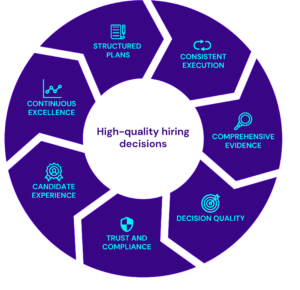
A candidate scorecard only produces reliable data when it draws from the interview itself, not from memory. Four components separate defensible scorecards from noise:
- Weighted criteria: weights force the intake conversation about what actually predicts success, and they stop a minor competency from overriding a critical one in the final decision.
- A defined scoring scale: defined levels make scores comparable across candidates and across interviewers.
- Behavioral anchors: anchors describe what the candidate said or did, not what the interviewer felt.
- A required evidence field: no evidence, no score. This single rule eliminates most vague feedback.
You get measurable payoff from this structure. The Schmidt and Hunter meta-analysis of 85 years of personnel selection research found structured interviews reach an average validity of .51 versus .38 for unstructured interviews, per Cogn-IQ’s validity review. In plain terms: when you build structure into the scorecard, you convert interview time into predictive signal.
Prioritizing key candidate competencies
Coverage and cognitive load trade off against each other. A panelist tracking 12 competencies in a 45-minute interview will evaluate none of them well. Select three to five competencies per role using this sequence:
- Start at the intake meeting: extract must-haves versus nice-to-haves from the hiring manager before sourcing begins.
- Map competencies to failure modes: ask what has made people fail in this role before, and convert those answers into evaluation criteria.
- Cut anything that duplicates: if two competencies would produce the same evidence, merge them into one.
- Weight by predictive value: assign the highest weights to the competencies that separate strong performers from average ones, not the ones easiest to assess.
Quantifiable metrics for interview feedback
| Score | Label† | Behavioral description |
| 1 | Strong no | Candidate either provided no example when prompted, gave an example unrelated to the competency being assessed, or gave an example that directly demonstrates the absence of the competency |
| 2 | Leaning no | Candidate provided a relevant example but omitted key details the anchor requires, such as a measurable outcome, a named decision, or a specific tradeoff, and could not supply them when probed |
| 3 | Mixed | Candidate provided a relevant example with sufficient detail to meet the anchor in at least one area, but either omitted a required element or gave a noticeably weaker response to a follow-up probe in a second area of the same competency |
| 4 | Yes | Candidate provided a relevant example with all anchor elements present, such as a named situation, a specific action they took, and a measurable or observable outcome, and answered at least one follow-up probe with additional supporting detail |
| 5 | Strong yes | Candidate met all anchor elements and, without prompting, extended the response with a measurable outcome, a named constraint they worked within, or a second example that demonstrates the competency applied in a different context |
†Score labels are illustrative. Standard BARS frameworks use labels such as “Poor” or “Below Expectations.” Align your panel on label definitions during the calibration session before the loop begins.
Calibrate these descriptions with your panel before the loop begins, because a scale only works when every interviewer reads each level the same way.
Mapping performance to interview criteria
You get greater predictive validity, reliability, and less bias when you use behaviorally anchored rating scales (BARS), per academic research on BARS methodology. Build them by identifying key responsibilities, collecting critical incidents of effective and ineffective performance, translating incidents into observable behaviors, and anchoring behaviors to rating levels, per Engagedly’s BARS guide.
The difference between weak and strong anchors:
| Evaluation dimension | Weak anchor | Strong anchor |
| Language focus | “Seems technical,” “appears motivated” ‡ | “Identified a race condition in the payments service, walked through the distributed tracing steps used to isolate it, and named the fix deployed” |
| Measurability | “Good communication” | Articulates a multi-step approach, asks clarifying questions, adapts based on feedback |
| Evidence basis | Interviewer impression | Specific quote or observable action with a concrete example |
| Specificity | “Problem solver” | “Reduced API latency by 40% by implementing caching, taking ownership when initial approach failed” |
‡Examples in this table are illustrative. The principle, weak anchors use vague adjectives, strong anchors name a specific observable action with context, is consistent across behavioral hiring literature, including Pin’s scorecard guidance.
Documenting high-quality interview data
You make a score defensible in a debrief when you require an evidence field. When a panelist writes “4 on system design” with no supporting observation, the debrief has nothing to work with. When they write something like “walked through how she redesigned the payments pipeline to handle 10x load, named the tradeoffs, and explained the rollback plan,” the debrief can evaluate the evidence rather than the impression.
You should care about timing as much as content. Target feedback submission as close to the interview as possible. Metaview’s analysis of 811,298 real scorecards found median submission at 2.3 hours, with 74.7% submitted within 24 hours and 82.1% within 48 hours, which means more than one in four panelists is already past your standard SLA before the debrief begins. Treat 24 hours as the standard and 48 hours as the absolute outer limit before signal degradation makes the scorecard unreliable.
Designing your structured evaluation rubric
- Define role-specific competencies: start with the intake meeting. Sit with the hiring manager and extract must-haves versus nice-to-haves, then convert each must-have into an evaluable competency. If the hiring manager cannot describe what evidence would demonstrate the competency, it is not ready for the scorecard.
- Prioritize key candidate competencies: cut the list to three to five competencies and weight them based on what predicts success. Write the weights down before the loop begins, because weights you agree on in advance are harder to relitigate in the debrief.
- Build a consistent rating rubric: define the 1 to 5 scale with a behavioral description for each level, using the table above as your starting point. Every interviewer on the panel scores against the same scale definitions, which is what makes scores comparable across the panel.
- Anchor scores to observable behaviors: write anchors that describe what the candidate said or did, not what the interviewer felt. Talenta’s BARS overview covers the mechanics of anchoring behaviors to rating levels if you need a deeper methodology reference.
- Align panelists to competencies: assign competencies to the panelist best positioned to assess them. The interviewer whose function, seniority, or domain experience gives them the clearest view of what strong performance in that area actually looks like. Overlapping coverage on one or two shared competencies gives you a consistency check across the panel.
Driving interviewer calibration at scale
You need calibration to separate scorecards that work from ones that produce noise. When your panels never align on what “strong” means, they produce data that looks consistent but cannot be compared across candidates. That false consistency is worse than no data because it gives your debrief confidence it has not earned.
Use calibration to sync your panel
Run a calibration session to align your panel on what each score level means before live candidates enter the loop. Run a 60 to 75 minute session for new roles and 30 minutes for re-calibration: have the panel score a sample interview independently, compare ratings, discuss gaps, run a bias check, and document the agreements, per Pin’s interview debrief guide and Windmill’s facilitation framework.
Capture feedback while insights are fresh
Memory degrades fast, and it degrades selectively: your interviewers retain their overall impression and lose the specific evidence that justified it. Set a short submission window as the SLA for your panel and enforce it consistently, because every other scorecard quality problem compounds when the underlying feedback is recalled rather than observed.
Mandate evidence for every rating
Make the evidence field required. No evidence, no score. When you tell panels you will reject ratings without supporting observations, feedback quality improves. This rule also protects you in the debrief, because you can ground disagreements in evidence rather than negotiating between impressions.
Identify scoring bias in panels
You can diagnose panel bias in scorecard data when you know what patterns to spot. The four most common, per Pace University’s interview bias research and Factorial’s bias analysis:
| Bias type | Symptom in scorecard data | Fix |
| Leniency bias | All candidates rated 4 to 5, narrow score distribution | Structured, evidence-required evaluation process |
| Halo effect | One strong competency inflates all other ratings | Score competencies independently, require per-competency evidence |
| Recency bias | Final interview’s performance dominates overall recall | Capture feedback immediately after each interview |
| Central tendency | Scores cluster at 3, no differentiation | Use the full scoring range and evaluate multiple evidence points |
Avoid these common scorecard pitfalls
Four failure modes break most scorecard systems. Each has a specific fix.
- Standardize your interview criteria: the problem is that each interviewer runs their own version of the interview, so your panel collects data against different criteria and cannot compare candidates. The fix: build a shared interview plan tied to competencies, with each panelist assigned specific areas to cover.
- Replace gut feelings with data: “I think she was strong” carries no debrief weight and lets the loudest voice dominate. The fix: require evidence fields and behavioral anchors so every claim traces back to what the candidate actually said or did.
- Prevent post-interview recall errors: scorecards filled from memory reflect what interviewers remember walking out of the room, not what candidates said during it. The fix: capture feedback immediately, or automate capture entirely.
- Fix flawed scoring logic: unweighted scores let a minor competency override a critical one, so charming but weak candidates outscore stronger ones on aggregate. The fix: weight criteria to reflect role priorities, agree on weights at intake, and lock them before the loop begins.
How BrightHire automates scorecard completion
The system your scorecard needs to produce reliable data is described above. The operational reality is that you cannot enforce that system manually across every interviewer and every req without the process breaking down. BrightHire operationalizes the system so the discipline does not depend on follow-up from your recruiting team.
AI-generated scorecards from interview recordings
BrightHire joins the interview alongside your team, records and transcribes in real time, and generates a pre-filled scorecard mapped to your evaluation criteria when the call ends. Your interviewers review and edit rather than starting from a blank form, which removes the blank-page barrier that drives delayed submission and keeps the evidence field grounded in what the interview recording captured, not what the interviewer remembered.
This is the practical difference from lightweight notetakers. BrightHire wraps capture in a full structured hiring framework: interview plans tied to competencies, in-interview guidance, and pre-filled scorecards synced to your ATS, so the notes feed a decision system rather than sitting in a transcript library.
The same distinction applies to ATS-native scorecards. Greenhouse offers deeply customizable competency-based scorecards with required submissions and a native calibration workflow, as detailed in this Greenhouse ATS review. BrightHire builds on that structure by filling your Greenhouse scorecard from the interview recording itself, so the data entering your ATS is evidence-based rather than memory-based. Ashby’s native scorecards are weaker on competency-based evaluation, per 100Hires’ Ashby vs. Greenhouse comparison, and BrightHire’s structured interview plans give Ashby teams the competency layer the ATS does not provide natively.
Sync interview scorecards directly to your ATS
BrightHire’s native bidirectional integrations cover Greenhouse (deepest), Lever, Ashby, Workday, and 14 others. Here is what syncs and when:
- Before the call: interview guides pull from the ATS so the interviewer sees the agreed plan live.
- At call end: the scorecard, AI-generated notes, and evidence push back to the candidate record automatically.
- Direction: BrightHire pulls from your ATS before the call and pushes to your ATS when the call ends.
- What BrightHire syncs: score, evidence, notes, and highlight clips, all living inside the candidate record rather than a separate tool.
The result is one-click scorecard completion and full interview replay inside the ATS, which means adoption does not require interviewers to log into a new system. BrightHire holds a 4.7/5 rating on G2 across 182 verified reviews, with customer support rated 9.8/10. BrightHire customers report 27% fewer interviews per hire, because structured scorecards and evidence-based debriefs eliminate the redundant rounds that accumulate when panels lack shared evaluation criteria.
Maintain audit-ready interview records
BrightHire backs every scorecard with the full interview recording, transcript, and highlight clips, so you can trace any rating to its source evidence. If you run an enterprise team, you need that audit trail for compliance, not as a nice-to-have. BrightHire maintains GDPR and CCPA compliance, annual third-party bias audits, candidate consent workflows, and Zero Data Retention partner status, and does not use customer interview data to train third-party AI models. You should confirm the specifics that matter to your legal and security teams during your evaluation process.
Request a demo to see how BrightHire generates scorecards from live interviews and syncs them into your ATS, such as Greenhouse, Lever, Ashby, Workday, and more, before your next hiring plan review.
Frequently asked questions (FAQs)
What should be included in an interview scorecard?
Four components: weighted competencies (three to five per role), a defined 1 to 5 scoring scale, behavioral anchors per competency, and a required evidence field. Before the loop begins, assign each competency to the interviewer best positioned to assess it and document those assignments alongside the scorecard so the panel enters the loop with defined coverage.
How many competencies should a scorecard have?
Three to five. Fewer than three leaves important signals unmeasured, and more than five creates evaluation fatigue and inconsistency across the panel.
Should all interviewers use the same scorecard?
Yes, but assign coverage. Every panelist scores against the same scale definitions and criteria, with each interviewer owning the competencies they are best positioned to assess and one or two shared competencies as a consistency check.
What's the difference between a scorecard and interview notes?
A scorecard is a structured evaluation against predefined weighted criteria with a defined scale. Interview notes are unstructured observations, which capture detail but cannot be compared across candidates or interviewers.
How do you prevent interviewer bias with scorecards?
Require evidence for every rating, score competencies independently to block the halo effect, capture feedback immediately after the interview to limit recall distortion, and run calibration sessions so the panel shares one definition of each score level.
Key terms glossary
Interview scorecard: A structured evaluation form used to rate candidate responses against predefined competencies, a defined scoring scale, and weighted criteria. It converts interview performance into comparable data for debrief decisions.
Behavioral anchors: Observable descriptions of what each score level looks like in practice, using specific candidate actions or statements as examples. They replace subjective labels like “good” with evidence-based definitions.
Weighted criteria: Competencies assigned percentage weights that reflect how much each predicts success in the role. Weights prevent a minor competency from overriding a critical one in the final evaluation.
Calibration session: A structured alignment meeting where you bring the interview panel together to score a sample interview independently, compare ratings, and agree on what each score level means. Sessions run 60 to 75 minutes for a new role and 30 minutes for periodic re-calibration.
Competency-based evaluation: An assessment approach that scores candidates against specific, role-relevant capabilities rather than general impressions. Each competency carries defined anchors and a required evidence field.