







Every TA team gets questions that are often hard to answer. Are our comp bands right? Why isn’t hiring faster? How many recruiters do we need to hit the plan?
The data to answer them usually exists, spread across the ATS, interview transcripts, and sourcing tools. Pulling it together is the tricky part, and that’s where Model Context Protocol (MCP) helps. MCP is an open standard that lets AI tools like Claude and ChatGPT connect directly to that data in a structured, secure way, so a recruiter can ask a question in plain language and get an up-to-date answer.
To show what this looks like day to day, BrightHire and Gem hosted a joint webinar, MCP Explained: How TA Teams Are Bringing Recruiting Data Into Their AI Tools.
BrightHire’s Customer Success Lead, Mary Kate Bailey, sat down with two recruiting leaders who use MCP in their everyday work. Clara Vallejo, Lead Recruiter at Remote, leads the company’s design, product, and engineering hiring. Nathalie Grandy, Director of Recruiting at Linktree, has spent about 15 years in TA.
What MCP changes for TA teams
Before MCP, answering a hiring question often meant downloading data from each system and stitching it together to get answers. At Linktree, Nathalie said that work frequently landed on her because her recruiters were busy hiring, and it could sometimes take hours. Clara described the same problem: the insight leaders want typically goes deeper than standard metrics, and getting to it takes a lot of effort.
According to Mary Kate, MCP acts as a connector between an AI tool and the places your data lives, such as BrightHire, Gem, or Slack. Instead of working from a scheduled export, you ask a question inside the AI tool, and it pulls current data from the source(s) to give you a clear answer that informs your hiring strategy.
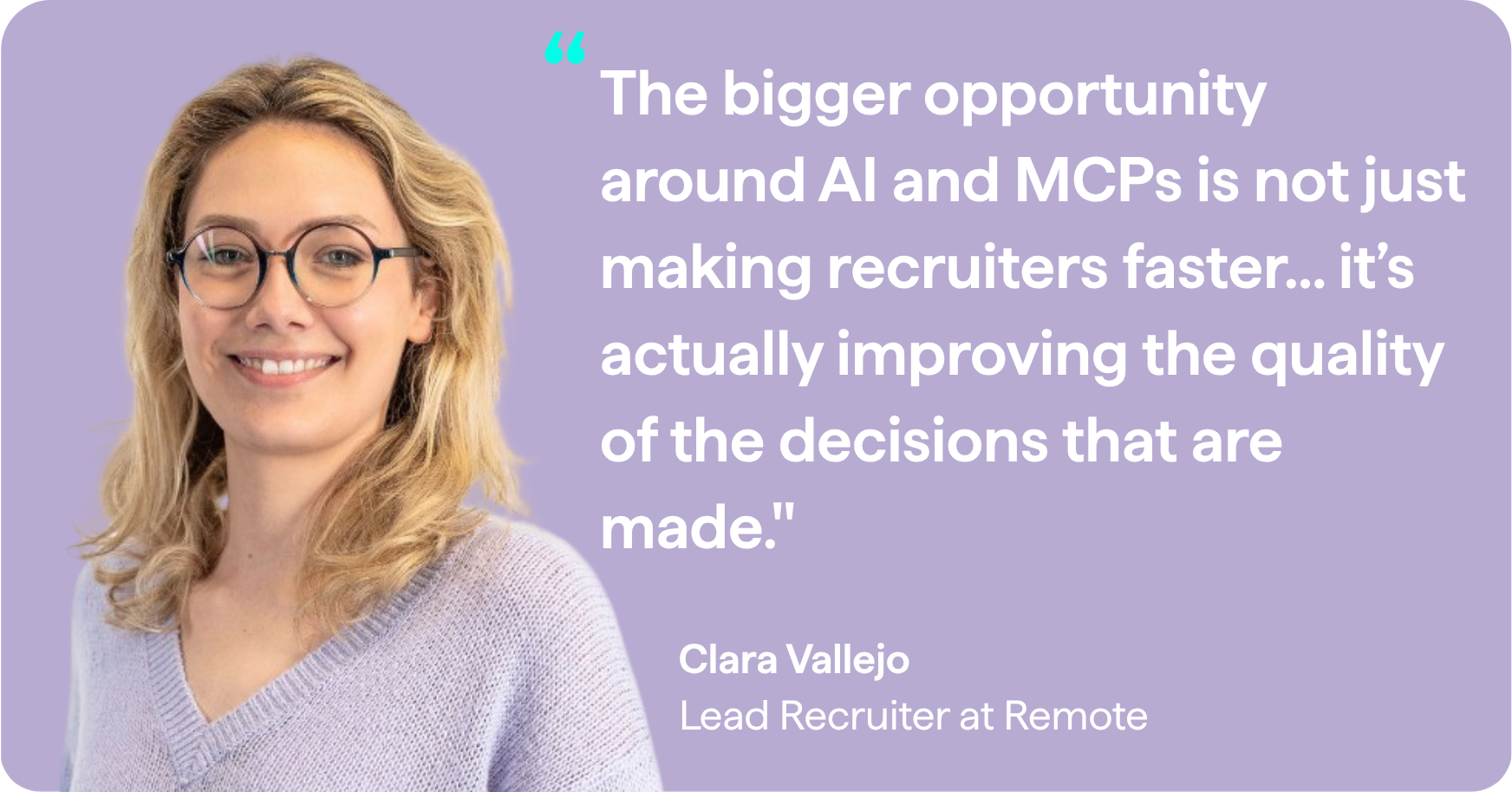
“The bigger opportunity around AI and MCPs is not just making recruiters faster and actually getting the data, it’s actually improving the quality of the decisions that are made.”
– Clara Vallejo, Lead Recruiter at Remote
Clara and Nathalie shared four ways their teams are using MCP to inform hiring strategy and decisions.
Bringing evidence to leadership conversations
At Linktree, Nathalie’s team uses its own hiring data to support its conversations with finance and executives.
Her team suspected Linktree’s compensation bands were out of step with what product marketing candidates expected, even though the comp consultant data it received didn’t show it.
Using their MCP connections, they looked at how often candidates said in conversations that they were aligned with the bands. The result: 70% of product marketing candidates were 15% above the existing bands. The team repeated the analysis for design and product management roles and took the findings to finance.
“We were able to get our comp bands corrected with finance, backed by real candidate data instead of anecdotal data.”
– Nathalie Grandy, Director of Recruiting at Linktree
Nathalie said the corrected bands also helped the team raise its offer acceptance rate.
Headcount followed the same pattern. When executives proposed a set of new roles to hire by a target date, Nathalie built a forecasting model from time to hire by department and her team’s capacity over the past six months. It showed how many recruiters and sourcers each location would need. The team added three people on six-month contracts without pushback, which Nathalie called probably the quickest headcount approval she’s ever gotten.
Spotting calibration gaps in interviewers and questions
At Remote, the share of candidates advancing from stage to stage looked healthy. But interview-to-offer sat around 10%, and the overall funnel view didn’t show why.
She used the Sigma and BrightHire MCPs to analyze how her engineering interviewers were calibrated at each stage. From that, she built a leaderboard comparing each interviewer with peers and a general benchmark. The team pulled assessment criteria from the best-calibrated interviewers, turned them into skills and interview prep for the whole group, and brought more consistency to how candidates are assessed. Within about six weeks, interview-to-offer rose to roughly 18%.
“MCP can ultimately really help us go granular, as opposed to just looking at things at face value and think, ‘This looks okay, but we’re still not getting those hires. What’s going on?'”
– Clara Vallejo, Lead Recruiter at Remote
At Linktree, engineers used five different interview questions, but pass-through rates for each were buried in a nonstandard scorecard. Nathalie pulled thousands of scorecards into a dashboard showing pass-through rates by question and level. That let the team see whether a question passed fewer senior engineers than staff engineers, and recalibrate it.
Measuring interviewer signal quality is one of the use cases BrightHire highlights for its hiring intelligence, which teams can bring into tools like Claude and ChatGPT with BrightHire MCP.
When a stage looks healthy but offers aren’t following, check how each interviewer and each question performs there.
Turning one good prompt into a team habit
Recruiters at Remote used to pull data in their own ways, and it varied from person to person and team to team. Clara’s team now builds shared artifacts and skills, which has made that work more standardized. She thinks of a skill as a recipe: once the ingredients and steps are set, anyone who uses it gets the same result.
Nathalie does the same with packaged prompts. When she builds an artifact, like sourcing response rates by country, she asks the AI tool to turn it into a prompt her team can reuse for the exact same data pull. Her team also keeps an AI project tracker, so people build on each other’s work instead of duplicating it.
How those tools reach the team matters too. Clara’s team largely skipped a formal rollout. When something is framed as a new tool, she said, people may treat it like a policy update and shelve it. Instead, she demoed the basics live, shared a library people could use right away, and pushed outputs into places the team already checks, like Slack.
Treat AI analysis as one more data point
One big misconception Clara has seen is that AI replaces human decision-making. Both panelists were clear that it doesn’t. In Clara’s view, AI is very good at analyzing, but a person still owns the decision.
Nathalie’s team is putting that into practice in design hiring. One of her recruiters built an artifact that assesses a candidate’s portfolio against the craft bar set by strong designers already at Linktree. Nathalie compared the output to a rubric in an interview plan: one more data point for the team to weigh. Recruiters and hiring managers still decide who moves forward.
“It’s not replacing you, it’s empowering you.”
– Nathalie Grandy, Director of Recruiting at Linktree
The same care applies to what you connect. Both panelists worked with their security, IT, and legal teams on guardrails for sensitive data. Clara also kept Greenhouse data out of Claude until Greenhouse released its own MCP. Nathalie recommends over-communicating with those teams, even through a shared Slack channel.
You don’t need to be technical to get started
Every example in this post came from two recruiting leaders who, by their own account, started out unsure where to begin. Nathalie calls herself one of the least technical people you’ll meet.
Both learned how to use MCP by experimenting. Nathalie set aside two to three hours a couple of times a week and asked the AI to break things down step by step. Her suggested first moves:
- Set up the connections you already have.
- Ask your vendors’ customer success teams for guidance and starter prompts.
- Ask the AI which bottlenecks in your hiring process deserve a closer look.
Setup and data approvals may still involve IT and security.
“I started to shift my mindset towards using Claude the way I’m using Google.”
– Clara Vallejo, Lead Recruiter at Remote
Nathalie sees recruiters becoming more technical and data-inclined, and roles like recruiting engineer appearing more often as a result. BrightHire customers can find starter questions in the Hiring Intelligence Cookbook, and Gem users can learn more about GemCP.
Watch the full conversation for more examples from Clara and Nathalie, including how they prep for offer calls and plan their day.