








Hiring teams are dealing with a lot of change all at once. Application volume keeps climbing, AI is making resumes harder to trust, and fake candidates are becoming a regular part of the job. At the same time, TA leaders are being asked to rebuild their teams around AI. The work ahead is figuring out where technology helps and where people still need to lead.
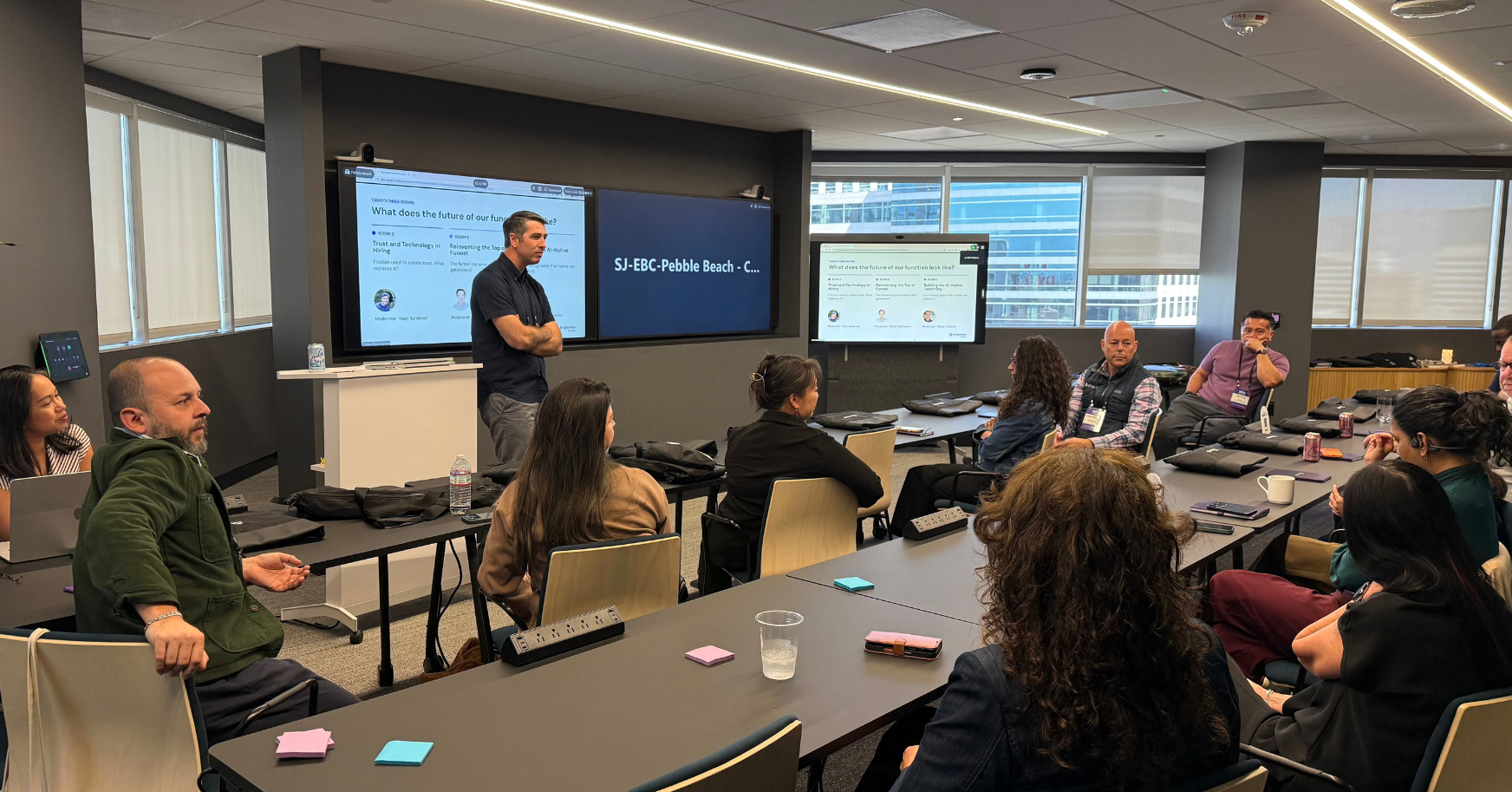
In September, BrightHire brought together talent leaders in San Jose, CA for the Shine Exec Summit, a working session built around small-group discussion rather than presentations. Leaders from companies including Google, Adobe, Databricks, and Proofpoint split into groups to compare notes on what’s working and what isn’t.
The day focused on three topics: managing the top of the funnel, building trust in hiring as candidate fraud rises, and what it takes to become an AI-native talent team. Below are key takeaways from those conversations.
7 takeaways from BrightHire’s Shine Executive Summit
1. Teams are turning to sourcing as inbound gets noisier
Application volume is overwhelming recruiters, with one leader managing 1.6 million applicants. At that scale, recruiting turns into triage, and every new application makes the right person harder to find.
Teams are changing how they handle inbound. Some cap the number of applications a role accepts, add intentional friction to the process, or outsource the first review. Others discussed using AI to filter and prioritize candidates, and building job postings from market data instead of a static description.
AI screening interviews came up as another option, especially for high-volume roles. Leaders said AI handles skills assessment well, while people still need to judge cultural alignment and make the final call. That split fits the top of the funnel, where recruiters can’t talk to everyone. In BrightHire’s study of 17,000 positions, only about 1 in 10 applicants got a recruiter screen on average. An AI interviewer can give far more candidates a structured first-round interview, with every candidate answering the same questions against the same rubric. Recruiters then review the evidence and decide who moves forward.
For TA leaders, the challenge is less about processing more applications and more about finding the signal inside them.
2. Resumes don’t tell you much anymore
Across the sessions, leaders described the same shift: AI has made it easy for candidates to write resumes that mirror the job description, and traditional screening has become less effective as a result. When most applications look like a match on paper, keyword matching stops separating strong candidates from weak ones. Several leaders said their sourcers and recruiters now spend significant time checking a candidate’s resume against their LinkedIn profile and a basic web search before moving forward.
Teams are trying different ways to get better signal earlier. Some use qualifying questions or screen for AI-generated content. Others are looking at video interviews or bot-assisted steps for high-volume roles. A few are rethinking the job description itself, from tailoring it to what candidates care about to replacing written postings with video.
One leader pointed to a step that comes before any of that: defining the role clearly. They described closing a search that had been open for a long time by researching the market in real time and redefining what the role required. Once the target was clear, the right candidates were easier to find.
The group kept human oversight at the center. AI can help draft job descriptions and sort applicants, but leaders wanted people making the calls.
3. Fake candidates are showing up more often
Leaders in the trust and technology group said fraudulent applicants have become more common over the past few years, as AI tools make it easier to mirror a job description and rehearse for an interview. Experiences varied, though. While some Leaders said fraud remains relatively rare in their experience, remote-first companies described being hit hardest.
Some of the examples were serious. One company reported catching about 1,000 fake candidates a month. Another leader described candidates with distorted voices who refused to turn on their cameras, which led the recruiting team to work with internal security.
The problem goes beyond candidates posing as someone else. Leaders also described people impersonating recruiters. One team found that LinkedIn accounts belonging to employees on leave had been hijacked and used to send fraudulent messages to CFOs at well-known companies. That team’s recruiters now change their passwords every week.
Teams are responding by adding checks at more points in the process. These include comparing a candidate’s photo across interview stages, running background checks earlier, tracking IP patterns in applications, and, in at least one case, requiring biometric ID.
For TA leaders, confirming who a candidate is has become part of running a hiring process.
4. Stopping fraud takes more than the recruiting team
A clear theme was the need for recruiting, security, and legal to work more closely to protect against candidate fraud.
When evaluating fraud detection tools, the group looked for three things: integration with their existing ATS, the quality of the detection models, and pattern recognition. Leaders also raised concerns about false positives and false negatives. They cautioned against adding fraud detection to recruiters’ already full workloads without care. One team is training its recruiting coordinators to spot patterns in fraudulent applications, starting with customer support roles.
The lesson for TA leaders is to bring security and legal in early, and to design checks that don’t make recruiters the last line of defense.
5. Interviews now test what candidates can do live
With AI use now widespread among candidates, companies are redesigning interviews around work that’s harder to fake. Leaders described shifting toward craft demonstrations, case study presentations, and live problem-solving, and away from traditional technical assessments. The goal is technical and behavioral interviews that hold up even when candidates have AI help.
The group also debated a harder question: where does acceptable AI use end and cheating begin? Some teams now prepare candidates by explaining what AI use is expected during the process. Leaders also discussed using LLMs in interviews to assess critical thinking. Another leader is moving up plans for a pre-hire assessment tool that includes interview cheating analysis.
AI is also changing assessment itself. One leader described an AI-powered simulation that tests decision-making in crisis scenarios. Another compressed expensive business simulations into a 35-minute AI assessment.
Interviews are becoming the place where candidates have to show their work, not just describe it.
6. Culture change is the hardest part of AI adoption
Leaders placed their teams on a simple matrix: curious, piloting, operating, or native. Answers ranged from curious to operating. One large tech company’s recruiting team reported significant progress, which it credited to dedicated AI training and tools. Leaders in financial services and other regulated industries described moving more slowly because of legal review and a lower tolerance for risk.
Several participants agreed that team buy-in and openness to change matter more than technical skills or org design. One team that has made significant progress pointed to foundations like a centralized data lake and an AI champions program.
On governance, one leader described an “operating system” model for AI: a controlled framework with an internal “app store” of custom tools. Recruiters can build and experiment inside it while candidates still get a consistent experience.
For TA leaders, rolling out tools is only part of the work. Getting the team ready to change how it works matters more.
7. Relationships and hiring decisions still belong to people
Leaders described the most successful AI uses in recruiting as ones that support human interactions rather than replace them. As automation takes over routine tasks, recruiter roles are moving from administrative work toward strategic work.
There was consensus that human connection will stay central, especially with passive candidates and executive hires. On assessment, participants said AI handles skills evaluation well, but people still need to judge cultural alignment.
Good decisions also depend on what interviewers capture. One leader’s approach to scorecard quality is to require hiring leaders to write meaningful feedback summaries within a set timeframe. Others discussed connecting hiring data with exit interviews and performance reviews to learn what makes a strong hire. Data is valuable, but predicting a successful hire is still hard, with many variables and a long gap between the hire and performance results.
For TA leaders, AI can speed up the process and inform it, but the relationships and the final call stay with people.
Final takeaway
Across discussions, one tension stood out: AI is adding volume and noise to hiring, and TA teams are working harder to find signal they can trust. Leaders are responding by sourcing with more intention, verifying candidates more carefully, and redesigning interviews around live work. The teams that get this right will use AI to take on more of the process while keeping people in charge of relationships and decisions.