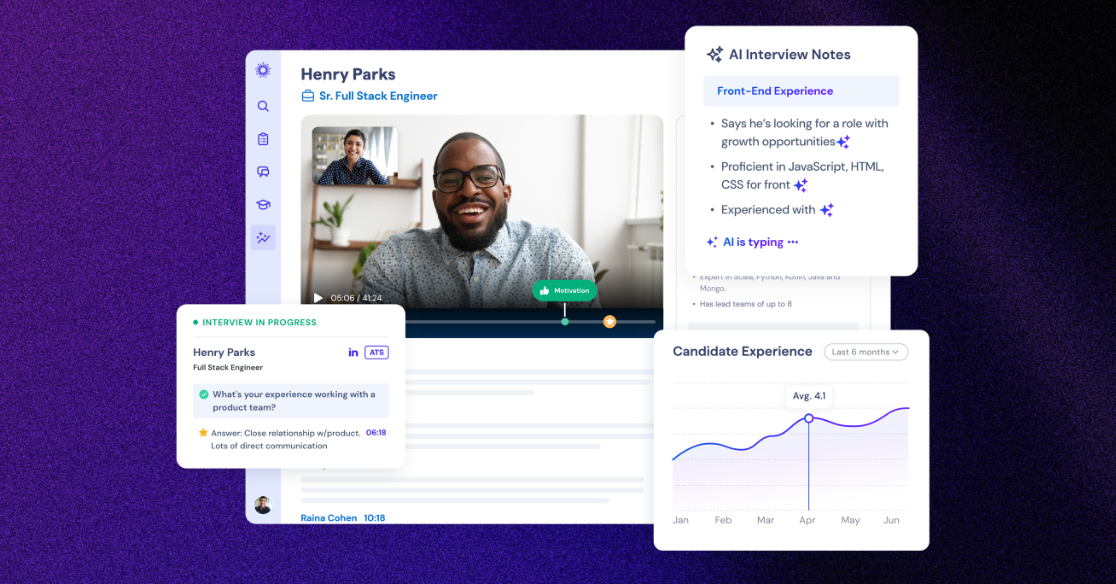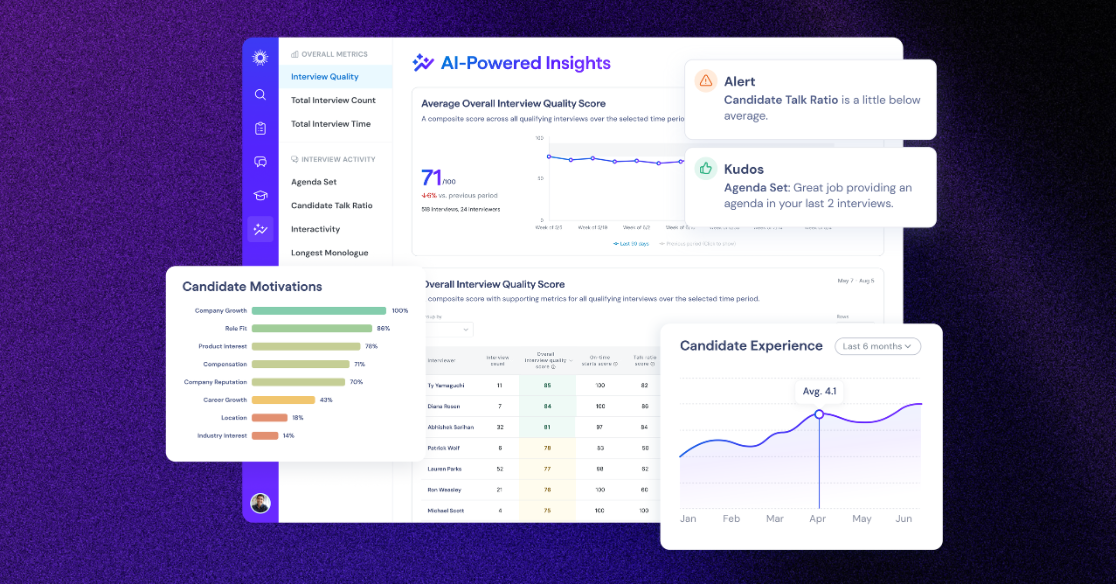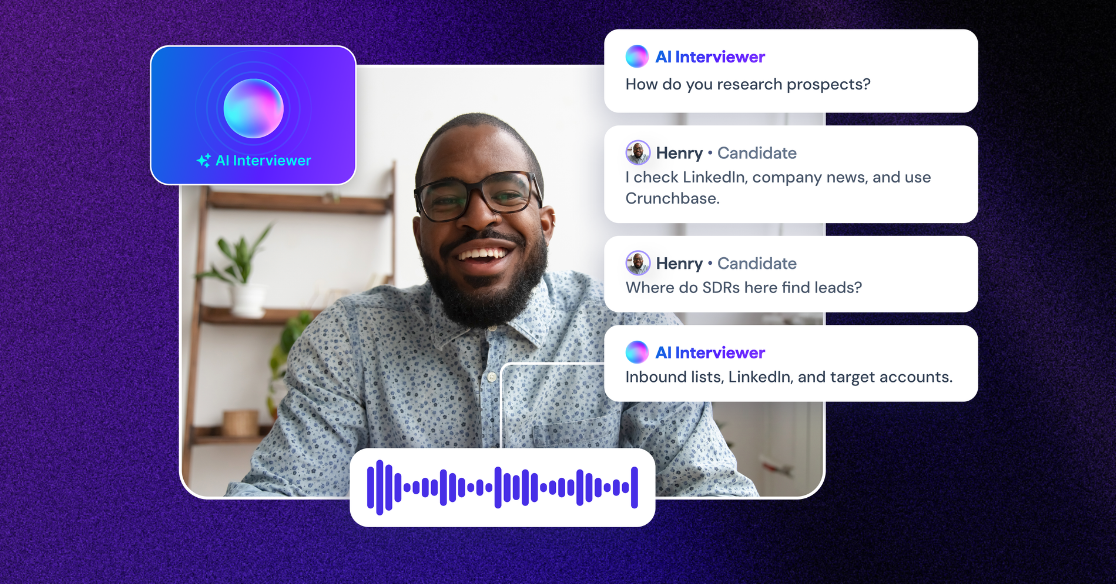






An AI interviewer is not a chatbot layered on top of your ATS. It is a structured interview AI agent that replaces early screening interviews for roles where volume, consistency, or speed is a constraint.
BrightHire Screen replaces manual calls with 24/7 AI interviews. It captures consistent data and identifies the best candidates instantly. Results sync directly with applicant tracking system (ATS) so you can move fast and hire better without the coordination stress.
BrightHire Screen runs the workflow in four steps:
- A candidate moves into the designated stage in your ATS (Greenhouse, Ashby, or Workday).
- The candidate receives an email to complete an AI interview and can complete the interview on their own schedule, on any device.
- The AI agent conducts a structured interview using your guide, your questions, and your evaluation criteria.
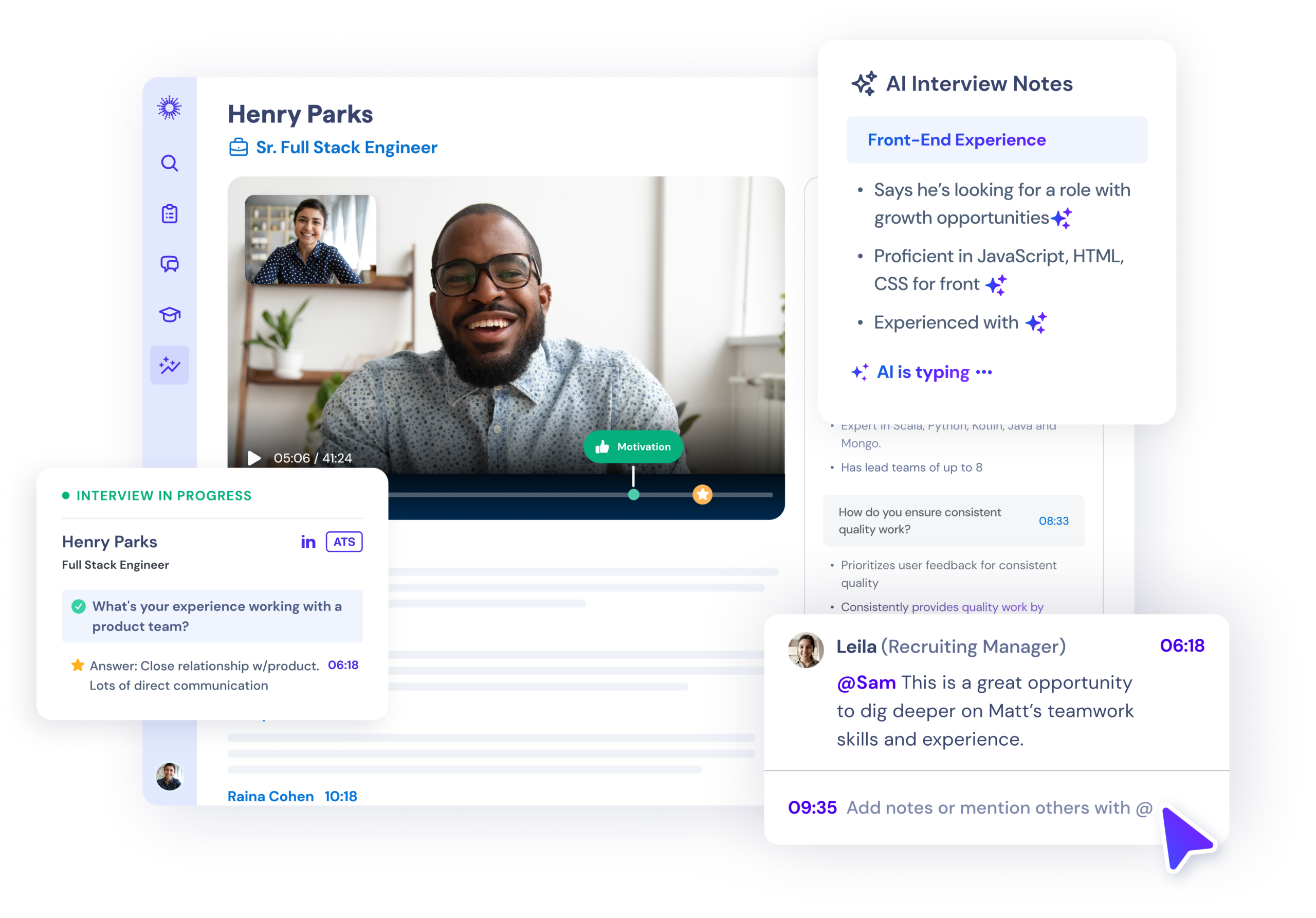
- Results push back into your ATS: overall score, structured summary, answers evaluated against your rubric, and a link to the full recording and transcript.
Your recruiter reviews the output. Your hiring manager sees structured evidence. No one coordinates a phone call.
Three Evaluation Formats That Produce Useful Signal
Not every question needs a 1-to-4 score. BrightHire Screen supports three evaluation formats, and recruiting teams can mix them within a single guide.
| Format | How It Works | Best For |
| Tiered rubric (1–4) | Team defines criteria at each level. AI evaluates the answer against those criteria and scores it. | Competency questions where you need comparable signal across candidates. |
| Summary | AI captures the substance of the answer without scoring it. | Open-ended questions like career trajectory or motivation, where context matters more than comparison. |
| Qualification (yes/no) | Binary screen. AI flags disqualifying answers at the top-level candidate view. | Work authorization, location requirements, or any pass/fail criterion. |
Before any candidate takes the interview, an AI assistant reviews the interview guide. It flags redundant questions, identifies rubrics where scoring criteria are too similar to differentiate candidates, and recommends edits. The final call belongs to the recruiting team.
How the ATS Integration Works
The integration runs in both directions. Greenhouse and Ashby customers connect in under 15 minutes.
Once live, the workflow triggers automatically when a candidate reaches the designated stage.
When a candidate finishes the interview, BrightHire pushes the overall score, a structured summary, and a completion notification back into the ATS.
Greenhouse customers get additional depth through the BrightHire Chrome extension. The full evaluation, question-level scores, and recording access appear directly in the candidate’s Greenhouse profile without requiring a tab switch.
Ashby customers see the score and summary with a direct link to the full BrightHire review.
Teams without an ATS can run BrightHire Screen in ATS-less mode using a shareable link they can embed in any outreach campaign or careers page.
Why Generic AI Tools Are Not a Substitute
Several tools now summarize interviews. AI companions, meeting notetakers, and general-purpose models can transcribe a conversation and generate a recap.
Summarizing a conversation is not the same as evaluating it.
A generic notetaker records what was discussed. BrightHire Screen evaluates what was said against the criteria your team defined.
The output is not a list of topics covered. The output is a structured scorecard your recruiter can compare across 50 candidates. Hazy Sandoval, Product Lead for BrightHire Screen, puts it directly: “We want to provide signaling. If recruiters had to prioritize, we give them a mechanism to prioritize. It is entirely not meant to make a decision on anyone’s behalf.”
Generic tools also lack the flexibility to match how hiring teams actually work. Rigid templated formats, which some competitors enforce by design, do not accommodate every role, every rubric, or every evaluation style.
BrightHire Screen supports fully customizable guides so teams can design the interview around what the role actually requires.
The Time-to-Interview Problem AI Solves
Before AI interviews, the path from application to first screen followed a predictable sequence: recruiter works through hundreds of resumes, identifies candidates worth calling, reaches out, coordinates schedules across two working-day calendars, and waits.
Oliver Stephenson, Strategy and Operations at BrightHire, describes the reality: “Realistically, it could be weeks before a candidate’s resume even gets looked at.”
With an AI interview in the stack, that timeline collapses.
Candidates complete the interview within hours of applying. One customer cut their first-interview-to-hire timeline from 24 days to one week.
Another saw inbound candidates reach hiring manager screens the day after applying, a speed previously reserved for referred candidates.
The time compression goes beyond efficiency. Strong candidates run multiple processes simultaneously. Getting them in front of a hiring manager on day one instead of day ten is a competitive advantage in tight talent markets.
Consistency Is the Structural Case for AI Interviews
Human screens are inconsistent by default. A recruiter on a Friday afternoon runs a different interview than the same recruiter on a Monday morning.
Questions get skipped. Follow-ups vary. Impressions drift.
AI interviews eliminate that variability. Every candidate receives the same questions in the same order, evaluated against the same criteria. The output is comparable across the full candidate pool.
Oliver Stephenson puts the consistency argument plainly: “Everyone understands that when I’m tired on a Friday afternoon, I might not be giving you as good a quality of experience as I otherwise would.”
The issue is not bias in the traditional sense. The issue is that human screens are variable in ways that obscure signal and produce uneven candidate experiences.
For high-volume roles, AI-driven consistency is the baseline requirement. For specialized or senior roles, it is the foundation that makes downstream calibration reliable.
The Candidate Experience Case
Some AI interview tools run 360-degree environment scans and rigid five-question templates applied to every candidate regardless of role. Candidates leave those processes feeling processed, not considered.
BrightHire Screen works differently. The candidate experience is designed to feel like a real conversation, not a form submission.
Candidates get a practice round before the real interview starts. Hiring managers can record a short video introduction that plays before the first question. The AI answers candidate questions in real time using an FAQ the recruiting team sets up in advance. Candidates close the interview by leaving a rating and optional feedback.
BrightHire Screen earns a 4.5 out of 5 average candidate rating. Candidates describe the experience as natural and conversational.
“The call felt natural and it allowed me to answer like I was in a conversation.”
— Customer Support Representative Candidate
78% of candidates say they prefer AI-led interviews. They describe them as fairer, more comprehensive, and more convenient, and they lead to higher satisfaction, more offers, and better retention.
“It felt like a real interview — so much better than just uploading a resume or answering multiple choice questions.”
— Product Manager Candidate
Where AI Interviews Belong in Your Funnel
The right placement depends on two variables: volume and talent scarcity.
For high-volume, early-career, and frontline roles, AI interviews work at the top of the funnel with minimal human touchpoint. Recruiters send the invitation after initial resume review, and the AI screening interview becomes the first live signal in the process.
For senior, specialized, or scarce-talent roles, the stronger pattern is a brief recruiter call first. The recruiter frames the purpose of the AI interview and sets context for the broader process.
The AI screening interview then captures structured signal without putting senior candidates in an automated-first experience without context.
Some teams layer BrightHire Screen after an initial automated assessment. One customer uses a skills screen to narrow 8,000 applicants to 4,000, routes that group through BrightHire Screen, then advances top performers to panel interviews. Both assessments run asynchronously, so candidates who want to move quickly can complete both within hours of applying.
What Recruiting Teams Ask Before Adding an AI Interviewer
Does the AI interviewer make hiring decisions?
No. BrightHire Screen evaluates candidate answers against the criteria your team defines and returns a score and summary. The recruiting team reviews that output and decides whether to advance the candidate.
BrightHire does not auto-disposition candidates, remove anyone from consideration, or recommend advancement. Every hire, pass, or rejection is a human decision. The AI produces the structured input your team uses to make that decision faster and with more consistent information.
Is an AI interview legally defensible?
Yes, and BrightHire Screen‘s design is specifically built with this in mind.
The scoring is fully transparent. Recruiters can see the criteria, the candidate’s answer, the evaluation, and the recording for every question. There is no black box, and your team can reconstruct exactly what was evaluated and how. Felicia Shakiban, a leading labor law expert and Partner at Arn Law, reviewed BrightHire’s approach: “BrightHire is an invaluable tool for supporting a fair and compliant hiring process. It ensures that employers have complete and accurate records, that candidates are considered consistently, and gives employers the ability to ensure interviews are conducted properly.”
How quickly can a recruiting team go live?
ATS-connected teams on Greenhouse or Ashby are typically live within 15 minutes. The integration connects your existing ATS stage workflow to BrightHire Screen, and the guide setup uses your existing job description and evaluation criteria as inputs.
Teams piloting without ATS integration can use ATS-less mode from day one using a shareable interview link. Full ATS integration can be added when the team is ready. The platform also includes an optional test link so the team can run through the candidate experience before sending to any live applicants.
What makes this different from HireVue or CodeSignal?
BrightHire has the deepest integration with Greenhouse in the market. The Chrome extension brings full evaluation detail into the recruiter’s Greenhouse workflow without requiring a platform switch. Competitors surface a score and a link back to their own product.
On evaluation flexibility: BrightHire supports fully customizable guides with mixed evaluation formats. Unlike BrightHire’s AI video interview software, CodeSignal and similar products anchor on rigid templates that do not fit every role or team.
On candidate experience: BrightHire does not run environmental scans or introduce surveillance-style features. The product earns a 4.5 out of 5 candidate rating because the experience is designed to be warmer, not more guarded.
Can one account run AI interviews for multiple roles and teams?
Yes. BrightHire Screen supports multiple AI Interviewers under a single account, each configured independently with its own guide, evaluation criteria, email templates, and access controls.
Role-based permissions let admins provision access at the individual interviewer level. A recruiting team can run simultaneous interviewers for sales, engineering, and operations roles without any overlap in guides or candidate data. Site admins control which team members can edit versus view each interviewer.