






TL;DR: An applicant tracking system is the system of record for your hiring process: reqs, stages, candidate records, and pipeline reporting. Interview intelligence captures what actually happens inside the interview itself: what was asked, what was said, and what was demonstrated. These are complementary systems, not competing ones. Your ATS stores the scorecard. Interview intelligence captures the evidence behind it. If your panel submits scorecards from memory, the ATS is only storing recall. Interview intelligence closes that gap without replacing your ATS.
Your ATS records every stage a candidate passes through, but the conversations that moved them from one stage to the next rarely make it into the record. That gap is where interview intelligence fits. If you’re weighing whether adding interview intelligence to your existing ATS is worth the investment, this article maps the functional split so you can make that call with clarity.
Core components of interview intelligence
Interview intelligence covers three components that work together to turn the interview from a conversation into structured, usable evidence.
First, BrightHire captures every structured interview by recording and transcribing in real time, then generates AI-assisted notes so interviewers stay focused on the conversation. The system captures the full narrative: every question asked, every answer given, and every competency signal surfaced.
Second, BrightHire structures the evidence by pushing AI-generated scorecards directly into the ATS at the end of each call, giving the debrief a shared evidence base rather than competing recollections. In-interview guidance surfaces the agreed question plan live during the call, keeping each interviewer calibrated to the same criteria.
Third, BrightHire delivers insights, coaching, and process improvement by surfacing interviewer-level benchmarks, question coverage analytics, and coaching signals that help TA leaders identify where the process breaks down and which interviewers need support. Compliance flags surface high-risk questions for admin review. These insights live in BrightHire, not in your ATS.
How your ATS supports structured hiring workflows
Your ATS manages the pipeline: req status, candidate stage, scorecard templates, and reporting. It’s the operational backbone of your hiring process, and for most enterprise TA teams, it’s non-negotiable infrastructure. Platforms like Greenhouse, Lever, Ashby, Workday, and more are designed to track candidates through stages, store evaluation rubrics, and generate the funnel metrics you report to leadership.
Structured hiring workflows live here. Enterprise ATS platforms define scorecards that capture the attributes for a successful candidate, assign interview kits with specific questions to each interviewer, and use rating scales to standardize evaluation. Your ATS tracks whether scorecards are submitted on time and flags bottlenecks in the funnel.
To assess how a rating was reached, your team needs to review the conversation behind it, including the questions covered and the responses that support the evaluation.
How ATS and interview intelligence systems differ
Each system has a distinct role in the hiring process. The ATS tracks candidate progress and next steps, while interview intelligence lets your team review the conversations behind each evaluation.
| Dimension | ATS | Interview Intelligence |
|---|---|---|
| Purpose | Manage reqs, stages, candidate records, pipeline reporting | Capture, structure, and analyze what happens inside the interview |
| Data captured | Application status, scorecard outcomes, stage transitions, offer details | Interview narrative, question coverage, interviewer consistency, competency evidence |
| Primary users | Recruiters, Recruiting Ops, hiring managers | Interviewers, hiring managers, TA leadership |
| Decisions supported | Pipeline health, time-to-fill, offer acceptance, funnel conversion | Quality of hire, interviewer calibration, debrief grounding, compliance documentation |
Functional scope of each tool
An applicant tracking system manages the end-to-end recruiting workflow: capturing applications, tracking candidates through pipeline stages, storing scorecards and offers, and feeding TA analytics. It’s the system where hiring decisions get logged, where SLAs get tracked, and where your headcount plan gets measured against delivery.
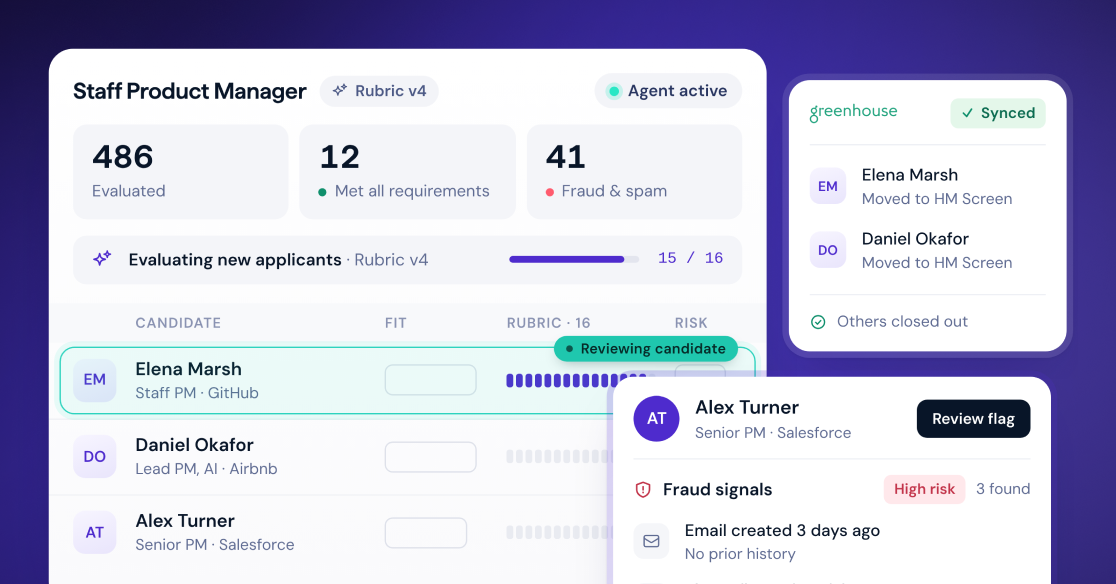
Interview intelligence platform operates one layer deeper. It records, transcribes, and structures live interviews, then pushes AI-generated notes and scorecards into your ATS for interviewer review. It guides interviewers through the plan while the call is happening, surfaces interviewer performance patterns across your full interview corpus, and flags compliance risks before they become audit findings.
Compare captured interview signals
Every scorecard in your ATS is the end point of a conversation. The rating, recommendation, and advance-or-reject decision are stored there, but the questions asked, the candidate’s exact responses, and whether the interviewer stayed on the structured plan are not. Interview intelligence captures that missing input.
If three interviewers submit scorecards from memory two hours after the call, your ATS is storing three different versions of what happened. BrightHire captures and structures recorded interviews so the debrief starts with shared context: full transcripts, highlight clips keyed to competencies, and pre-filled scorecards grounded in what was said, not what was remembered.
The difference matters most when hiring managers push back on a decision or when a debrief stalls because panel members recall different moments from the same conversation.
Map users to system functions
Recruiters and Recruiting Ops live in the ATS. They manage reqs, monitor pipeline health, enforce SLAs, and report funnel metrics to leadership. Hiring managers interact with the ATS to submit scorecards and review candidate status.
Interviewers engage with interview intelligence during the call itself. The interview guide surfaces live, keeping them on the structured plan. After the call, they review AI-generated notes and submit the pre-filled scorecard with one click. TA leadership uses interview intelligence to monitor interviewer consistency, identify coaching opportunities, and build the audit trail for defensible hiring decisions.
The overlap happens at the scorecard: interview intelligence generates it for review, the ATS stores it, and both systems stay in sync.
Optimize evidence-based hiring decisions
A candidate might move from phone screen to onsite in four days. To explain that decision later, you need a record of the responses that informed the panel’s assessment.
Interview intelligence makes that record available through transcripts and highlight clips. Hiring managers can revisit specific answers during the debrief, resolve disagreements, and assess candidates against shared criteria with fewer delays.
What happens inside the interview that your ATS doesn’t capture
Interview recordings let your team revisit the questions and responses behind a scorecard, giving debrief discussions a shared reference point.
Capture the interview data your ATS leaves out
Your ATS stores scorecard outcomes filled out after interviews, but it lacks the real-time interview data itself. Without capture, your team relies on interviewer notes (incomplete, inconsistent, filtered through memory) or recruiter summaries (secondhand, delayed, subject to interpretation).
Interview intelligence platform records, transcribes, and structures every interview, then syncs AI notes and scorecards to your ATS. When a hiring manager questions a scorecard rating, you can pull the exact moment the candidate walked through their approach, not a paraphrased summary from the interviewer’s recollection.
“Overall, I like that BrightHire isn’t just a note-taking or recording tool. We use it for interview documentation, hiring team alignment, calibration, and interviewer development, which makes it useful throughout the hiring process.” – Auriel O. on G2
Without these records, your ATS holds the evaluation but little evidence of how the interviewer reached it.
Interviewer performance and consistency
Timely scorecards tell you feedback arrived when expected, but they reveal little about question coverage, competency assessment, or whether interviewers applied a consistent hiring standard.
Without visibility into interviewer behavior, you can’t coach interviewers who are asking the wrong questions, missing key competency areas, or delivering an inconsistent candidate experience. Interview Insights surfaces per-interviewer performance patterns across your full interview corpus: which interviewers stay on the structured plan, which go off-script, which ask high-risk questions, and which need coaching.
This matters when you’re scaling hiring across distributed panels. If one interviewer consistently rates candidates lower because they’re evaluating against a different standard, per-interviewer analytics surface that pattern. A list of ratings in the ATS won’t.
Audit trails for interview fairness
At enterprise scale, the risk of biased or legally problematic interview questions, undocumented decisions, and insufficient audit trails is real.
High-risk interview questions are flagged for admin review, creating a documented record of what was asked and how evaluations were conducted. Candidate consent workflows are baked in by default. Full transcripts and recordings create an auditable record of what was asked and how the candidate responded. BrightHire is SOC 2 Type II certified, GDPR and CCPA compliant, and undergoes annual third-party bias audits.
The audit trail matters most when Legal or HR asks for documentation after a hiring decision is challenged. “The interviewers felt she wasn’t a fit” is not defensible. A full transcript with competency-mapped scorecards is.
Define data ownership: ATS vs. interview intelligence
The two systems hold different data, and the boundary is deliberate. Scorecards live in the ATS. Insights, benchmarks, and coaching live in BrightHire.
Manage candidate data in your ATS
When interview intelligence syncs a scorecard back to the ATS, it lands in the candidate record alongside everything else your team tracks. Recruiters and Recruiting Ops don’t need to log into a separate system to see the outcome. AI-drafted scorecard content syncs to supported ATS scorecard fields for interviewer review and submission.
Beyond the ATS: captured interview data
Interview intelligence holds the raw evidence: full transcripts, highlight clips, interviewer performance analytics, talk ratios, structure adherence patterns, and coaching signals. These insights live in BrightHire, not in your ATS, because they serve a different function.
The split follows who uses the data. Recruiters managing workflow need pipeline reporting and candidate tracking, while TA leaders working on evaluation quality need calibration and coaching data.
Synchronize intelligence and ATS records
The integration connects both systems without requiring manual effort from interviewers or recruiters. Interview guides pull from the ATS before the call, so interviewers see the structured plan tied to the role’s competencies. After the call, AI-generated notes, highlights, and pre-filled scorecards push back to the candidate record automatically.
Greenhouse and Ashby customers connect BrightHire Screen in under 15 minutes. Once connected, the workflow triggers when a candidate reaches the designated stage, and results push back into the ATS when the interview is complete. No manual export. No separate login. No duplicate data entry.
Most teams are operational in under one day, with ATS-less mode available from day one via shareable link for teams piloting before full integration.
How interview intelligence and your ATS connect
BrightHire designed the integration to keep candidate records intact and recruiters out of a second system. For the full mechanics on field-level sync, error handling, and setup by ATS platform, see interview intelligence integrates with your ATS.
Automate your ATS scorecard workflow
The scorecard workflow starts before the interview. The interview guide pulls from the ATS, surfacing the competencies and structured questions assigned to that interviewer. During the call, the guide stays visible, keeping the interviewer on the plan.
When the call ends, AI scorecard auto-fill translates the interview transcript into a pre-populated scorecard mapped to your evaluation criteria. The interviewer reviews the draft, adjusts ratings if needed, and submits with one click. The scorecard syncs back to the ATS immediately.
BrightHire customers submit feedback 28% faster because the administrative work of writing notes and filling scorecards from memory is removed. That speed compounds across your full interview panel: faster scorecard submission means faster debriefs, which means faster decisions, which means less candidate drop-off.
Candidate records stay in your ATS
The sync keeps candidate records intact. Interview summaries, highlight clips, and scorecards land in the same candidate profile your team already uses. Recruiters don’t toggle between systems. Hiring managers don’t log into a separate tool to review interview evidence.
For teams running Greenhouse, Lever, Ashby, Workday, and more, the integration is native and bidirectional.
Sync with your full hiring stack
The ATS is one node in your hiring stack. Interview intelligence also syncs with your video conferencing platform (Zoom, Google Meet, Microsoft Teams), your calendar, and your communication tools.
BrightHire joins calls automatically, so interviewers don’t need to remember to hit record or manually upload notes. It captures and structures each interview, then pushes AI-generated notes and a pre-filled scorecard to your ATS when the call ends, without adding work to the interviewer’s plate.
For a deeper comparison of how interview intelligence differs from lightweight notetakers, see AI notetaker vs interview intelligence.
Beyond the ATS: why you need interview insights
The question is not whether your ATS is doing its job. It is. The question is whether the scorecards stored in your ATS are grounded in evidence or recall.
Interview intelligence adds value when:
- Hiring volume is high. If your team runs structured interviews at scale, the time saved on note-taking and scorecard completion compounds. In a BrightHire study, of 25,000+ candidates, teams saw 27% fewer interviews per hire and 28% faster feedback submission, which translates directly to faster time-to-fill and lower interviewer hours per role.
- Interviewer consistency is a known challenge. If debriefs stall because panel members recall different moments from the same interview, or if hiring managers push back on scorecard ratings, evidence-based calibration sessions replace memory-based negotiation.
- Compliance documentation is a requirement. If your organization operates in a regulated industry, or if Legal has flagged interview documentation as a gap, interview intelligence creates the audit trail your ATS cannot provide.
- Candidate fraud is a concern. If you’re hiring remotely at scale, candidate fraud detection runs during the interview itself, flagging anomalies for human review without interrupting the flow.
The decision to add interview intelligence is not a judgment on your ATS. It’s a recognition that the interview itself is a consistently under documented part of the hiring process.
Request a demo to see how BrightHire syncs with your Greenhouse, Lever, Ashby, or Workday setup and what an AI-generated scorecard looks like in your ATS.
FAQs
No. Your ATS continues to manage candidate records and recruiting workflows. Interview intelligence connects to it, bringing your interview plans into each conversation and sending AI-drafted feedback back to the candidate record for interviewer review.
No. Scorecards, interview summaries, and highlight clips sync directly into the candidate record in your ATS. Recruiters and hiring managers see interview evidence in the same system they already use for pipeline management.
Nothing. Your ATS remains the system of record. Interview intelligence adds a capture and analysis layer for the interview itself, then syncs structured data (scorecards, notes, highlights) back to the candidate record. Existing workflows, scorecard templates, and pipeline reporting stay intact.
Yes. BrightHire pulls interview plans and scorecard templates from your ATS before each call, then pushes completed scorecards back to the same fields your team already uses. The integration maps to your existing evaluation criteria without requiring template changes.
Key Terms Glossary
Interview intelligence: Platform that captures, transcribes, and analyzes live interviews, then pushes structured data (notes, scorecards, highlights) into your ATS automatically.
Applicant tracking system (ATS): The system of record for the hiring process, managing reqs, candidate stages, scorecard templates, and pipeline reporting.
Scorecard: A structured evaluation rubric tied to role competencies, used by interviewers to rate candidates against shared criteria.
Bidirectional sync: The two-way data exchange between interview intelligence and the ATS, where interview guides pull from the ATS before the call and scorecards push back after the call.
System of record: The platform where hiring decisions and candidate data are stored and tracked (the ATS).