




“AI-native” gets thrown around a lot these days, but there isn’t a clear definition. For many TA teams, becoming AI-native has meant treating new AI tools like a coat of paint layered on top of existing workflows. But a smaller group is treating the technology disruption as a chance to renovate the function itself: rebuilding the workflows, redesigning roles around what AI can and can’t do, and hiring against a different set of skills.
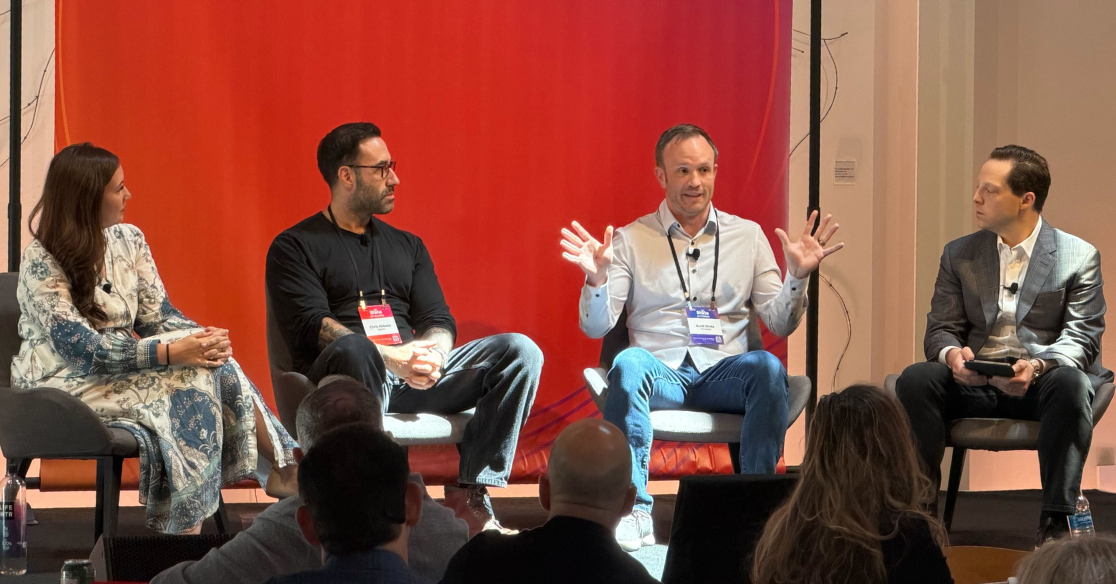
Chris Abbass, CEO of Talentful, Tracy St. Dic, Global Head of Talent at Zapier, Scott Dicke, VP of Talent at MaintainX, are three talent leaders who are driving that work for their teams. At Shine 2026, they sat down with BrightHire’s CEO, Ben Sesser, to share their insights and advice for talent leaders who want to build truly AI-native teams.
1. Start with a vision, not a tool stack
The first trap, the panel agreed, is focusing solely on AI tools. Adding agents to an existing workflow is not the same as redesigning the workflow around them.
According to Tracy, AI-native comes down to two things: strategic vision from the TA leader and the AI fluency of the team. “If you don’t have the strategic vision of how your function is fundamentally going to change, how you have to redesign the factory and break hiring down into its core components and rebuild them, then you’re just chasing tools,” she says.
According to Chris, the work is architectural:
“We’re building kind of two different companies. One is for humans to be successful, and one is for our agents and AI to be successful. And that involves thinking from first principles and re-architecting all the workflows in your business.”
— Chris Abbass, CEO of Talentful
2. Narrow the use case before you build anything
Chris described how Talentful picked one specific outcome internally, getting new hiring managers calibrated faster, and made that the only job-to-be-done for their AI work. Everything else came second. He’s seen too many teams try to boil the ocean.
In practice, Chris sees the recruiter’s role as keeping what he calls the “data cube” accurate: the job description and candidate information. AI then does the research, looking at company history and market mapping and building it out for the recruiter immediately. The research AI takes over is the kind of toil Tracy talks about automating away, freeing her team to do “more of what they really love and less of what we call the toil.”
The pre-work is unglamorous: getting the underlying data clean. Job descriptions, scorecards, sourcing notes, candidate context. All of it has to be accurate, structured, and reliably available before any of the more interesting work pays off. “You have to get your team to do their admin properly. There has to be a single source of truth for this information we’re using as a business,” Chris said.
3. Make AI fluency a hiring criterion — and define what you mean
Tracy’s team uses a four-part rubric for AI fluency that Zapier has open-sourced and now factors into hiring at every level of the company:
- Mindset. Are you curious about these tools? Are you experimenting? Do you lean in?
- Strategic acumen. Function-specific: how do you think your role changes over the next few years? Which parts of it should and shouldn’t use AI, and why?
- Builder skills. Can you use AI as a thought partner? Do you iterate? Do you have a deliberate prompting approach?
- Accountability and discernment. Can you tell a good output from AI slop? Do you know when to trust the model and when to override it?
Each component is scored against three levels (capable, adaptive, transformative) and assessed at four points in Zapier’s hiring funnel: application, recruiter screen, a live skills test, and the executive interview. Tracy invests heavily in calibration, with her recruiting and executive teams aligned on the rubric together and each function building its own examples of what each level looks like in their domain.
The principle most worth copying: what a candidate’s AI use looks like today matters less than how it’s changed over the last six months. A candidate who has used the same three tools for three years is a different bet than one whose workflow has visibly evolved.”We’re looking at the slope and not the snapshot,” says Tracy.
The interview question Tracy recommends: tell us how you were using AI six months ago, and walk us through the journey to now.
4. Govern what your team builds, not just what you buy
Once a team is AI-fluent, governance stops being about vendor selection. Where you used to complain about three overlapping SaaS tools, you now risk ending up with eighty-seven homegrown ones: some duplicative, some half-broken, some maybe illegal.
There are really two layers to the problem: the agents themselves, and the workflows people build on top of them. The panel offered an approach for each:
A harness for what agents can do
Scott built plugins for Claude Cowork that ship with skill documents telling every agent what the team’s existing tech stack already handles. The docs forbid agents from:
- Rebuilding functionality the tech stack already has
- Asking for API keys
- Going off-script
The harness travels with every agent his recruiters spin up, so the rules are enforced automatically.
A pipeline for what people build
Tracy moves home-built workflows through four Google Drive stages, with each step earning more reach across the team:
- Personal folder. Every recruiter builds their workflows here. An audit skill scans each new build for PII handling and API-key issues before anything can be promoted.
- Staging folder. Promising builds move here so the team can test and refine them together.
- Templates. Builds that prove themselves graduate here: copy-and-modify starting points that recruiters adapt to their context.
- Master folder. The best move here and become required tooling for everyone.
Both approaches assume the team is actually building things — and Zapier makes the time for that, too. Every three weeks, the team has protected “build days” for development and sharing. Citizen development is part of Zapier’s mission, Tracy noted, but the structure around it is what turns it from a hobby into a system.
5. Let the work redesign the org chart, not the other way around
The team a TA leader needs today doesn’t look like the team they had a few years ago.
Scott pointed to the coordinator-to-recruiter ratio as one immediate shift. With auto-scheduling, AI-drafted job descriptions, and AI-built interview plans, the manual scheduling and admin that used to define coordinator and operations work happens faster, and recruiters can take on more open reqs. But, there’s a caveat:
“We’re all going to get really good at this. We’re all competing against each other for the same talent. Your recruiters are taking on more openings, and executive management is looking at it going, ‘You have more capacity now. Sounds like we can hire faster.’ The goalposts are going to keep moving.”
— Scott Dicke, VP of Talent at MaintainX
That’s why Tracy is redesigning roles, not just ratios. For example, faced with an open leadership-recruiter req, she chose not to hire for it. Instead, she built an AI-orchestrated system in its place, with humans brought in only for parts of the candidate experience that need finesse.
In addition, coordinators on her team are now recruiting operations specialists. Roles are more fluid because everyone builds their own solutions. The skill she hires for is less I know how to recruit and more I can learn hard things fast.
6. Plan for a function that won’t look the same in a year
Ben closed the panel by asking each leader what would look different a year from now. Here’s what they had to say:
- Resumes start to disappear. Scott expects them to be replaced by AI-driven prompting against richer candidate context (work samples, social profile, demonstrated thinking) matched directly to role context, rather than two pieces of paper matching to each other.
- Everyone has a personal and a professional agent. Chris flags the open question of which one travels with the employee when they leave.
- AI operations becomes a defined function. Chris sees this emerging as a discrete role inside companies.
- Token budgets enter headcount planning. Chris expects companies to start setting aside budget for token usage the way they do for tooling.
- AI becomes inseparable from TA workflows. That’s where Tracy is aiming, and getting there means rebuilding hiring from its parts.
“I hope we’re moving to a place where if I look across all of my TA workflows and systems, you can’t pull the AI out of it anymore. I hope that we have rebuilt and stripped down hiring to its parts, which would mean asking things like: why do we have resumes? Why do we have applications?”
— Tracy St. Dic, Global Head of Talent at Zapier
Her team is also focused on bringing AI to where the work actually happens. For Zapier, that means pulling tools like BrightHire into Slack, where the team already works. As Tracy put it, the point is to expand the capacity of the human element by automating the toil around it.
Final takeaway
AI-native is not a procurement decision. It’s a redesign of the workflow, of the team’s skill set, of the governance around what gets built, of how progress gets measured.
The teams doing this well are treating their TA function the way Chris described his own org: as two functions operating in parallel, one for humans, one for agents, both deliberately designed. The technology will keep getting better. The advantage will sit with the leaders who use 2026 to do the unglamorous work of completely renovating their function.