





AI screening for high-volume hiring uses an AI interviewer to run structured first-round screening interviews, not resume screening, so every qualified applicant gets a real first-round conversation instead of the roughly 1 in 10 who reach a recruiter today. Recruiters and hiring managers still make every decision; the AI surfaces the signal they decide on.
Why only 1 in 10 applicants gets a recruiter screen
For teams hiring at scale, applications often arrive faster than anyone can screen them, meaning many go unseen. In BrightHire’s study of 17,000 positions, only about 1 in 10 applicants got a recruiter screen. The other nine were sorted by their resume, or not looked at closely at all.
AI-written resumes have amplified this challenge in recent years. When many applications are polished by the same tools, the document says less about who can actually do the job. And when the resume tells you less about a candidate, the first-round interview is where you actually learn whether they can do the job.
What AI screening for high-volume hiring actually means
“AI screening” can mean two different things. One is resume screening, which ranks or filters written applications before anyone talks to a candidate. The other is a screening interview, a structured first-round conversation an AI interviewer runs with each applicant. For high-volume hiring, the screening interview is the one that gets more candidates a real first round.
An AI screening interview gives every qualified applicant a consistent, job-related conversation, and the recruiter or hiring manager makes every advance-or-pass decision based on what that conversation surfaces. The AI interviewer runs the interview itself, evaluates each answer against the criteria your team set, and hands a recruiter the evidence. It surfaces signal, which allows a person to decide.
How AI-led screening interviews work
A screening interview with an AI interviewer runs on the candidate’s own schedule and follows the same structure for everyone. Here’s what it typically looks like:
- The team sets the questions and the bar. Recruiters and the hiring manager define the questions and the evaluation criteria for the role, so the interview measures what the job actually requires.
- The candidate is told it’s an AI-led interview. Disclosure comes first, and many tools let the candidate try a quick practice question so they can get comfortable before the real conversation begins.
- The conversation happens. The candidate talks with the AI interviewer by voice, on their own device and time, and the AI asks follow-up questions based on what the candidate says rather than reading a fixed script.
- Answers are evaluated against the rubric. The AI scores each answer against the criteria the team defined and writes a structured summary. Depending on the tool, that output can be a tiered rubric score, a plain summary, or a simple qualified-or-not read.
- A recruiter reviews and decides. A person reads the score, the summary, and the recording, and decides whether to advance the candidate. A responsible AI interviewer does not advance or reject anyone on its own.
- The record is kept. The transcript, summary, score, and recording are retained as an auditable record of how each candidate was assessed.
Why the interview format matters at scale
Format is not a cosmetic choice at volume because it changes how many candidates finish. A 2026 University of Exeter working paper that randomized more than 3,000 applicants across asynchronous and live formats found that the asynchronous, one-way format cut application continuation by more than half, and the drop held even among the most qualified applicants.
A two-way conversational interview, where the AI asks follow-up questions and the candidate responds in real time, tends to hold more of your qualified pipeline through the first round. The full comparison of the formats, including one-way recorded video and chatbots, lives in Conversational AI Interview vs. One-Way Video.
Does the AI make the hiring decision?
Employers and candidates both ask this first, and the answer depends on the tool. Some AI interviewers score candidates and automatically advance or reject them. A well-designed one keeps that decision with a person. It evaluates each answer against your criteria and returns a score and a summary, which a recruiter or hiring manager reads before deciding.
Responsible AI interviewers do not auto-reject candidates, do not recommend who to hire, and treat a score as evidence rather than a verdict.
This matters more when the numbers are large. When a first round covers thousands of applicants, a person still makes each advance-or-pass call, so the team can explain any hiring decision to a candidate, a hiring manager, or a regulator later.
Fairness, bias audits, and compliance when you screen at volume
Screening more people with AI raises a fair question from legal and HR: does scale make bias harder to control? Handled well, structured screening interviews can reduce some of the inconsistency that creeps into ad hoc phone screens, because every candidate answers the same job-related questions against the same rubric. Handled badly, an unaudited model can scale a single biased pattern to thousands of people at once. What separates the two is whether the system is audited, documented, and open to human review.
BrightHire Screen, for example, undergoes independent third-party AI bias audits. It is SOC 2 Type II certified and GDPR and CCPA compliant, with candidate consent and opt-out and a Zero Data Retention option available.
The rules are tightening, and they vary by where you hire. New York City’s Local Law 144 requires a bias audit within the year, public posting of the results, and notice to candidates. Illinois requires notice, consent, and deletion on request when AI analyzes recorded video interviews. Colorado’s automated-decision-technology law applies new duties to high-risk AI used in “consequential decisions,” including employment, starting January 1, 2027. The EU AI Act treats employment AI as high-risk, with those obligations phasing in for employment use by December 2, 2027, under the Commission’s current implementation position.
When you evaluate any AI interviewer, ask to see an independent third-party bias audit rather than a vendor’s own assurance that its system is fair.
Keeping the candidate experience strong in high-volume hiring
With AI screening interviews, two worries often come up: candidate drop-off and backlash.
Structured screening interviews can widen fair access rather than narrow. If only 1 in 10 applicants reaches a recruiter today, that’s the gap AI can close by giving far more candidates a real first-round interview.
When applicants in a 70,000-person field experiment were given the choice, 78% picked the AI interview over a human one. Candidates who went through AI-led screening also came out ahead: 12% more likely to get an offer, 18% more likely to start, and 18% more likely to still be employed a month later (Jabarian and Henkel, 2026). BrightHire Screen’s own average candidate rating is 4.5 out of 5.
None of that works without disclosure. In a 2026 Greenhouse survey, 63% of US job seekers had already done an AI interview, but 70% said it was not clearly disclosed, and only 8% believed AI makes hiring fairer. Telling candidates up front that the interview is AI-led, and that a person reviews it can alleviate that skepticism.
For the full candidate-experience playbook, including how to reduce drop-off and protect employer brand, see Candidate Experience with AI Interviews.
High-volume screening use cases by role
High-volume hiring looks different by role, and the screening interview adapts to each.
Contact center and SDR roles come down to communication and composure, which a two-way conversation surfaces far better than a resume. A structured screening interview lets a candidate demonstrate how they actually sound with a customer or a prospect, on the first day they apply.
Healthcare teams run constant, repeatable requisitions for clinical and support staff, often against licensure and shift constraints. A consistent first round keeps every qualified applicant moving instead of stalling in a queue while the best people take other offers.
For frontline and retail hiring, speed and availability decide who you lose to another employer. A screening interview a candidate can take on their own time, the same day they apply, protects the pipeline when a resume tells you almost nothing about fit.
Early-career and campus hiring brings large applicant spikes in tight windows. Structured interviews give first-time candidates a fair, uniform shot to show what they can do, rather than a resume that mostly reflects who had access to internships and connections.
Fitting AI screening into your ATS
An AI screening interview only helps if it fits the system your team already runs on.
BrightHire Screen connects to your ATS and triggers the interview automatically: when a candidate reaches the right stage in Greenhouse, Ashby, or Workday, Screen sends the invitation, and the results write back to the candidate’s record. Teams on Greenhouse or Ashby are typically live within about 15 minutes.
To pilot before wiring up the ATS, Screen also has an ATS-less mode that works from day one with a shareable interview link.
What to look for when evaluating AI screening software
If you’re comparing tools for high-volume hiring, a few criteria separate a real screening interviewer from a resume scorer with a chat interface:
- Format. Does it run a two-way conversation with follow-up questions, or a one-way recording? The format drives both signal and completion.
- Human control. Can a person review every result, and does the tool avoid auto-rejecting anyone on its own?
- Independent bias audits. Is there a third-party audit you can actually see, not just a page that says the vendor takes fairness seriously?
- Security and compliance. SOC 2 Type II, GDPR and CCPA, candidate consent and opt-out, and clear data-retention and model-training terms you can get in writing.
- ATS fit. Does it connect to your ATS and write results back where recruiters already work?
- Candidate experience. Is there evidence that candidates complete the interview and rate it well?
How BrightHire Screen delivers AI screening at enterprise scale
As part of the interview intelligence platform BrightHire has run for years, Screen draws on more than 3 million hiring conversations the company has captured, and BrightHire has supported more than 1.5 million candidates. Screen runs structured first-round screening interviews at volume, scores each against the rubric your team defines, and returns evidence a recruiter acts on, never a decision.
By design, Screen never auto-rejects a candidate, and it does not use customer data to train its AI models. Candidates can warm up with a Practice Round, a short Hiring Manager Introduction can open the interview, and teams choose the output that fits the role, from a tiered rubric score to a plain summary to a simple qualified-or-not read.
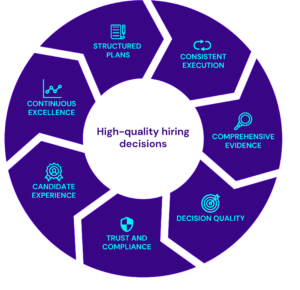
Screen sits inside the wider approach BrightHire calls the seven pillars of the quality of hiring system, which treats quality of hire as the output of a consistent process rather than a lucky read on a resume.
Adam Grant, the Wharton organizational psychologist, calls BrightHire “the most compelling technology I’ve ever seen for making better hiring decisions.”
Frequently asked questions (FAQs)
How do you screen a high volume of job applicants with AI?
You give every qualified applicant a structured first-round screening interview run by an AI interviewer, instead of trying to read every resume by hand. The AI holds the same job-related conversation with each candidate, evaluates the answers against your rubric, and passes the results to a recruiter, who decides who advances. It screens through interviews, not resume filtering.
What is AI screening for high-volume hiring?
AI screening for high-volume hiring uses an AI interviewer to run structured first-round screening interviews, not resume screening, so every qualified applicant gets a consistent conversation while recruiters and hiring managers make every decision.
Can AI interview candidates at scale fairly?
It can, when the system is built for fairness and oversight: the same structured questions for everyone, independent third-party bias audits, and a person who reviews results and makes the call instead of an automatic reject. Structure can make a high-volume first round more consistent than ad hoc phone screens. Because fairness depends on those controls, ask any vendor for an audit you can actually see.
How do recruiters handle thousands of applicants?
Most cannot screen them all by hand, which is why in a BrightHire study of 17,000 positions only about 1 in 10 applicants got a recruiter screen. An AI interviewer lets a team offer a real first-round interview to far more of them without adding recruiter hours, then spend recruiter time on the candidates who show signal.
Is a two-way conversational AI interview better than a one-way recorded video at high volume?
For keeping candidates in your funnel, two-way tends to hold up better. One-way recorded formats have been linked to sharp drop-off in application continuation, including among stronger candidates. A conversational interview lets candidates respond and be asked follow-ups, which feels closer to a real interview. See Conversational AI Interview vs. One-Way Video for the full comparison.