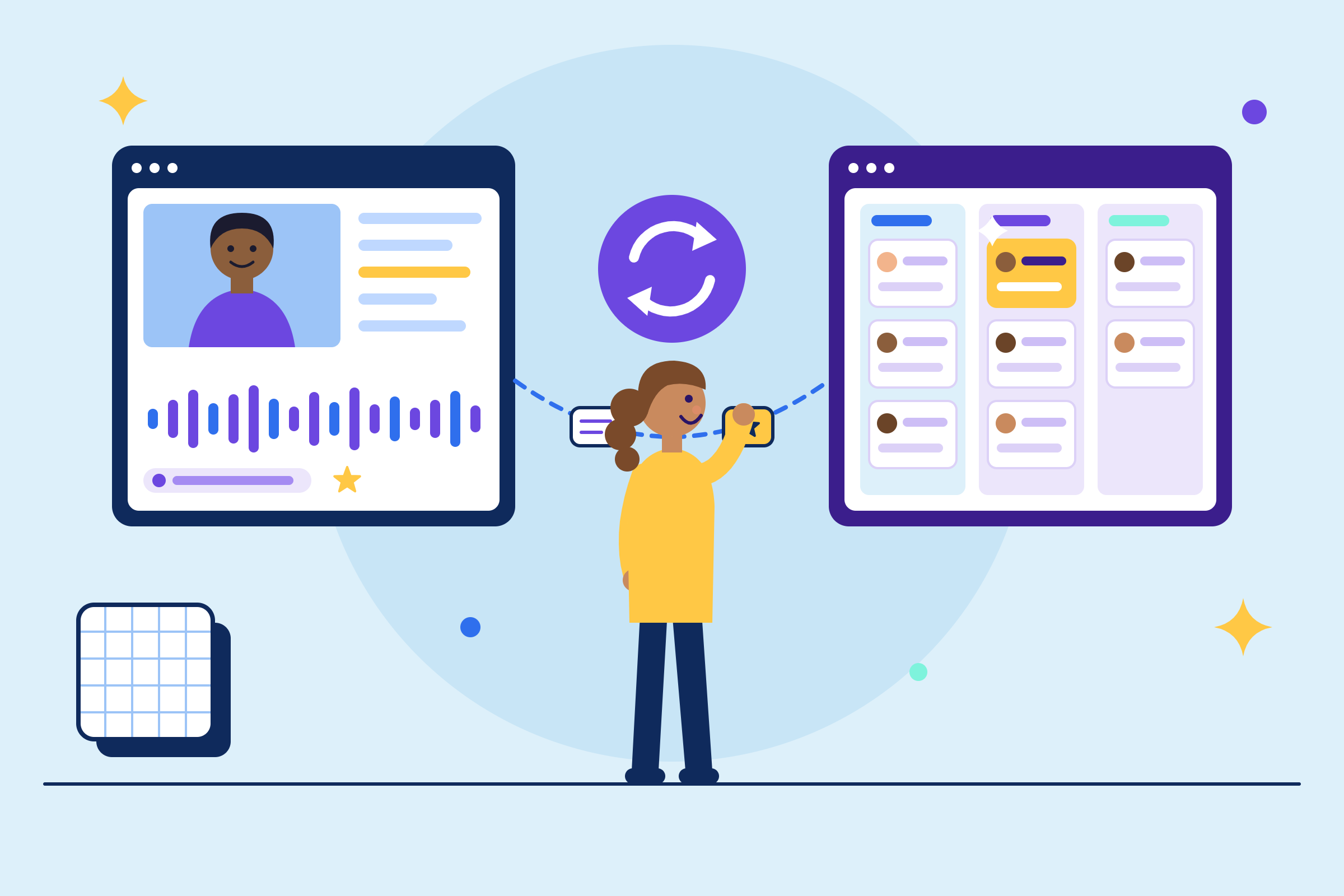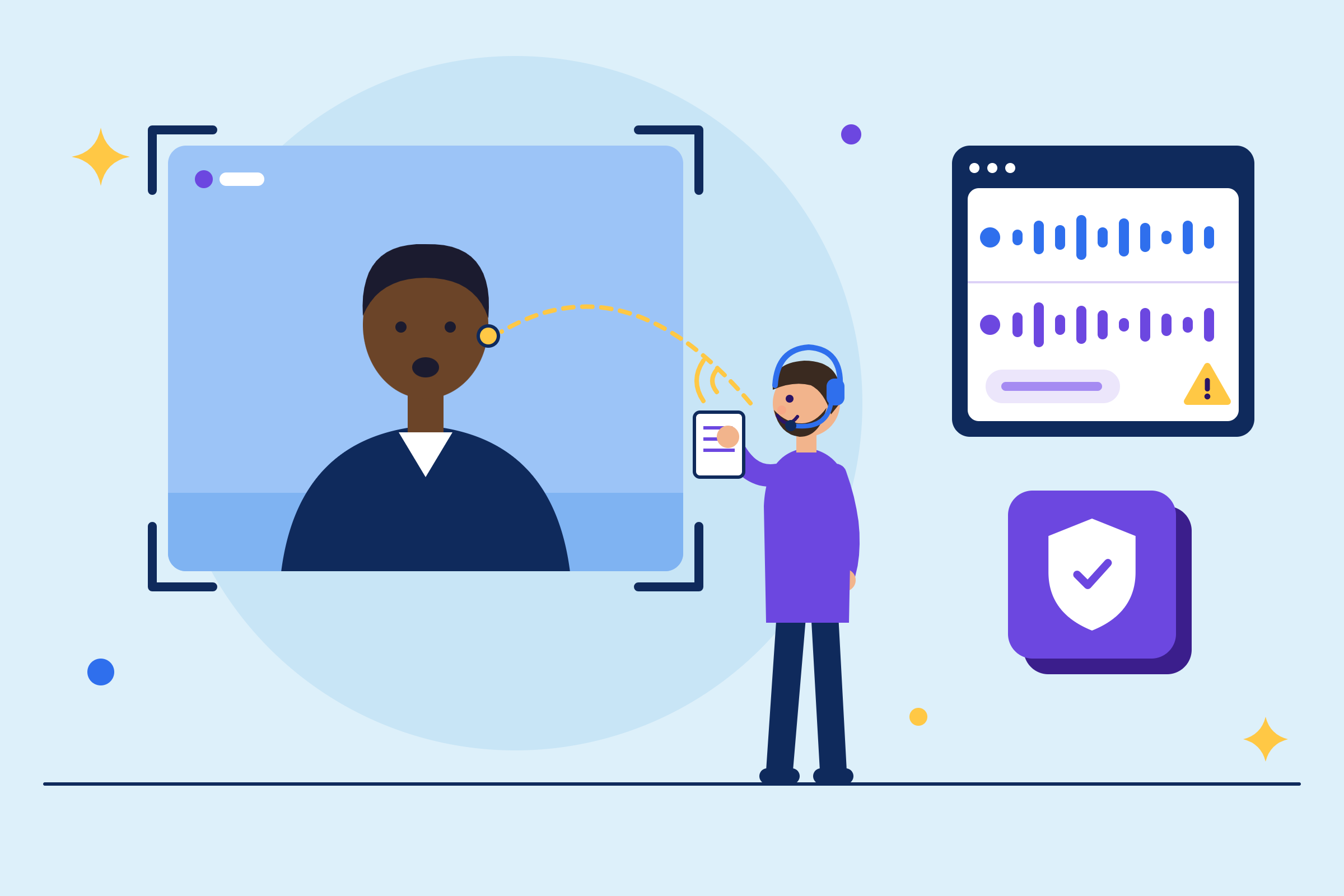




TL;DR: Customer interview data is not used to train third-party AI models, and humans confirm every scorecard before it becomes part of the candidate record. These are two points enterprise legal teams ask about first. The pipeline itself works like this: BrightHire joins the call and captures audio after candidate consent, transcribes the conversation, labels each speaker, maps evidence to your interview rubric, and drafts notes and a pre-filled scorecard for the interviewer to review. Scorecards, notes, and highlight clips live in your ATS. Insights, benchmarks, and coaching signals live in BrightHire.
Your ATS shows that an interviewer submitted a scorecard. It doesn’t show whether that scorecard reflects what the candidate said, or whether what the interviewer remembered is accurate. Interview intelligence is built to close the gap between evidence and recall, and understanding how AI interview analysis works at the mechanism level lets you evaluate vendors on integration depth, compliance posture, and failure handling rather than on demo polish.
Translate interview audio into ATS data
Interviews are the most consequential part of hiring, and they run almost entirely on memory. Interviewers who focus on taking notes miss the conversation. Interviewers who focus on the conversation submit scorecards from recollection hours later. By the time the debrief happens, you are comparing different versions of what each interviewer retained.
AI interview analysis replaces that recall with a structured record. The pipeline follows a defined sequence: capture the audio, transcribe it, attribute each segment to the correct speaker, map the evidence to your interview rubric, and deliver structured outputs that a human confirms and submits back to your ATS. Each step has a defined output and a defined owner, and each output has a defined home. That structure makes the pipeline auditable, and auditability makes it defensible internally.
The five-step pipeline
The pipeline moves from capture through ATS delivery. Each step produces a specific output, and each output feeds the next step in sequence.
1. Securely capture interview audio
BrightHire syncs to your recruiting calendar and ATS, so we know which meetings are interviews and join them automatically. On Zoom, we join the call as a participant and surface interview guidance directly within the meeting experience. On Google Meet, we join as a participant through the calendar connection. On Microsoft Teams, we join as a participant through your calendar and meeting setup. Interviewers don’t have to start it, invite it, or log into a separate system. The consent workflow triggers before capture begins, so recording only starts after the candidate has been asked.
2. Transcribe the interview automatically
Once the call ends, BrightHire generates a time-stamped transcript from the captured audio. Transcription is the raw material, and the transcript becomes the source text that every downstream step (notes, highlights, scorecard mapping) draws from. Interviewers can flag key moments as they go, and AI interview notes are ready right after the call. Transcription accuracy improves with clear audio and standard speech, and interviewers review and edit outputs to confirm accuracy before anything syncs to the ATS.
3. Attribute every transcript segment to the right speaker
Speaker diarization assigns each part of the transcript to the correct speaker. The transcript is labeled by speaker so the system can track who asked what and who answered what.
This matters for two reasons. First, evidence in a debrief needs to be tied to the interviewer who asked the question, not just to the call generally. Second, if speaker attribution is wrong, summaries can attribute statements to the wrong participant, which breaks the audit trail your compliance team depends on. Interviewers should review speaker labels alongside notes and correct any misattributions before confirming the output.
4. Map evidence to interview rubrics
This is the step that separates a notetaker from a structured hiring system. BrightHire captures each interview against your team’s interview plan: the questions that matter, the competencies being assessed, and the rubric your team agreed on before the call. The AI maps transcript evidence to those competencies and organizes notes around them, so you can see what a candidate said about each criterion instead of scrolling a raw transcript to find it. Because every interviewer on the panel runs against the same structured plan, the scorecards that come out are comparable across interviewers in a way that free-form notes are not.
5. Structure, review, and sync to your ATS
At call end, the AI drafts notes, highlights, and a pre-filled scorecard mapped to your specific ATS scorecard fields. The interviewer then reviews the draft, adjusts if needed, and submits in one click. This review step is the control point. Interviewers edit and confirm rather than starting from a blank page, which removes the blank-page barrier that drives delayed submissions and keeps the evidence field grounded in what the recording captured. Once the interviewer confirms and submits, the scorecard and notes sync to the candidate record automatically.
Map AI outputs to your existing ATS
The ATS is the system of record for candidate data. BrightHire is the system of record for interview insights. That split is deliberate, and understanding it is how you avoid creating another data silo.
Generate AI-drafted interview records
After each interview, BrightHire generates four structured outputs: AI interview notes, highlight clips, a pre-filled scorecard, and a full transcript. Each one has a defined home, and knowing where each lives is what lets you answer the “where does the data go” question in a procurement review. The table below also includes insights and benchmarks, a fifth category that lives in BrightHire and spans interviews rather than sitting inside a single candidate record.
| Output type | What it contains | Where it lives | Who reviews it |
|---|---|---|---|
| AI interview notes | Structured summary organized by competency and rubric criterion | ATS candidate record | Interviewer |
| Highlight clips | Replayable video moments tied to specific evidence | ATS candidate record | Debrief panel |
| Pre-filled scorecard | AI-drafted evaluation mapped to your ATS scorecard fields | ATS candidate record | Interviewer confirms before submission |
| Full transcript | Complete time-stamped record of the conversation | BrightHire (accessible from ATS) | Available for compliance audit |
| Insights and benchmarks | Per-interviewer performance, process analytics, coaching signals | BrightHire | TA leadership and Recruiting teams |
Share replayable interview moments with the debrief panel
Highlight clips and replayable moments give the debrief panel a shared starting point and give Recruiting teams post-call visibility into what happened inside each interview. Instead of negotiating between competing recollections, the panel watches the clip where the candidate described their approach to a specific competency, and recruiting teams can spot where interviewers went off-script without manually reviewing full recordings.
Evidence is tied to the candidate record in the ATS, so anyone reviewing the file can replay the moment without leaving the system they already use. This shifts debrief conversations from “I think she was strong” to “here is what she said.”
Sync structured feedback to your ATS
Scorecards, AI-generated notes, and highlight clips land in the candidate record automatically when the interviewer confirms the output. BrightHire’s native bidirectional integrations connect with Greenhouse, Lever, Ashby, Workday, and more. Before the call, interview guides pull from the ATS so the interviewer sees the agreed plan live. At call end, score, evidence, notes, and highlight clips push back to the candidate record.
Sync fields across ATS platforms
Interview guides and candidate context pull from the ATS when the interview is scheduled. Scorecards, notes, highlight clips, and evidence push back when the call ends and the interviewer confirms the output. BrightHire integrates with a wide range of ATS platforms, which are listed on the integrations page.
| ATS | Sync direction | Trigger point | Example fields |
|---|---|---|---|
| Greenhouse | Bidirectional | Interview scheduled (pull), call end (push) | Job req, interview plan, scorecard score, notes, highlights |
| Lever | Bidirectional | Interview scheduled (pull), call end (push) | Interview guide, notes, and scorecard data (specific field mapping varies by configuration) |
| Ashby | Bidirectional | Interview scheduled (pull), call end (push) | Interview guide, competencies, scorecard, evidence summary |
| Workday | Bidirectional | Interview scheduled (pull), call end (push) | Candidate and requisition data, interview guides, and outcomes (specific field mapping varies by configuration) |
“AI Notes make it easy to summarize, transcript and video recording are helpful for reviewing past interviews, integrates with different video conferencing tools, customer support responds quickly and is very helpful.” – Verified user on G2
What enterprise legal and security teams ask about first
For enterprise procurement, compliance is a prerequisite, not a differentiator. Your legal and security teams will ask about consent, data retention, and training data usage before they ask about features.
How consent workflows protect data
Candidate consent and opt-out workflows are built in by default. Candidates are asked for consent before recording begins, and customizable data retention policies let you align with your legal team’s specific requirements. For a deeper look at how consent, notice, and AI governance work in recorded interviews, see our breakdown of AI interview compliance and our compliance and security documentation.
How we protect candidate interview data
We hold SOC 2 Type II certification, which means an independent auditor has verified our security controls and data handling practices over time. We comply with GDPR and CCPA, and we offer a Zero Data Retention option with our AI sub-processors, meaning interview data is not stored by third-party AI providers. Customer interview data is not used to train third-party AI models. For enterprise legal teams, that last point is often the first question they ask.
Security and compliance certifications
We run annual third-party bias audits through an independent auditor. This covers the AI models that structure interview evidence and confirms they operate within defined fairness parameters. SOC 2 Type II covers security controls and data handling. GDPR and CCPA cover data privacy for European and California residents. Zero Data Retention covers what happens to interview data after processing. Each certification addresses a different layer of risk, and together they give procurement a complete picture. You can verify the full set on our compliance and security page.
Human verification of AI-generated insights
Syncing a confirmed scorecard to the ATS is not the finish line, but where the accountability loop closes and the audit trail begins. Once structured data is in the candidate record, your recruiting team can track whether interviewers are covering the right competencies, flag where the process is breaking down across the panel, and surface coaching signals for interviewers who are consistently going off-script or skipping criteria. Human review and audit are continuous, and the design assumes that every AI output requires a human checkpoint before it becomes part of the candidate record.
Refine AI-generated hiring data
The interviewer’s edit step is where AI-drafted evidence meets human judgment. We draft the scorecard from transcript evidence mapped to your rubric, and the interviewer confirms or adjusts before submitting. Teams using this workflow submit feedback 28% faster, because the reviewer is verifying evidence that already exists rather than reconstructing the conversation from memory.
Review AI outputs for bias
AI-generated scorecards map evidence to the competencies and criteria your team defined. The AI does not score candidates independently of the rubric, and it doesn’t recommend who to hire. Any score is an input to a human decision. The annual third-party bias audit adds a second layer of review, confirming the models operate within fairness parameters your legal team can verify.
Audit structured interview output
Every scorecard in your ATS carries the audit trail and competency mapping that produced it. Insights, benchmarks, and coaching signals live in BrightHire, not the ATS, so your Recruiting team can track per-interviewer performance and process adherence without cluttering candidate records. When an auditor asks who reviewed what and when, the answer is in the record. BrightHire has captured interviews across 2 million+ candidates, and the audit trail makes the output defensible in a compliance review.
Request a demo to see the pipeline in your own ATS, from call end to scorecard sync.
Frequently asked questions (FAQs)
Automated scorecard completion uses AI to draft interview feedback directly into your ATS scorecard fields, mapped to the competencies and criteria defined in your interview plan. The interviewer reviews, edits, and submits the draft. Scorecard submissions run 28% faster under this workflow.
BrightHire joins the call automatically, captures audio after candidate consent, transcribes the conversation, attributes dialogue to the correct speaker, and maps evidence to the interview rubric. The AI drafts notes and a pre-filled scorecard for the interviewer to review, and confirmed outputs sync to the ATS.
Scorecards, AI-generated notes, and highlight clips push to the candidate record in your ATS. Full transcripts are retained in BrightHire for searchability and compliance. Insights, benchmarks, and coaching signals live in BrightHire and are not synced to the ATS.
BrightHire integrates natively with Greenhouse, Lever, Ashby, Workday, and more. Interview guides pull from the ATS before each call, and scorecards, notes, and evidence push back to the candidate record when the call ends. No manual re-entry is required.
No. Customer interview data isn’t used to train third-party AI models. BrightHire also offers a Zero Data Retention option with AI sub-processors, meaning interview data isn’t stored by third-party AI providers after processing.
Key terms glossary
AI interview analysis: The process of converting interview audio into structured data (notes, scorecards, highlights) through capture, transcription, speaker attribution, rubric mapping, and ATS delivery with human review.
Interview intelligence: A category of software that captures, structures, and analyzes hiring interviews to produce consistent, auditable evidence. Covers three components: capture, structure, and analysis.
Speaker diarization: The process of assigning each segment of a transcript to the correct speaker. Accurate diarization ties evidence to the interviewer who asked the question.
Automated scorecard: An AI-drafted evaluation form populated from interview evidence and mapped to the competency rubric. The interviewer confirms and submits.
Bidirectional sync: A two-way data exchange where interview guides pull from the ATS before the call and scorecards, notes, and evidence push back to the candidate record when the call ends.
Zero Data Retention: A data handling option where interview data is not stored by third-party AI sub-processors after processing. Available as part of BrightHire’s compliance infrastructure.