


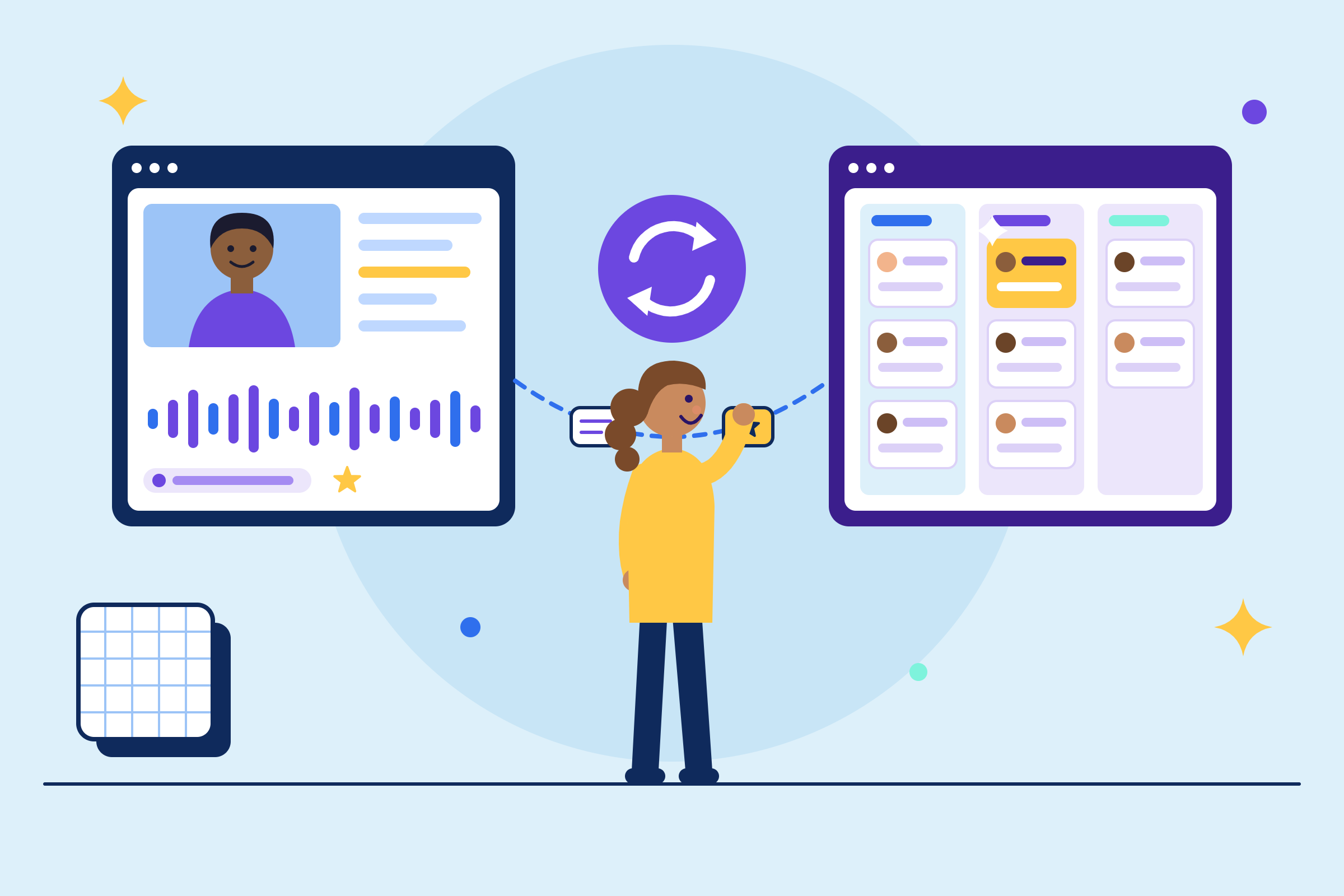


TL;DR: BrightHire integrates with your ATS through bidirectional API sync. Interview guides and candidate context pull from the ATS before each call, and AI-generated scorecards, notes, and evidence push back into the candidate record when the call ends, so the ATS remains the system of record. Before recommending any tool, Recruiting Ops needs field-level answers to three questions: which fields sync, in which direction, and at what trigger. BrightHire supports 18 ATS integrations, including Greenhouse, Lever, Ashby, Workday, SmartRecruiters, and more, with ATS-less mode available from day one.
Your ATS (applicant tracking system) is the system of record for every hiring decision. Interview intelligence, the platform that records, transcribes, and structures what happens in every interview, only helps if its output makes it back into that record. When an interview tool doesn’t push its data back, your candidate records are incomplete and your audit trail breaks. That’s the core problem with one-directional interview intelligence integrations: they treat your ATS as a data source, not a data destination.
This article maps exactly how interview intelligence integrates with your recruiting tech stack. We’ll walk through what data flows each direction, at what trigger events, how scorecard sync actually works, what to ask any vendor before recommending them internally, and where BrightHire’s integration architecture fits.
How does interview intelligence integrate with an ATS?
Interview intelligence is only useful if the evidence it captures reaches your ATS, which stays the system of record. That means interview data has to land in the candidate record itself, through a native two-way sync rather than a summary someone pastes in. Ask any vendor three questions: which fields sync, in which direction, and at what trigger. If they can’t answer at that level, you’ll find out what their integration really does when you’re auditing candidate records for compliance, or explaining a hiring decision to Legal.
In practice, integrations fall into three patterns, ranked by ATS record completeness:
| Integration type | Sync direction | Trigger | ATS record completeness |
|---|---|---|---|
| Deep integration | Bidirectional | Automated, event-based sync | Complete: scorecards, notes, highlights, and transcript links land in the candidate record |
| One-way sync | ATS to tool only | Manual or batch export | Incomplete: interview data may not return to the ATS automatically, leaving candidate records without structured feedback |
| No integration | None | Manual copy-paste between systems | Broken: no audit trail, duplicate records, version control issues |
A real ATS integration means the interview tool treats your ATS as the system of record, not a staging area. When your head of talent acquisition (TA) asks for a complete audit trail on a hiring decision from three months ago, every piece of evidence should live in one place.
What interview intelligence does
Interview intelligence covers three distinct functions:
- Capture: the tool joins every interview, records and transcribes the conversation in real time, and generates AI-assisted notes while the interviewer stays focused on the candidate.
- Structure: the tool translates what happened in the interview into a scorecard format your ATS understands, then pushes that structured data back into the candidate record automatically.
- Insights, coaching, and process improvement: the tool surfaces patterns across your interview corpus: per-interviewer performance benchmarks, question coverage analytics, compliance flags, and coaching signals that help you identify where the process breaks down.
Where each type of data lives is a deliberate split, and we’ll cover exactly why in the data divergence section below.
Map fields to your ATS workflow
Custom field support matters. If your Greenhouse configuration uses custom scorecard competencies or your Workday setup includes role-specific evaluation criteria, the integration should map those fields automatically. Ask the vendor for a field-level data map before the contract is signed.
Field mapping for ATS sync workflows
This table shows what data should flow between your ATS and an interview intelligence tool, in which direction, at what trigger, and what manual work it eliminates when the integration is built correctly.
| Field | Direction | Trigger | What it saves |
|---|---|---|---|
| Candidate profile | ATS to tool | Before the call | No manual candidate entry, no duplicate records |
| Interview guide (competencies, question sets, evaluation criteria) | ATS to tool | Before the call | Interviewers stay on script, consistent candidate experience |
| Scorecard template (ratings, required fields, custom competencies) | ATS to tool | Interview scheduled | Scorecard criteria already mapped, no manual setup |
| AI-generated scorecard (ratings, notes, summary) | Tool to ATS | Call ends | No feedback chasing, no memory-based submissions |
| Interview notes (AI summary, highlights, key moments) | Tool to ATS | Call ends | Evidence in the candidate record, debrief starts from shared context |
| Highlight clips (video snippets of key answers) | Tool to ATS | Call ends | Debrief panel reviews evidence, not recollection |
| Transcript link (full searchable interview record) | Tool to ATS | Call ends | Complete audit trail, compliance-ready documentation |
| Fraud signals (risk flags, anomaly detection) | Tool to ATS | Call ends | Auditable record of integrity checks before candidate advances |
Note: Fraud signal detection is a BrightHire-specific capability, not a universal feature across all interview intelligence tools.
This is the field-level detail that separates a real ATS integration from a one-way export. Every row represents a manual step that disappears when the integration works correctly.
How BrightHire and ATS data diverge
The data location split prevents duplication and keeps your audit trail clean. Scorecards, interview notes, highlight clips, and transcript links live in the ATS because they’re candidate-specific decision inputs. Insights, benchmarks, coaching signals, and process analytics live in BrightHire because they’re cross-interview diagnostics that require pattern detection across your entire interview corpus.
Automate your scorecard data sync
Interviewers that submit scorecards from memory hours or days after the call, face delayed debriefs waiting for feedback, and candidate records sit incomplete while hiring managers ask for updates. Scorecard submission rates become a metric you report on, not a metric you control.
AI Scorecard Auto-fill changes the workflow. BrightHire translates the interview transcript into a pre-populated scorecard mapped to your evaluation criteria, then pushes it into the ATS when the call ends. The interviewer reviews and submits instead of writing from scratch, so feedback lands faster, debriefs start on time, and candidate records stay current.
Streamline ATS feedback workflows
The operational change is straightforward: recruiters stop chasing feedback, debriefs start on time, and candidate records stay complete without manual intervention. The ATS remains the single source of truth for candidate decisions, and Recruiting Ops stops being the enforcement layer for process adherence.
“BrightHire helped us massively scale our engineering hiring and increase our hiring volume by 300%. It was very important that we train interviewers on how to assess technical problems and on Angi’s expectations of candidates so that we are interviewing fairly and upholding our bar for candidate quality. By building out a training program with BrightHire, we trained up an army of people to help us hire really quickly.” – Jessica Haber, VP of Corporate Talent Acquisition, Angi
Key criteria for evaluating ATS integrations
Define sync direction and field maps
Ask for a field-level data map. The answer should name specific ATS objects (candidate profile, job requisition, and interview stage), sync direction (ATS to tool, tool to ATS, or bidirectional), and trigger events (interview scheduled, call starts, call ends, scorecard submitted). “Seamless integration” without those specifics is a red flag.
Green flag: documented field mapping with sync direction and trigger events, available before the contract is signed. BrightHire’s integrations engineering team provides this documentation during the evaluation process, because Recruiting Ops owns integration health and needs to stress-test failure modes before recommending anything internally.
Prevent data gaps in hiring records
Ask what happens when a sync fails. The answer should cover error handling, retry logic, reconciliation workflows, and notification protocols. If an interview doesn’t record or a sync fails, does the ATS record stay unchanged? Can the interviewer submit feedback manually? Does the vendor provide a recovery workflow?
When an interview isn’t recorded, no sync data is generated. Interviewers can still take notes and submit feedback manually in the ATS, just as they would without an integration.
Map event-based ATS triggers
Ask which events trigger sync. The answer should name specific trigger points tied to the interview workflow, covering the key moments from scheduling through scorecard submission. You want automated triggers at each stage of the interview workflow, not a sync someone has to remember to run.
BrightHire fires sync automatically across the interview workflow: candidate context pulls from the ATS when an interview is scheduled, the interview guide pulls when the call starts, the scorecard and notes push back when the call ends, and final ratings sync when the scorecard is submitted. No manual step required.
Handle ATS-less hiring workflows
Ask whether the tool works without an ATS during a pilot. This matters for two reasons: it reduces implementation risk by allowing a pilot before full integration, and it provides a fallback if your ATS isn’t among the natively integrated platforms.
Security specs for ATS integration
Ask for five compliance documents before procurement review: SOC 2 Type II certification, GDPR compliance documentation, CCPA compliance documentation, data retention options (including Zero Data Retention), and AI training data policy. Procurement and legal will ask for these.
BrightHire is SOC 2 Type II certified, GDPR and CCPA compliant, offers Zero Data Retention options, undergoes an annual third-party bias audit, and does not use customer interview data to train AI models. These credentials are table stakes for enterprise procurement, and full documentation is required before legal and security teams sign off. Full documentation is available on the compliance and security page and through BrightHire’s Trust Center.
“Great interviewing at Toast means being fully engaged in the conversation and making decisions based on what actually happened. BrightHire gives us that visibility so every interview builds on the last.” – Lori Busch, Senior Director, Talent Operations, People Technology, and Analytics, Toast
Which ATS platforms BrightHire integrates with
BrightHire integrates natively with Greenhouse, Lever, Ashby, Workday, SmartRecruiters, and more, covering 18 ATS integrations and 30+ integrations overall including video conferencing, calendar, identity tools, automation and AI tools. BrightHire’s integrations give teams 1-click scorecard completion, full interview replay, and candidate highlights directly inside Greenhouse.
Field-level specifics may vary by platform based on available API endpoints and your configuration.
Sync scorecards and interview data
What syncs from BrightHire to the ATS: AI-generated scorecard (ratings, notes, summary), interview highlights (video clips of key moments), full transcript link (searchable record), and fraud signals (risk flags detected during the call). Where it lands: the candidate record in your ATS, mapped to the appropriate scorecard and activity feed fields.
Request a demo to see how BrightHire syncs with your setup and what an AI-generated scorecard looks like in your ATS.
Frequently asked questions (FAQs)
No interview data syncs for a call that wasn’t recorded, so the ATS record stays as it was. The interviewer can still submit feedback manually in the ATS, just as they would without an integration.
Yes. BrightHire offers ATS-less mode from day one via a shareable link, so teams can pilot before full integration. Full ATS integration can be added when the team is ready.
BrightHire is designed for fast rollout: most teams are fully operational in under one day. BrightHire joins calls automatically, with no manual setup required per interview.
Interview guides and candidate context pull from the ATS before each call. AI-generated scorecards, notes, highlights, and transcript links push back into the candidate record when the call ends.
Yes. BrightHire supports field-level mapping, including custom ATS fields. Ask your implementation contact for the specific field map for your ATS configuration.
Key Terms Glossary
Bidirectional sync: Data flows in both directions between two systems, with each system both sending and receiving updates. In an interview intelligence ATS integration, this means interview guides pull from the ATS and scorecards push back in, keeping the ATS as the system of record.
Field-level mapping: The specific data fields that sync between two systems, including which direction each field flows and how conflicts between systems are resolved. A field-level data map names exact ATS objects (candidate profile, scorecard template, custom competencies) rather than describing integration in general terms.
Trigger event: The specific action or state change that initiates a data sync between systems. When a defined event occurs, such as a candidate moving from interview to offer in the ATS, connected applications can use that event to trigger the appropriate workflow.
Scorecard: A structured feedback form used to evaluate a candidate against predefined criteria, typically including numeric ratings and open-text fields. Scorecards live in the ATS as decision inputs for hiring teams.
Interview guide: A structured set of competencies, questions, and evaluation criteria that surfaces during a live interview to keep the interviewer on script. Interview guides pull from the ATS before each call to ensure consistency across interviewers.
ATS-less mode: A configuration that allows an interview tool to function without a direct ATS integration, typically via a shareable link or manual data entry. ATS-less mode allows teams to pilot before full integration or to operate without an ATS in place.
System of record: The authoritative data source for a specific type of information. In recruiting, the ATS is the system of record for all candidate decisions and hiring outcomes.
Data integrity: The accuracy, completeness, and consistency of data across systems. In an ATS integration context, data integrity means candidate records are complete and up-to-date without manual re-entry or reconciliation.
Audit trail: A chronological record of actions, decisions, and data changes that provides documentation for compliance and review. A complete audit trail in hiring means every interview, scorecard, and decision is documented in the ATS.
Time-in-stage: The amount of time a candidate spends in a specific stage of the hiring pipeline, measured from stage entry to stage exit. Time-in-stage is a key operational metric for Recruiting Ops, and delays often trace to incomplete scorecards or debrief scheduling issues.