










BrightHire analyzed 1,000 hires made through its platform. The average candidate went through 2.4 rounds.
Each interview lasted about 40 minutes.
For most TA teams running four, five, or six rounds, that number feels uncomfortably low. The data backs it up, and the cost of ignoring it shows up in candidates who drop, offers that expire, and roles that stay open longer than they should.
If you want to make confident hiring decisions with a leaner process, the answer is rarely more rounds. It is better structure inside the rounds you already have.
Most companies are running more rounds than the data supports
Across 1,000 real hires, BrightHire found the average hired candidate went through 2.4 rounds. Each interview lasted about 40 minutes.
Most TA teams are not running 2.4 rounds. Many run four, five, or more, particularly for senior and leadership roles.
More rounds feel like more rigor and more reliable data.
The problem is the data does not support that assumption.
Glassdoor research found interview duration has roughly doubled since 2009. Quality-of-hire outcomes have not tracked proportionally upward.
Past a certain threshold, additional rounds stop producing meaningful new signal. They slow time-to-fill, stretch interviewers who already carry full workloads, and drive away the candidates you most want to hire.
Candidate interview fatigue shows up in the data. A Robert Half study found 57% of job seekers lose interest in a role when the hiring process runs too long.
When a strong candidate walks, the damage compounds: a longer open req, more hours from the hiring team, and often a weaker final hire.
The average number of interview rounds that works, by role level
The right number of rounds scales with role complexity, not with how uncertain the hiring team feels going in.
BrightHire’s platform data tells a clear story: teams using structured interviews need 27% fewer interviews per hire. The sweet spot for most roles sits between two and four rounds.
After that, rounds add scheduling overhead and candidate fatigue without generating new signal.
| Role Level | Recommended Rounds | Notes |
| Entry-level / IC | 1–2 | Screen + one substantive panel covers core competencies |
| Mid-level | 2–3 | Recruiter screen, skills interview, hiring manager conversation |
| Senior / Director | 3–4 | Each round should go deeper, not cover the same ground |
| VP / Executive | 4 max | Any round beyond four needs a clear justification before scheduling |
Average number of interview rounds for entry-level and individual contributor roles
One to two rounds is enough. A structured screen followed by one substantive panel covers the core competencies for most IC roles without burning candidates out or slowing time-to-fill.
Average number of interview rounds for mid-level roles
Two to three rounds works well. A recruiter screen, a skills-focused interview, and a team or hiring manager conversation give enough signal without extending the timeline.
Average number of interview rounds for senior and director-level roles
Three to four rounds is the ceiling most strong candidates will tolerate. For senior hires, rounds should get progressively deeper, not broader.
Multiple interviewers covering the same territory do not add signal. They add friction and put the candidate interview experience at risk.
Average number of interview rounds for VP and executive roles
Four rounds, maximum, with deliberate sequencing. Each conversation should cover genuinely new ground: strategy, stakeholder alignment, or specific domain depth.
Anything beyond four needs a clear business case before it gets scheduled.
Structured interviews let you cut rounds without cutting confidence
Fewer rounds do not mean less rigor. The rigor moves upstream.
Teams that hire well with two or three rounds do the hard work before the first interview starts: defining the competencies for each role, assigning each interviewer a specific area to cover, and agreeing on how to score what they hear.
When every interviewer has a defined lane, redundancy disappears. Three interviewers covering the same behavioral questions across three separate rounds produce far less useful signal than three interviewers each probing a different competency with calibrated rubrics.
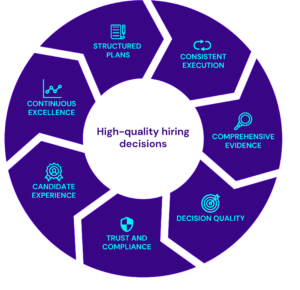
A structured process needs four things in place before round one:
- Role-specific questions tied to defined competencies, not generic behavioral prompts
- A consistent scoring rubric each interviewer completes independently before the debrief
- Feedback captured immediately after the interview, while details are fresh
- A debrief grounded in evidence, not competing impressions
When those four elements run consistently, hiring managers report higher confidence in their decisions, even with fewer rounds.
BrightHire’s interview planning platform gives teams a place to build structured plans, assign competencies by interviewer, and scale the same quality process across every role and region.
What happens to candidates when the process drags
A slow process does not just frustrate candidates. It changes who ends up accepting your offers.
Candidates with the most options move fastest. When a process runs five or six rounds over several weeks, the strongest people in the pipeline accept elsewhere.
What remains at the end of a long process skews toward candidates who could not move faster, not toward the best fits.
Candidate experience degrades as rounds accumulate. Candidates give shorter, less specific answers in behavioral interviews as fatigue sets in.
A candidate in their fourth 45-minute interview of a two-week process performs differently than that same candidate in round two.
The risk is not only losing great candidates to a faster competitor offer. Long processes produce lower-quality signal at the exact moment the hiring team makes its final decision.
Teams focused on reducing time-to-hire without losing quality consistently point to process structure as the lever. The fix is fewer rounds with better architecture inside each one.
What TA leaders ask before cutting rounds
The better question is not how many rounds to run. It is whether the rounds you run cover your defined competencies, with interviewers prepared to assess them.
For most roles, the answer lands between two and four. For most teams, the constraint lives inside the rounds, not in the count of them.
Most roles do not need more than three rounds to produce a confident hiring decision. Past four, the marginal value of each additional round drops sharply while candidate drop-off rates climb.
BrightHire’s benchmark across 1,000 hires puts the average at 2.4 rounds, with 40-minute interviews.
Across 1,000 hires analyzed on BrightHire’s platform, the average candidate went through 2.4 rounds. Each interview averaged 40 minutes, not counting shorter first-round screens.