





How AI-Native Companies Are Built for Constant Change
New AI models drop every four to six weeks. Each one resets what’s possible. Each one can make last month’s architecture obsolete.
That pace has quietly rewritten the playbook for how AI-native companies are built. The old assumption was that your tech stack was stable enough to design around. That doesn’t hold anymore. The companies operating well right now assume the opposite: that everything underneath them is going to change, and the job is to be ready when it does.
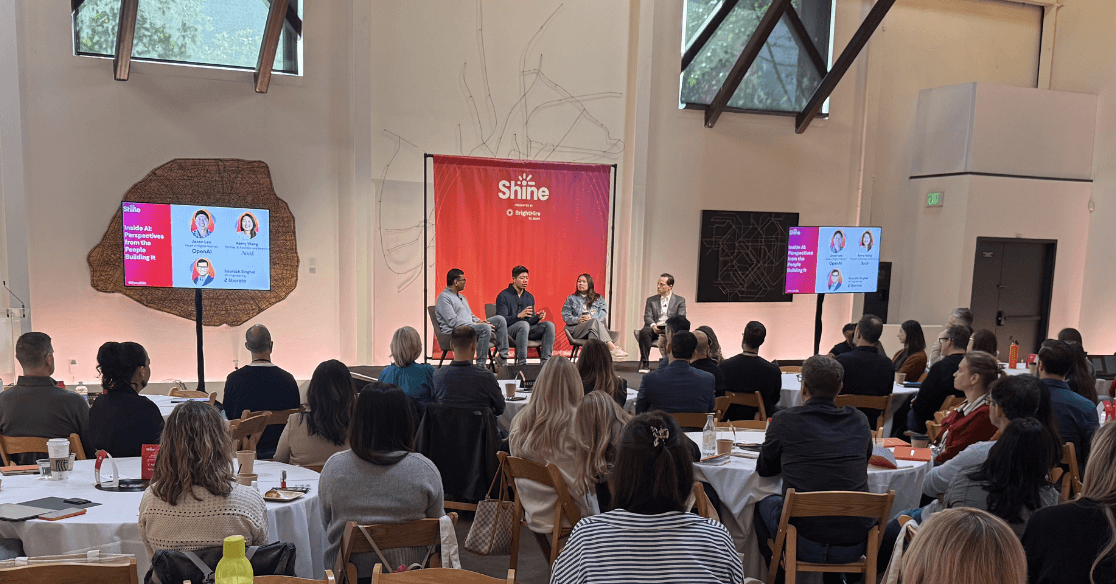
At Shine 2026, we opened the day with three people building from inside that reality: Saurabh Singh, VP of Engineering at Liberate; Kerry Wang, Partner at Accel; and Jason Lee, Head of Digital Natives at OpenAI. The conversation mapped what’s actually changed in the last 12 months and what the constant-change reality means for the companies being built on top of it.
Key takeaways
- AI agents went from a topic of conversation to genuinely useful in 12 months, driven by models that can now think longer and reliably take multiple turns.
- With new foundation models arriving every four to six weeks, the AI companies operating well are designed like factories with supply chains: built to absorb constant change rather than locked to a single model.
- Durable advantage in an AI company doesn’t come from the model. It comes from what’s built around it: specialization for a specific use case, proprietary data, and the discipline to keep adapting.
The structural shift that made AI agents work this year
A year ago, asking AI questions was mostly a single exchange. The model returned an answer based on what it already knew, sometimes with one quick lookup, and the interaction was over.
This year, that’s changed. According to Jason Lee, two things have shifted: models can now “think longer” before responding, working out a strategy before they act, and they can take multiple turns reliably, doing something, checking the result, and adjusting based on what they find. Together, those capabilities let a model sustain a complex task for minutes at a time instead of seconds.
“A year ago, we were all talking about agents, but in reality there weren’t too many agents that we actually saw a lot of useful utility from. That’s probably changed. And everybody here probably uses AI for more sophisticated tasks today than they did a year ago.”
— Jason Lee, Head of Digital Natives, OpenAI
Kerry Wang gave a longer view on the pace of change. Before joining Accel, she spent seven years founding and running Searchlight, an AI recruiting company. At the time, her team stitched together seven laptops to train their own models because the APIs and open-source tools available today didn’t exist.
“The pace of AI change is now in the speed of weeks and months. It’s really hard to think back to seven years ago.”
— Kerry Wang, Partner, Accel
AI has gotten meaningfully more capable in 12 months, and the pace isn’t slowing.
Designing companies for constant change
If models keep changing every few weeks, the question becomes: how do you build a company on top of them?
Kerry Wang offered an analogy. In the old world, companies were like craftsmen, picking a tech stack and refining the painting over time. The new world looks more like a factory with a supply chain.
“Companies that will be more successful are more like a factory with a supply chain that they’re investing in, making sure that their entire tech stack and suppliers could change overnight with every new model that comes out.”
— Kerry Wang, Partner, Accel
One consequence Kerry pointed to: companies are becoming multi-product much earlier than they used to. When the underlying capabilities expand every few weeks, a single-product company leaves a lot of value on the table. A factory designed to absorb these constantly changing inputs can push new products out quickly and capture more value as a result.
Saurabh Singh, VP of Engineering at Liberate, described what this looks like in practice. Liberate builds voice agents for the insurance industry, handling 2.8 million transactions a month across more than 200 agents in production. To operate at that scale through constant model churn, his team built a modular architecture: harnesses sit on top of the foundation models, and the models themselves can be swapped without redoing the system underneath.
“Changing a model, if it is indeed giving you a better accuracy or better reliability, is sort of a quick change on an interface or an API rather than a whole surgery on the system.”
— Saurabh Singh, VP of Engineering, Liberate
Every time a new model drops, the team benchmarks it against production workloads, typically overnight. If it’s faster, more accurate, or more reliable, it ships. If not, it doesn’t.
Where AI-native companies build durable advantage
If every AI company plugs into the same foundation models, what’s left to compete on?
Saurabh Singh’s answer started with the limits of generalized models. They can do a lot of things reasonably well, but they aren’t built for any one of them. In a real production environment, that gap matters.
“Yes, the models can do a lot of things, but they’re like a Swiss Army knife. Unless you actually build a special sauce on top, the last mile in terms of really making sure it has all the edge cases covered, all the real-world scenarios covered, like no plan survives the contact with the enemy and the same thing — no model can survive the contact with the real use case that you want to use it in.”
— Saurabh Singh, VP of Engineering, Liberate
Kerry Wang’s answer focused on what makes a company hard to replicate over time. The most durable competitive advantage she sees is proprietary data — the kind a company accumulates by working with specific customers on specific use cases, getting more signal over time, and using it to keep widening the gap.
She also pointed to something less tangible: the founders. The ones worth backing are the ones who don’t pretend they’re immune to what the next model release will do to them.
“I would rather back a founder that will be honest and say, ‘You know what? We will probably not have the answer to always be durable and differentiated. We do expect to get punched in the face with every new model release, and we will respond.'”
— Kerry Wang, Partner, Accel
The pattern across both answers: durable advantage in an AI company doesn’t come from the model. It comes from what gets built around it — the specialization for a specific use case, the proprietary data, and the discipline to keep adapting when the foundation moves.
Final thoughts
Across three vantage points — building, investing, and shipping — the panel landed on the same observation. The foundation underneath AI companies keeps moving, and the ones operating well have made that fact part of how they’re designed.
Stepping off stage, what struck me most was how much of the panel’s observations describe the company we’ve spent six years building. BrightHire is purpose-built for the work of hiring, not bolted onto an ATS. We’ve now grown to multiple products on one connected platform, with more on the way. Underneath it sits the most valuable dataset in hiring: more than 4 million conversations across 3 million candidates, which is what gives our agents the context to make meaningful recommendations for hiring teams. The technology will keep moving. We’re built to move with it, and to grow with the teams who rely on us.
Explore more highlights from Shine 2026.