



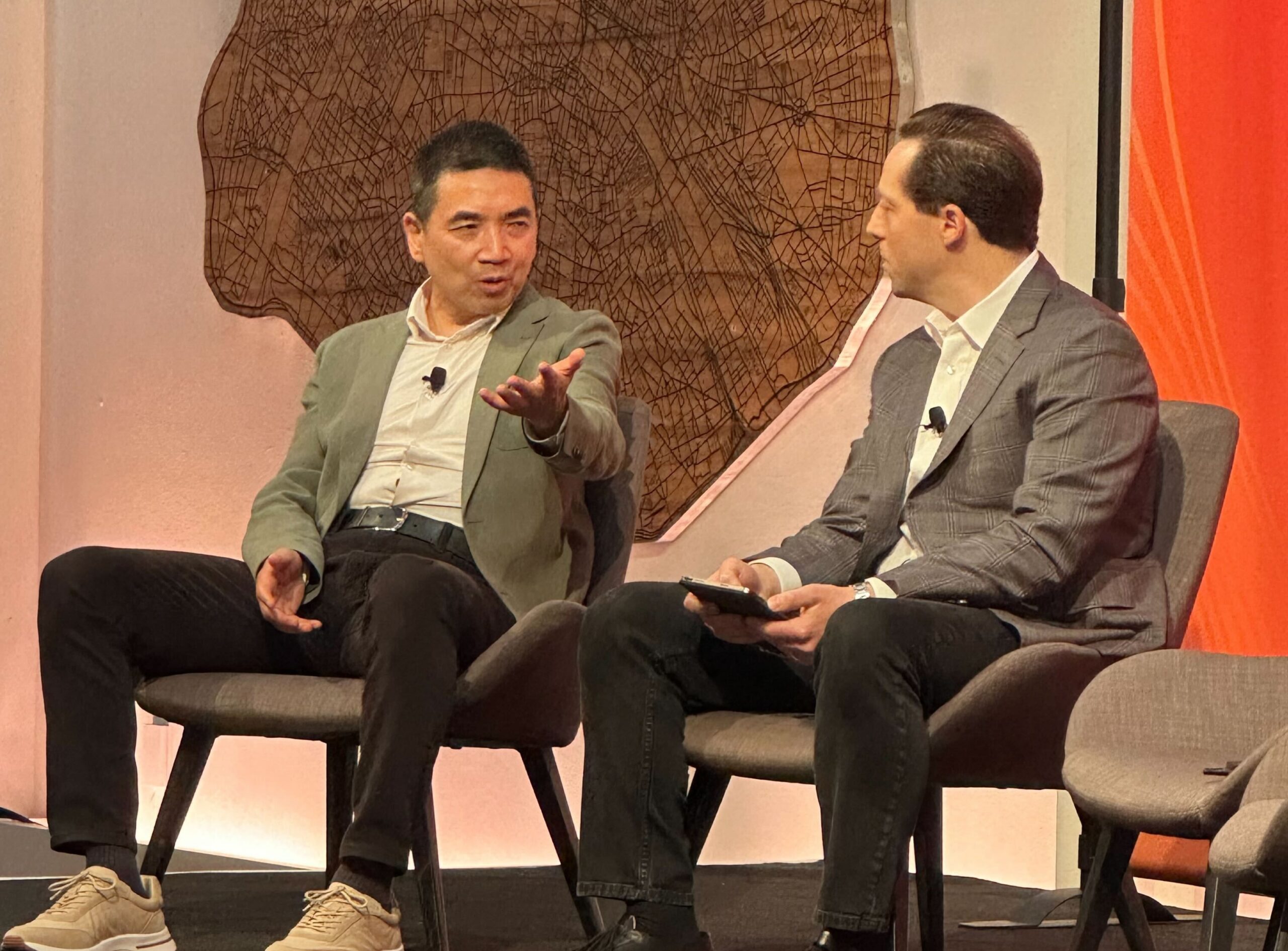


A lot of the conversation at Shine 2026 came back to the same question: what does hiring look like when AI is reshaping the work itself? Eric Yuan, founder and CEO of Zoom, had a clear point of view when he joined me on stage.
Eric has spent the last fifteen years building one of the most consequential companies of the internet era, and he’s now leading it through the AI transition. His view: the technology is moving fast, but the disciplines that separate great teams from average ones are the same as they’ve always been, and matter more now, not less.
The leverage on every talent decision just went up
According to Eric, the impact of every hire — good or bad — has gotten bigger in the AI era. A strong individual contributor isn’t bounded by what they can do themselves anymore. They’re directing a network of agents that multiplies what they ship. A weak hire, equipped with the same tools, multiplies the damage at the same rate.
“If you hire a very good individual contributor in the AI era, guess what? One good engineer can deploy so many digital agents to work for you. And the inverse is also true.” — Eric Yuan, Founder and CEO of Zoom
The gap between a great hire and an average one used to be linear. It’s now multiplicative. That changes the stakes on every talent decision a TA function makes.
What that means for how you hire:
1. Hire slowly, even when the pressure is to hire fast
Eric’s biggest career mistake, in his own words, was hiring too fast. When the pandemic hit, demand on Zoom multiplied many times over across every part of the business, and every leader made the case for more headcount. Eric signed off. Within 18 months, the company had grown by more than 6,000 employees. He says it broke the company culture, and he calls it the biggest regret of his time as CEO.
The lesson he carries from it: hire slowly, focus on quality over quantity, and ignore the pull to set quarterly headcount targets. A team announcing it needs 500 engineers this quarter is, in his view, missing the point. The job is to find the right people, not fill a number.
“Hire slowly. Hire the top talent. Focus on quality, not quantity. That’s the lesson I learned, even to date.” — Eric Yuan, Founder and CEO of Zoom
Most TA functions are still measured on speed-to-fill, req close rates, and pipeline volume. Eric’s experience runs the other direction. In an AI era, an empty seat is recoverable. A wrong hire, equipped with agents, is not.
2. Hire for self-learning and self-motivation
Zoom’s hiring philosophy, according to Eric, screens for two traits: self-learning and self-motivation. AI is moving fast enough that the technology floor changes constantly, and the people who keep up are the ones who teach themselves without being prompted.
“Self-learning and self-motivation are very important. You really want to learn something by yourself. And every day you motivate yourself. You do not need a manager to motivate you.” — Eric Yuan, Founder and CEO of Zoom
Past experience tells you what someone has done. Self-learning tells you whether they can grow as fast as the role will. Self-motivation tells you whether they’ll do it without being pushed. And as Eric advised HR leaders later in the conversation, the best hires are the ones who can adapt. “Recruit or develop talents who would like to try something new,” he said. “Whatever worked before may not work now.”
3. Talent decisions should be backed by data
Eric described a problem most TA leaders will recognize. A team can run a rigorous, structured hiring loop, make an offer, and six or twelve months later watch the hire not work out, with no way to trace why.
“No matter how good your recruiting process is, after you recruit the talent, quite often six months or a year later it didn’t work out, and you have no idea what happened. Who interviewed this candidate? Who scored them high or low, and why? You can’t connect the dots.” — Eric Yuan, Founder and CEO of Zoom
That gap, in Eric’s words, is the reason Zoom and BrightHire came together. BrightHire captures and structures the interviews themselves: what was asked, how the candidate responded, what each interviewer flagged, and the rationale behind every score. When a hire works or doesn’t, that record is still there to learn from. Teams can see which interviewers tend to predict success, which signals show up early in candidates who ramp quickly, and where the process drifts from how it was designed. The hiring decision stops being a one-time judgment call and starts being a decision a team can get better at.
The principle isn’t just about hiring. The same discipline applies to layoffs and other hard talent calls. Eric refuses to act until the data clearly shows whether a problem is short-term or structural. At either end of the talent lifecycle, the decisions worth making are the ones backed by data you can stand behind.
The bottom line
Every talent decision a team makes now carries more weight than it used to. A great hire, equipped with agents, ships dramatically more than they could have a few years ago. A wrong hire, equipped with the same tools, multiplies the damage at the same rate. The teams that hire well in an AI era will be the ones whose process is rigorous enough to consistently bring in the right people, and whose data is good enough to know when it isn’t.