





TL;DR: AI notetakers capture what was said in interviews, while interview intelligence platforms structure that conversation into evidence that improves hiring decisions, interviewer consistency, and compliance posture. Notetakers solve individual productivity problems. Interview intelligence solves organizational process consistency, data quality, and defensibility. The upgrade decision hinges on hiring volume, compliance exposure, and whether your debriefs are currently grounded in evidence or memory. ATS integration depth is the technical dividing line: notetakers store transcripts, intelligence platforms sync structured scorecards and evidence into the candidate record.
AI notetakers have made interview capture cheap and easy, but they only go so far in terms of usefulness. A notetaker hands you a record of the conversation, but it doesn’t tell you whether the interviewer covered the right competencies, it doesn’t put a scored evaluation in the candidate record, and it doesn’t give the hiring team a shared starting point before the debrief. Those are the things an interview intelligence platform does.
How AI notetakers function in recruiting
Generic AI notetakers such as Otter and Fathom record and transcribe meetings, converting speech into searchable notes and summaries. Most connect to an ATS only through Zapier or manual copying, or push summaries rather than structured scorecard fields.
What interview intelligence platforms do differently
Interview intelligence platforms turn interviews into structured, searchable data instead of a raw transcript that sits unread in a dashboard. At Brighthire, we capture every interview and write structured scorecards back to your ATS.
Sync interview data to your ATS automatically
Recruiting-native tools send interview data straight to the ATS, not a separate dashboard. At BrightHire, we surface your interview guide live during the call, then pushes notes and a summary back to the candidate record when the interview ends. The scorecard in your ATS fills from what the candidate actually said, so the interviewer reviews and submits it there rather than writing from memory. Ratings stay with them. We integrate with Greenhouse, Lever, Ashby, Workday, and more.
BrightHire Screen conducts a structured interview using your guide and your evaluation criteria, with results pushing back into your ATS: overall score, structured summary, answers evaluated against your rubric, and a link to the full recording.
We integrate with Greenhouse, Lever, Ashby, Workday, and more, so structured interview data flows into the system your team already uses to manage candidates.
Key differences between AI notetakers and interview intelligence platforms
The dividing line is the depth of insight each tool surfaces, the time it saves interviewers and recruiters, and whether it pushes structured data into the tools your team already uses. Notetakers document the conversation, while intelligence platforms structure it into scorecards, push it into the candidate record, and give your team a shared evidence base before the debrief begins.
| Capability | AI notetaker | Interview intelligence platform |
|---|---|---|
| Capture | Records and transcribes conversations | Records, transcribes, and structures interviews against role competencies |
| ATS sync | Most connect via Zapier or push summaries to the ATS rather than structured scorecard fields | Bidirectional sync: pulls interview guides before call, pushes scorecards to candidate record after |
| Structure | Generic summaries and action items | Role-specific scorecards, rubric scoring, competency mapping |
| Decision support | Searchable notes | Evidence-based debriefs with highlight clips and interviewer benchmarks |
| Coaching | Aggregate conversation analytics only; no per-interviewer performance signals | Per-interviewer performance analytics, automated coaching signals |
Assess the limits of basic meeting assistants
A notetaker is sufficient for low-volume, low-compliance-risk hiring. The question is whether your current process can tolerate the gaps. For a solo recruiter or small TA team with low hiring volume, a generic notetaker may meet basic capture needs.
The upgrade decision shifts when hiring volume grows significantly, when compliance exposure increases (regulated industries, multi-jurisdiction hiring, or EEOC audit risk), or when debriefs are consistently grounded in memory rather than evidence. If scorecards are submitted hours after the call from recollection, if interviewers go off-script, or if debrief decisions are driven by whoever remembers the most, a notetaker is not solving the problem.
| Hiring profile | Tool recommendation | Key indicators |
|---|---|---|
| Low volume, low compliance risk | AI notetaker may meet basic needs | Individual productivity need, minimal debrief complexity, no regulated industry constraints |
| Mid-volume, growing compliance exposure | Consider interview intelligence platform | Scorecards submitted from memory, debrief inconsistency, hiring manager complaints about process rigor |
| High volume, enterprise scale | Interview intelligence platform | Compliance requirements, distributed interview panels, quality-of-hire accountability, ATS governance |
When to upgrade from basic AI notetaking
At high hiring volume, process rigor collapses under pressure. Across our data spanning 25,000+ candidates, teams ran 27% fewer interviews per hire, closing roles with less recruiter and interviewer time per decision. Angi increased overall engineering hiring by 300% after adopting BrightHire.
Meet the compliance requirements
Structured interview data makes bias mitigation measurable: you can audit which questions were asked, which criteria were scored, and whether the process was consistent across candidates.
| Compliance requirement | AI notetaker | Interview intelligence platform |
|---|---|---|
| Audit trail | Ask: does the tool log who conducted each interview, when, and against which criteria? | Audit-ready records of each interview |
| Consent workflow | Ask: is consent recorded per candidate, and can they opt out mid-interview? | Candidate consent workflows built in by default |
| Bias mitigation | Ask: does the vendor conduct independent bias audits, and are results published? | Annual third-party bias audit, rubric standardization |
| Data retention | Ask: is your interview data used to train any AI models, and what is the default retention period? | Zero Data Retention option, we don’t use customer interview data to train third-party AI models |
| Fraud detection | Ask: how are anomalies flagged, and who reviews them before a hiring decision is made? | Anomalies detected in AI and live interviews are surfaced for human review, so your team can assess risk before a hiring decision is made |
We are SOC 2 Type II certified and GDPR and CCPA compliant, and independent auditors run a bias audit every year. We offer candidate consent workflows, audit-ready records of each interview, and a zero data retention option. We don’t use customer interview data to train third-party AI models.
How interview intelligence platforms improve hiring outcomes
Structure every interview against agreed criteria
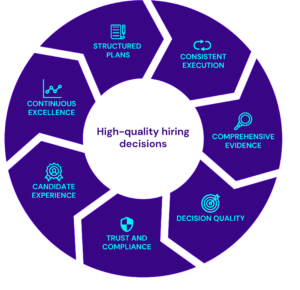
Every interview starts with a structured plan tied to the competencies and criteria that matter for the role, and interview guides surface live during the call, keeping interviewers on track and ensuring each candidate is assessed against the same criteria. That structure scales across your entire interview panel, whether you’re running eight interviews for a single role or 800 across a hiring surge, every candidate gets evaluated against the same rubric.
Our in-interview guidance keeps each interviewer calibrated to the agreed framework in real time. Every candidate gets the same structured experience regardless of which interviewer they draw. The consistency is what makes debrief comparisons meaningful.
Shift debriefs from opinion to evidence
When evidence is comprehensive and consistent, hiring decisions improve. Debrief conversations shift from “I think she was strong” to “here’s the clip where she walked through her approach.” The hiring team reviews the same scorecard data, the same highlight clips, and the same structured notes, so the decision reflects what candidates demonstrated rather than what interviewers recalled.
Give interviewers feedback based on their interviews
Interview Insights surfaces patterns across all your recorded interviews: per-interviewer performance, what candidates care about, high-risk compliance flags, and capacity data. Automated, personalized coaching built on interviews gives interviewers a continuous feedback loop based on their specific question patterns and evaluation consistency.
You can see which interviewers consistently go off-script or skip competencies, which ones ask high-risk questions, and which ones need calibration support. Because the feedback derives from their own interviews, it identifies the specific patterns and gaps that a general training program cannot surface.
The ROI case for interview intelligence ties to the metrics your leadership team already tracks: recruiter hours per filled role, interview-to-offer conversion, and scorecard submission rates. Candidates also rate the early-round AI interview well: at Angi, they gave BrightHire Screen a 4.8 out of 5 satisfaction rating. When the process is consistent, the evidence your leadership needs to defend the investment is already in the data.
The verdict
An interview intelligence platform like BrightHire addresses the three things a notetaker leaves unresolved: whether the interviewer covered the right competencies, whether a scored evaluation made it into the candidate record, and whether the hiring team goes into the debrief with a shared starting point. At BrightHire, we structure every interview against agreed criteria, pushes completed scorecards directly into your ATS, and gives every debrief a shared evidence base instead of competing recollections. Because every interview is captured and scored against a consistent rubric, every interview leaves an audit-ready record and your team goes into every debrief with the same evidence.
Request a demo to see how BrightHire syncs structured interview data into your ATS setup, and what an AI-generated scorecard looks like in your ATS before your next hiring plan review.
Frequently asked questions (FAQs)
Yes, for low-volume, low-compliance-risk hiring. Most generic notetakers capture what was said but don’t structure it into scorecards or provide coaching signals.
AI interview notes capture what was said. Interview intelligence structures that conversation into scorecards, pushes it into the candidate record, and gives your team a shared evidence base for the debrief.
No. They integrate with your ATS to sync structured scorecards and evidence into the candidate record. The ATS remains your system of record.
They provide SOC 2 Type II certification, GDPR and CCPA compliance, consent workflows, audit trails, and bias audits. Humans make all final decisions.
Bidirectional sync with your ATS (Greenhouse, Lever, Ashby, Workday, and more), support for your video platform (Zoom, Google Meet, Microsoft Teams), and calendar systems.
Key terms glossary
AI notetaker: A tool that records, transcribes, and summarizes meetings or interviews, storing notes in a searchable dashboard.
Interview intelligence platform: A system that captures, structures, and analyzes interviews, syncing structured data into your ATS and providing coaching insights.
BrightHire Screen: An AI interviewer that conducts structured early-round screening interviews automatically, with results syncing back to your ATS.
ATS integration: The connection between interview tools and your applicant tracking system, enabling bidirectional data flow.
Structured hiring: A methodology where every candidate is evaluated against the same criteria using consistent interview plans and scorecards.
Compliance posture: Your organization’s ability to demonstrate that hiring decisions are documented, criteria-based, auditable, and defensible in an EEOC or GDPR inquiry.
EEOC: Equal Employment Opportunity Commission, the federal agency that enforces workplace discrimination laws in the United States.
GDPR: General Data Protection Regulation, the European Union’s comprehensive data privacy law.
CCPA: California Consumer Privacy Act, California’s data privacy law that grants consumers rights over their personal information.
SOC 2 Type II: A security certification that validates a company’s controls for data security, availability, processing integrity, confidentiality, and privacy over time.
Zero Data Retention: A configuration with BrightHire’s AI sub-processors where third-party AI providers don’t store interview data or use it to train their models.