







TL;DR: A structured hiring process is a system built across seven sequential phases, from role alignment through data-backed debrief. Assigning a named owner and a concrete output to each phase is how the framework holds under pressure. Adoption risk lives with hiring managers and interviewers, and the way to manage it is through evidence and coaching rather than top-down enforcement. Four signals are worth monitoring: scorecard submission rates, plan adherence, time-to-fill, and interviews per hire. Each one points to a different breakdown in the process. When structure holds, teams submit feedback 28% faster and run 27% fewer interviews per hire.
Getting hiring managers and interviewers to follow a structured process is harder than building one. When req volume spikes, intake meetings get skipped, and scorecards get filled in from memory hours later, between other calls, when they get filled at all.
This framework treats structured hiring as an organizational change program with defined owners, measurable outputs, and explicit adoption work. BrightHire is built to operationalize exactly this kind of rollout. The seven phases below cover the full lifecycle from role alignment through debrief, and each phase produces a concrete output that the next phase depends on.
Define the structured hiring process
A structured hiring process is a system where every candidate for a given role is evaluated against the same criteria, by interviewers following the same plan, with decisions grounded in documented evidence rather than panel memory. That consistency is what makes it predictive. Harvard Business Review found that structured interviews predict job performance at twice the accuracy of unstructured ones, because when every interviewer asks the same questions against the same rubric, the panel is measuring the candidate, not their own impressions of the candidate.
Unstructured hiring leaves each interviewer to run their own version of the conversation. One focuses on technical depth, another on culture fit, a third on whatever felt interesting in the moment. By the time the debrief happens, the panel is comparing different assessments of different qualities against different standards. The debrief becomes a negotiation between competing recollections.
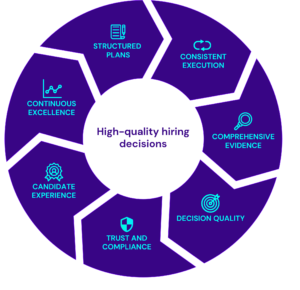
The system we describe in this article draws on four of BrightHire’s seven Quality of Hiring System pillars: structured plans, consistent execution, comprehensive evidence, and decision quality. Each principle corresponds to a set of operational phases with a named owner and a concrete output.
Reduce bias in high-volume hiring
Structure reduces bias by removing interviewer discretion over what to ask, how to evaluate responses, and how to weight different competencies. When every candidate answers the same questions against the same rubric, the evaluation compares candidates to a standard rather than to each other.
Quantify the cost of bias
Bias in hiring is not just a fairness problem, it’s a financial one. A widely cited rule of thumb puts the cost of a bad hire at 30% of the employee’s first-year salary, though it should be treated as an industry estimate rather than an official statistic.
Gallup (2019) separately estimates that replacing any employee, not a mis-hire specifically, can cost 50% to 200% of annual salary. For a Head of TA managing a high-volume req load, even a modest mis-hire rate translates to significant direct replacement costs. That doesn’t account for the productivity drag on the team that absorbed the mis-hire. Same goes for the management time spent on performance remediation, or the credibility cost with the hiring manager who now questions the recruiting process.
7 essential phases of the structured hiring process
The framework below treats structured hiring as a sequential system. Each phase depends on the output of the previous one. Skipping a step doesn’t save time. Instead, it shifts the cost downstream, where it shows up as misaligned interviewers, vague scorecards, and debriefs decided by whoever spoke loudest.
Step 1: align on role requirements
The intake meeting is the prerequisite for everything downstream. When role requirements are vague, every downstream step inherits the ambiguity. The recruiter and hiring manager must document three things before sourcing begins: the must-haves versus the nice-to-haves, the success criteria for the role, and what “good” looks like for this role.
Use our interview scorecard template to structure the intake conversation around the competencies that will be assessed.
Step 2: define role competencies
Competencies are the bridge between the intake meeting and the interview plan. A competency model defines the specific skills, behaviors, and knowledge required for success in the role, going beyond job description bullet points. Building one involves defining scope, gathering inputs from stakeholders, selecting five to seven core competencies, creating proficiency scales with behavioral anchors, and validating through calibration.
The key is specificity: “Strong communicator” isn’t a competency. “Can present a technical roadmap to non-technical stakeholders and adjust the message based on audience questions” is. The first version gives interviewers nothing to assess against. The second gives them a target.
Step 3: set up the structured interview plan
Map competencies to interview plan stages so each interviewer gets a defined focus area. This avoids overlap, where three people assess communication, and gaps, where nobody assesses the most important competency.
Our structured plans tie interview guides to competencies and surface them live during the call, keeping interviewers on track without requiring them to memorize the plan before the interview starts.
Step 4: write bias-free questions
Questions must be tied to the competencies identified through job analysis and written to elicit specific evidence. The Office of Personnel Management’s structured interview guide recommends questions that are reflective of the job, tied to competencies, open-ended, clear and concise, at an appropriate reading level, free of jargon, and written with superlative adjectives that ask for the most, last, worst, or best example.
Select around two questions per competency, balancing coverage against the time available. This typically yields a focused set of questions per interview. That’s enough to assess each competency without extending the conversation beyond what the candidate’s schedule allows.
Step 5: implement standardized rubrics
Anchored rubrics give each score level a behavioral description so interviewers are scoring against the same standard. A rating of “4 – Strong” tells the debrief nothing. A rating of “4 – Independently led a project of similar scope and delivered a measurable outcome” tells the debrief what to look for. These are called behaviorally anchored rating scales, and the OPM guide recommends labeling at least three proficiency levels, with five to seven levels as the target.
Use our interview scorecard template to build rubrics that connect each competency to observable behaviors.
Step 6: standardize candidate scoring
Interviewers submit scorecards independently before the debrief, without seeing each other’s ratings. This prevents anchoring bias, where the first interviewer’s score anchors subsequent scores and the panel converges on a number nobody would’ve reached independently. Independent submission blocks anchoring, halo bias, and post-hoc rationalization.
Our AI scorecard auto-fill translates interview transcripts into pre-populated scorecards mapped to your evaluation criteria, helping interviewers submit complete feedback faster. The scorecard is a draft, and humans review the evidence to make every hiring decision.
Step 7: drive data-backed consensus
When scorecards are submitted from memory, the debrief reflects recall. Independent scorecards go in beforehand. The debrief opens with an eight to 10 minute round-robin of votes and evidence, followed by a two-minute tally. If there’s disagreement, the panel spends 10 to 15 minutes on targeted discussion, then five minutes documenting the decision.
Use our interview debrief guide to structure the conversation around evidence. When highlight clips and transcripts replace “I think she was strong” with “here’s the clip where she walked through her approach,” the debrief becomes a review of what the candidate said.
“It allows interviewers to focus on meaningful conversations with candidates while still capturing structured feedback. BrightHire reduces the burden of manual note-taking, keeps interviews structured and consistent through standardized attributes, scorecards, and AI-supported notes, and improves fairness by grounding hiring decisions in documented insights rather than memory or personal bias.” – Divya Bharathi D. on G2
Drive adoption of structured hiring
Structured hiring programs stall when hiring managers skip the intake meeting or interviewers go off-script. This is a common pattern. The way to manage adoption is through evidence and coaching: showing interviewers where their process broke down and what it cost, rather than enforcing compliance from the top down.
Get hiring manager buy-in
Position structured hiring as a way to get better candidates faster. SHRM’s 2025 Talent Trends report found that 69% of organizations struggle to recruit for full-time roles, with low applicant volume, competition from other employers, and candidate ghosting as the top named challenges. When hiring managers see that structure produces faster debrief cycles and fewer wasted interviews, buy-in follows.
Train interviewers at scale
Train interviewers without pulling them out of their day jobs. Automated coaching based on actual interviews gives interviewers a continuous feedback loop, so they develop more consistent behavior over time without requiring a quarterly training session that half the panel skips.
Address interviewer resistance
Some interviewers resist structure because they believe it constrains their judgment. However, structured interviews produce better data, and better data produces better decisions. Frame this as a coaching conversation. When an interviewer sees that their off-script questions produced a scorecard too vague to submit, they have everything they need to understand why structure matters.
Protect process integrity at scale
When req volume spikes, the answer isn’t manual enforcement, but a system that keeps interviewers on track without the Head of TA personally reviewing every interview. Our in-interview guidance and interviewer performance analytics give TA leaders visibility into which interviewers are following the plan and which need support, without adding work to the interviewer’s plate.
“Everyone evaluates candidates using the same context and evidence, which reduces back-and-forth and helps teams reach decisions faster without miscommunication.” – Tanya R. on G2
How to audit your structured hiring system
A structured hiring process needs a measurement layer. Four signals are worth tracking: scorecard submission rates, plan adherence, time-to-fill, and interviews per hire. Each metric tells a different story about where the process is breaking down.
Monitor scorecard submission health
Scorecard submission rate measures the percentage of interviewers submitting evaluations within 24 hours of the interview. Low submission rates mean debriefs are running on memory, and not on evidence.
Measure interview plan adherence
Plan adherence measures whether interviewers are following the agreed plan and covering the competencies they were assigned. Low adherence means candidates are getting different experiences from different interviewers, which makes the debrief comparison meaningless.
Measure time-to-fill efficiency
Structure affects time-to-fill by reducing the number of interviews per hire. A BrightHire case study found teams using structured interviews need 27% fewer interviews per hire. When decisions are grounded in evidence, you do not need a fifth interview to break a tie that should have been resolved in the debrief.
Metrics for structured interview success
| Metric | What it measures | Failure mode it detects |
|---|---|---|
| Scorecard submission rate | % of interviewers submitting within 24 hours | Debriefs running on memory |
| Plan adherence | % of interviews using mapped competencies | Interviewers going off-script |
| Time-to-fill | Days from req open to offer acceptance | Process drag or misalignment upstream |
| Interviews per hire | Average number of interviews per hire | Decisions not grounded in evidence |
Request a demo to see how this framework runs inside your ATS. We will walk you through what an AI-generated scorecard looks like in your Greenhouse setup.
Frequently asked questions (FAQs)
Most teams are fully operational in under one day with BrightHire, using ATS-less mode from day one via a shareable link, with full ATS integration added when the team is ready.
Position structure as a way to get better candidates faster. When hiring managers see the connection between intake rigor and candidate quality, resistance drops.
Map three to five competencies to each panel member, drawn from the five to seven core competencies defined during role scoping, so each interviewer has a focused area of assessment. Research on panel interviews generally studies panels of two to four, with structure driving reliability more than panel size, so the quality of your interview plan matters more than the number of interviewers on it.
Yes. The seven phases and principles remain the same, but the competency models and question banks must be role-specific. A sales role and an engineering role use different competencies, but both follow the same framework.
Key terms glossary
Structured hiring process: A system where every candidate for a role is evaluated against the same criteria, by interviewers following the same plan, with decisions grounded in documented evidence.
Intake meeting: The kickoff alignment between a recruiter and a hiring manager where both sides agree on role requirements, success criteria, candidate profile, hiring process, and market expectations before sourcing begins.
Competency model: A defined set of specific skills, behaviors, and knowledge required for success in a role, built through job analysis and validated through calibration.
Interview plan: A structured document that maps competencies to interview stages and assigns each interviewer a defined focus area.
Anchored rubric: A scoring scale where each level has a behavioral description, so interviewers score against the same standard.
Scorecard: A structured evaluation rubric tied to role competencies, submitted independently by each interviewer before the debrief.
Debrief: The structured meeting where a hiring panel reviews a candidate against a shared rubric and decides hire or no-hire.
Calibration session: A structured debrief to align the panel on what good looks like for a role before interviews begin.
Plan adherence: The percentage of interviews that follow the agreed plan and cover the competencies assigned to each interviewer.
Time-to-fill: The number of days from requisition open to offer acceptance.