




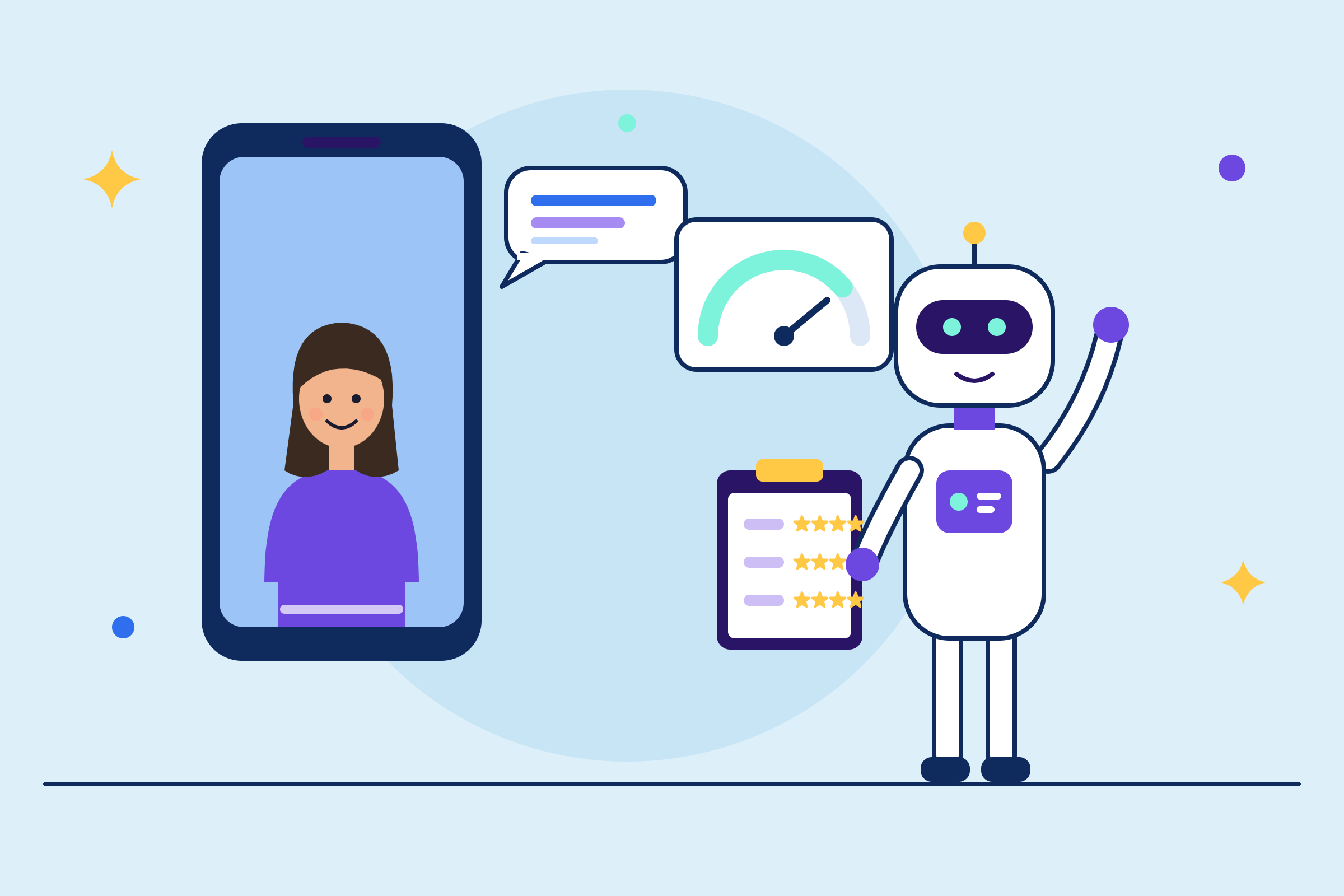


TL;DR: AI interviewers evaluate and score candidates through a six-step pipeline: your hiring team defines screening criteria, the AI asks structured questions, extracts evidence from transcripts, applies a rubric, ranks candidates against benchmarks, and hands every score to you for the final decision. Interview results sync to your ATS and create an audit trail you can inspect, configure, and defend.
Can you trace a candidate’s composite score back to the criteria and interview evidence behind it? If you’re evaluating an AI interviewer for early-round screening interviews, that’s the question to answer before you recommend it to your Head of TA.
BrightHire Screen is an AI interviewer that runs early-round screening interviews. Candidates complete a structured two-way voice interview on their own time, and results sync back to your ATS automatically. AI interviewers generally score candidates through a defined pipeline of criteria, structured questions, evidence extraction, rubric scoring, ranking, with a human reviewing the results before submitting.
How AI systems quantify screening interview data
AI interview scoring is not a black box. It’s a pipeline with six defined steps, and every step can be inspected, configured, and audited. AI scoring starts with structured data, not impressions. When a candidate completes an AI screening interview, the AI typically converts spoken responses into transcripts, then extracts evidence tied to the criteria your hiring team defined during setup. Each response maps to a rubric dimension, and the AI assigns a numeric value based on evidence strength.
A candidate who describes a specific project with metrics scores differently than a candidate who gives a vague overview. The rubric defines what “strong” looks like for each criterion, and the AI matches what the candidate said against that definition. You set up the screening agent by providing job descriptions, scoring rubrics, and intake materials. Guide Assistant helps recruiters refine interview questions, scoring rubrics, and follow-up questions during setup.
The AI interview scoring pipeline: step by step
The six-step pipeline runs the same way for every candidate. Each step produces data that syncs to the ATS, creating an audit trail your team can review.
1. Define early-round screening criteria
Your hiring team sets the criteria. For example, required skills, experience signals, communication ability, and role-specific competencies. These criteria map to structured questions and rubric dimensions before any interview runs.
For a software engineering role, the team might define criteria such as technical depth or communication clarity. Each criterion becomes a rubric dimension with defined levels.
2. Execute structured candidate queries
The AI interviewer asks the same structured questions to every candidate. Candidates complete a two-way voice interview on their own schedule, responding to the defined question set.
Structure makes scoring comparable. When every candidate answers a consistent core question set, with follow-ups that can vary by response, you can apply the rubric consistently.
BrightHire Screen runs early-round screening interviews asynchronously. Candidates complete the structured voice interview on their own time, and results sync back to the ATS automatically.
3. Isolate evidence from transcripts
The AI extracts specific evidence from the transcript: candidate statements, examples, metrics, and signals tied to each criterion.
Evidence extraction grounds the score in what the candidate said. The AI looks for specific examples, measurable outcomes, and relevant terminology that map to the rubric dimensions.
When a response is unclear or incomplete, the full transcript and recording are available in the ATS for your review. You can assess whether the candidate’s answer provided sufficient evidence for each criterion before making any advancement decision.
4. Score candidates via structured rubrics
Here’s how rubric-based scoring works: you define levels for each criterion, and the AI assigns a level based on the evidence it extracted. BrightHire Screen supports tiered rubrics where the team defines criteria at each level and the AI evaluates the answer against those criteria and scores it.
Rubrics can be configured and customized per role. Different roles prioritize different competencies, and the weights you assign to each criterion reflect what matters most for that position.
Here’s a hypothetical example of what a rubric for a “technical depth” criterion might look like:
| Score Level | What It Means | Example Evidence |
|---|---|---|
| 5 (Exceptional) | Deep technical knowledge with specific metrics and architectural decisions | “I redesigned our caching layer, which reduced API response time from 800ms to 120ms and handled 10x traffic growth” |
| 4 (Strong) | Solid technical understanding with concrete examples | “I optimized our database queries and improved page load time by about 30%” |
| 3 (Competent) | Relevant technical experience with at least one specific example | “I worked on the backend API and fixed bugs in the payment system” |
| 2 (Developing) | Limited technical detail or generic responses | “I have experience with databases and APIs” |
| 1 (Insufficient) | No relevant technical evidence provided | Vague or off-topic response |
5. Rank candidates against benchmarks
Individual scores roll up into a composite score. Competencies can be weighted to reflect their importance to the role, so the criteria that matter most for the position contribute more to the overall score.
The AI ranks candidates against your defined benchmarks, not on a curve against other candidates. The ranking shows which candidates met the screening criteria most strongly, so recruiters can review the top-ranked candidates first and work through the pipeline efficiently.
6. Verify AI-driven candidate ratings
Your team reviews the results and full recording before deciding whether a candidate advances. BrightHire Screen does not automate advancement or rejection decisions.
The interview results sync to the candidate’s ATS record, with access to the full review through the supported integration.
Scoring benchmarks for AI screening tools
AI screening tools produce rubric-based scores with supporting interview evidence for your team to review. Here’s what those scores look like and how they’re structured.
How AI evaluates interview responses
AI interviewers score job-related dimensions, which can include relevance and terminology, clarity and structure, depth of reasoning, communication clarity, and evidence of required skills. The AI weighs different dimensions based on the criteria you set.
What AI ignores during candidate review
The AI scores only on the criteria your team defined in the rubric, and human review is built into the process so recruiters can assess whether scores reflect the evidence before any advancement decision is made.
This is a design choice, not a limitation. Federal guidance on the Americans with Disabilities Act warns that a hiring technology can lead to unlawful discrimination even when the employer does not mean to discriminate. BrightHire covers the compliance framework in depth in the guide to AI interview compliance.
BrightHire partners with babl.ai for independent AI auditing and does not use customer interview data to train third-party AI models.
Map screening rubrics to candidate scores
Rubric-to-score mapping is what makes the scoring defensible and auditable. Every score traces back to a specific hiring criterion and specific evidence from the transcript.
Map AI scores to hiring criteria
Your rubric defines what each score level looks like for that criterion, the transcript shows what the candidate said, and the mapping in the ATS connects the two so any score can be traced back to the evidence behind it.
You can review this mapping through your supported ATS integration. If you use Greenhouse, you can review the evaluation and access the recording directly from the candidate’s Greenhouse profile.
Define scoring benchmarks for candidates
Your team sets the benchmarks: what score threshold means “advance,” what means “review manually,” and what means “decline.” Benchmarks are configurable and adjustable per role or req.
As an illustration: a high-volume customer support role might use a benchmark composite score of 3.5 or higher to advance, while a senior engineering role might set the benchmark at 4.2 or higher. Your recruiting team reviews candidates near the threshold manually to account for context the score doesn’t capture. A candidate who scores 3.4 when your benchmark is 3.5 is flagged for your review, and you decide based on the full picture.
Assess fairness in automated scoring
Fairness is an operational requirement, not a marketing claim. The scoring system needs bias controls, audit trails, and compliance certifications you can verify.
How audits assess scoring fairness
Third-party bias audits examine the AI system’s scoring outputs to check for disparate impact or bias. BrightHire runs annual third-party bias audits for both Screen and Interview Intelligence, and you can review the documented audits in BrightHire’s trust center.
Audit results should be available to customers. When you evaluate a vendor, ask to see the independent third-party bias audit itself, not just a line on a webpage claiming the tool is audited.
The audit examines whether the scoring system produces statistically different outcomes for different demographic groups when controlling for job-related qualifications. If disparities exist, the audit identifies where and recommends adjustments.
Prevent bias in AI rating models
Design controls help reduce bias risk: scoring only on defined criteria, ignoring protected characteristics, and human review of outlier scores. The AI scores what the rubric defines.
Your interview data stays in your environment and trains nothing outside it. This is a material procurement consideration for your enterprise legal and security teams.
Governance for AI scoring systems
Governance includes consent workflows, audit trails, data retention options, and compliance certifications. BrightHire holds SOC 2 Type II certification, GDPR and CCPA compliance, and offers candidate consent workflows, role-based access controls, and customizable data retention including Zero Data Retention options.
An audit trail documents who scored what, when, and on what evidence. Every screen-in, screen-out, rank change, and recommendation gets logged with a timestamp, the candidate ID, the input data used, and the output decision.
Evaluate AI candidate scoring: vendor checklist
When you’re evaluating an AI interviewer, these are the questions that separate tools with real scoring rigor from tools that produce a number without a defensible method. BrightHire walks through the full vendor evaluation framework in the guide to choosing an AI interviewer, but here are the scoring-specific questions that matter most.
How AI models calculate candidate scores
Ask these questions about scoring methodology:
- What criteria does the model score?
- How is the rubric configured, and can we customize it per role?
- Does the AI ever auto-reject or auto-advance a candidate without human review?
- Is “no auto-reject” stated in writing?
- Who is accountable for the final decision?
Look for a defined pipeline, not a “proprietary algorithm” with no explanation. The vendor should explain how candidate responses become scores and where your team reviews the evidence before making a decision.
Does the AI score or does it decide? The answer should be that AI scores and humans decide, stated explicitly in the contract or security documentation.
Map AI data to ATS records
Ask these questions about integration depth:
- Which ATS platforms do you integrate with natively?
- Which fields sync, in which direction, and at what trigger?
- What happens when a sync fails?
- Can we see a field-level sync map before we sign?
BrightHire integrates natively and bidirectionally with Greenhouse, Lever, Ashby, Workday, and more. Interview guides pull from the ATS before each call, and scorecards push back to the candidate record when the interview completes.
Here’s what syncs from BrightHire Screen to your ATS:
| Data Field | Direction | Trigger |
|---|---|---|
| Overall composite score | AI interviewer → ATS | Interview completion |
| Structured summary | AI interviewer → ATS | Interview completion |
| Question-level rubric evaluations | AI interviewer → ATS | Interview completion |
| Link to full recording and transcript | AI interviewer → ATS | Interview completion |
| Interview guide and criteria | ATS → AI interviewer | Interview scheduled |
The two-way sync means you can automatically trigger Screen invitations to candidates, and then transcripts, AI-generated summaries, and rubric-based scorecards appear in your ATS automatically. You review insights and move candidates forward without switching tools.
How to audit AI scoring for fairness
Ask these questions about bias controls and audits:
- Do you run third-party bias audits?
- Can we see the audit results?
- What data do you use to train your models?
- Do you use customer interview data for training?
- What compliance certifications do you hold?
What to look for: documented audit results, no customer data used for training, and clear bias controls. The vendor should hold SOC 2 Type II, be GDPR and CCPA compliant, and support candidate consent and opt-out workflows.
Ask what data was used to train the models and how the vendor handles customer data. Understand if your data will be retained or used for training their models. BrightHire does not use customer interview data to train AI models, which should be the standard you hold other vendors to.
Adjust AI scores for final decisions
Recruiters and hiring managers adjust, override, or confirm based on full context. The AI interviewer evaluates each answer against the criteria your team defined and returns a score and summary, and a recruiter or hiring manager reads them and decides.
The full recording is available for review, so any score can be traced back to the evidence. With BrightHire Screen, the AI conducts a structured screening interview and surfaces signal for a recruiter to review.
Walk through BrightHire Screen and see what the early-round AI screening interview looks like from the candidate’s perspective.
FAQs
AI screening tools typically produce numeric scores on a defined scale, such as 1–5 or 1–4, plus a summary, rubric comparison, and full recording. BrightHire Screen syncs all four to the ATS automatically, and Screen earns a 4.5 out of 5 average candidate rating across the platform.
Yes. You define the criteria, configure the rubric, and set benchmarks per role or req. The AI scores only what you defined as relevant, and you approve the interview questions before candidates hear them.
AI interviewers score only on defined job criteria, ignore protected characteristics, and run annual third-party bias audits. BrightHire does not use customer interview data to train AI models, and holds SOC 2 Type II certification plus GDPR and CCPA compliance.
No. Scores help inform your judgment, but your team reviews the interview evidence and makes every advancement, rejection, and hiring decision.
AI scoring is consistent across candidates because it applies the same rubric every time. Humans bring contextual judgment and final decision authority. BrightHire breaks down the strengths of AI interviewers vs. human interviewers in detail, but the short answer is that each is strongest at different stages of the hiring process.
Key Terms Glossary
Rubric: A defined scoring framework with criteria and levels that maps candidate evidence to numeric scores.
Evidence extraction: The process of isolating specific candidate statements from a transcript and tying them to rubric criteria.
Composite score: A single score that rolls up individual rubric dimension scores for ranking purposes.
Benchmark: A score threshold that indicates whether a candidate should advance, be reviewed manually, or decline.
Bidirectional sync: Data flows in both directions between two systems, such as an AI interviewer and an ATS.
Field-level mapping: The specific definition of which data fields sync between systems, in which direction, and at what trigger.
Audit trail: A documented record of who scored what, when, and on what evidence, used for compliance and review.
Third-party bias audit: An independent review of an AI system’s scoring outputs to check for disparate impact or bias.